


🏆 Expert Picks
- SpringWell CF1 Best overall for city water
- Kind E-1000 Best compact cartridge system
- Aquasana EQ-1000 Best for chlorine + scale control
- iSpring WGB32B Best DIY budget option
- SpringWell WS Best for well water
- SoftPro Chlorine & Fluoride Best for fluoride-focused homes
🎯 Find Your System in 3 Questions
Click your water source below to open options and find the right recommendation path.
Step 1
What is your household water source?
🏙️ City / Municipal Water
Step 2 of 3
What is your top water priority?
🧪 Chlorine, Chloramine & Chemical Taste
Step 3 of 3
Select your budget & system type preference:
💳 Under $600 (Budget-Friendly Cartridge Filter)
Your Recommended Match
iSpring WGB32B
A 3-stage cartridge layout best for smaller city-water homes seeking low entry costs.
🧪 QWL note: Best suited to basic sediment and chlorine taste/odor reduction.
See full details →💳 $600–$800 (Mid-Tier Compact Wall Mount)
Your Recommended Match
Kind E-1000
Strong chlorine/chloramine reduction. Reusable sediment prefilter helps curb long-term filter waste.
🧪 QWL Lab Verified: Tap Score testing confirmed THMs reduced to non-detect.
See full details →💳 Premium (Over $800) ★ High-Capacity Tank System
Your Recommended Match
SpringWell CF1
Top high-flow city pick with a long-life 1,000,000-gallon media tank. Strong flow with no noticeable pressure loss in our install.
🧪 QWL Lab Verified: 3-year performance testing confirmed total THMs drop from 31.83 ppb to non-detect.
See full details →🦷 Target Fluoride Filtration
Your Recommended Match
SoftPro Chlorine+ & Fluoride
Standard carbon is not a fluoride-first treatment. This setup uses fluoride-focused media plus catalytic carbon, but fluoride performance should be verified with pre- and post-filtration testing.
See full details →💧 Hard Water Scale Conditioning
Your Recommended Match
Aquasana EQ-1000
Best fit for city households that want chlorine reduction plus salt-free scale conditioning. It helps reduce scale buildup, but it does not remove hardness minerals like a salt-based softener.
See full details →🚰 Private Well Water
⚠️ Match the Filter to Your Well Test
Well water chemistry changes from home to home. A standard city-water filter is not the right fit for iron staining, sulfur odor, manganese, bacteria, nitrate, or arsenic.
The SpringWell WS is my top well-water pick when testing shows iron, manganese, or sulfur odor within the system’s rated treatment range.
Need help choosing a system from your well test?
My dedicated Well Water Hub covers iron, sulfur, manganese, sediment, tannins, bacteria, UV systems, and testing steps.
Choosing the right whole house water filter comes down to your water source, water test, home size, and how much maintenance you want to deal with. We scored each system on contaminant reduction, flow, pressure impact, upkeep, warranty, long-term cost, and the strength of its proof.
📊 How We Test & Score
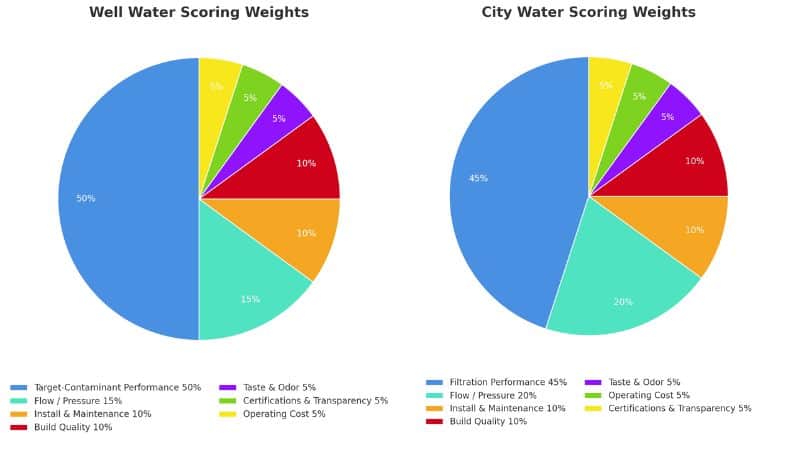
Whole house systems do not all solve the same problem, so we score city-water and well-water systems differently. We weigh lab results, flow and pressure stability, build quality, maintenance burden, and long-term ownership cost.
- City water: Filtration performance, flow and pressure, upkeep, build quality, operating cost, and testing transparency.
- Well water: Target-contaminant removal, flow and pressure, upkeep, build quality, and how well the system handles real well-water burden.
- What earns a spot: Clear buyer fit, stable whole-home flow, reasonable upkeep, and fewer ownership headaches over time.
- Extra credit: Published lab results, strong component certifications, better warranty coverage, and standout long-term value.
- What gets knocked down: Weak proof, flow bottlenecks, high filter churn, vague contaminant claims, or repeated owner complaints.
⚖️ Compare Whole Home Water Filtration Systems
Swipe on mobile to compare all 6 models side by side. The left column stays visible so you don’t lose your place.
| Compare Models |
Best Overall
 SpringWell CF1
|
Best Cartridge
 Kind E-1000
|
Chlorine + Scale
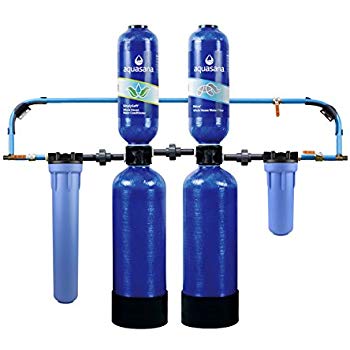 Aquasana EQ-1000
|
Best DIY
 iSpring WGB32B
|
Best for Wells
 SpringWell WS
|
Fluoride Focus
 SoftPro C+F
|
|---|---|---|---|---|---|---|
| QWL Score | 5/5 | 4.5/5 | 4.5/5 | 4.5/5 | 5/5 | 4.5/5 |
| Best For | Low-upkeep city water filtration | Budget city water cartridge setup | City water + scale control | Lower upfront cost + DIY | Well water iron, sulfur + manganese | Whole-home fluoride focus |
| Water Source | Municipal | Municipal | Municipal | Municipal / light well | Private well | Municipal |
| Flow Rate | 9–20 GPM | 15 GPM | 12 GPM | 15 GPM | 12–20 GPM | 10–14 GPM |
| Upfront Price | $1,144 | $770 | $1,748 | $419.99 | $2,255 | $1,027 |
| Capacity | 1M gal | 80K gal | 1M gal | 100K gal | 1M gal | 1M gal |
| Estimated 5-Year Upkeep | ~$200 | ~$750–$1,000 | ~$600 | ~$900–$1,125 | ~$200 | ~$100–$200 |
| Proof | Tap Score THMs ND after 3 years | Tap Score THMs ND | NSF/ANSI 42 chlorine data | QWL lab: lead >95% lower; copper + zinc ND | Research + well-owner field feedback | NSF 61 materials + media claims |
| Heads Up | Needs vertical clearance | Cartridge swaps add up | Pro install needed for full warranty | 1-year warranty only | Needs drain + power access | Lower flow for bigger homes |
| Skip If | You need well water treatment | You want the lowest long-term upkeep | You need chloramine-first filtration | You want longer warranty coverage | You are on municipal city water | Fluoride removal is not a priority |
| Warranty | Lifetime + 6-mo guarantee | Lifetime | 10 years | 1 year limited | Lifetime | Lifetime |
| Read More |
Jump to section Full review |
Jump to section Full review |
Jump to section Full review |
Jump to section Full review |
Jump to section Full review |
Jump to section |
On Well Water? The SpringWell WS is the well-water pick in this comparison, but private wells need a different buying process. Read our full Whole House Water Filters for Well Water guide if your water has iron, sulfur odor, manganese, sediment, or bacteria risk.
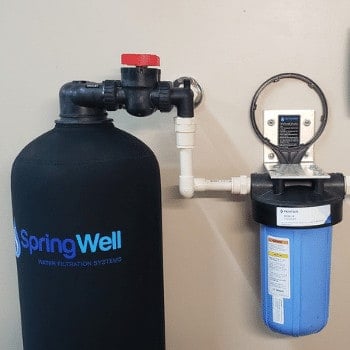
#1. SpringWell CF1 – Best Overall for Most City Water Homes
- Filtration 45% 5/5
- Flow/Pressure 20% 5/5
Full scoring basis
- Filtration (45%): Score: 5/5 — Catalytic carbon + KDF media; total THMs were below reporting limits in our 2025 kitchen sample
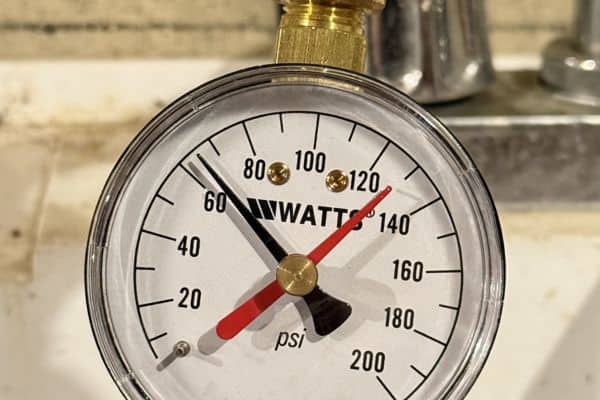
- Flow/Pressure (20%): Score: 5/5 — Field measured 5.4 GPM at utility sink under simultaneous washer load; 65 PSI held steady at year 3. No meaningful flow bottleneck after three years of daily use.
- Install/Maint (10%): Score: 4/5 — Clean install; sediment filter swaps every 8–9 months on our system
- Build (10%): Score: 4.5/5 — Solid tank and hardware; runs silently once in place
- Taste (5%) — Score: 5/5
- Cost (5%) — Score: 5/5 (~$0.00144/gal based on $1,144 purchase + ~$40/yr sediment filter upkeep over 10 years
- note 25% restocking fee applies if returned within the 6-month guarantee window)
- Certs (5%) — Score: 4/5
- Overall: 4.8/5 — weighted average of the factors above
The SpringWell CF1 ranks first because it’s the strongest answer to the most common city-water complaint: chlorine, chloramine, and disinfection byproducts like THMs.
We’ve run the CF1 since 2022. The lab results and ownership notes below are why it still holds our top spot.
Best fit: Treated city water where the main goals are better taste and odor, chlorine/chloramine reduction, THM reduction, and lower-maintenance whole-house filtration. CF1 covers most 1–3 bath homes; CF4 and CF+ are the larger-home versions.
What it doesn’t do: The CF1 is a whole-house carbon filter, not an RO drinking-water system. It won’t change your TDS, which rises and falls with your city’s source water no matter what filter is on the line. If you want dissolved minerals brought down at the kitchen tap, that’s an RO job. We run a Cloud RO system downstream from the CF1 for exactly that.
Before you buy: The carbon media needs a full 48-hour soak before you connect the tank. Plan the install around a weekend, not an evening.
Use code QWL5 if it applies at checkout.
✓ We tested this one ourselves – independent Tap Score panels, 2022 baseline vs. 2025 post-install, re-checked August 2026.
SpringWell markets the CF1 for chlorine, chloramine, VOCs, and PFAS. Our laboratory testing directly measured THMs, not every contaminant on that list.
🔬 Tap Score Lab Results – 2022 Baseline vs. 2025 Post-Install
| Parameter | Before | After 3+ years | Result |
|---|---|---|---|
| Total THMsiEPA MCL: 80 ppb | 31.83 ppb | ND Not detected | Below reporting limit |
| Chloroform (THM) | 21.57 ppb | ND Not detected | Below reporting limit |
| Bromodichloromethane | 7.93 ppb | ND Not detected | Below reporting limit |
| Dibromochloromethane | 2.33 ppb | ND Not detected | Below reporting limit |
| Copper | 20 ppb | 35 ppb | Context only |
| Barium | 10 ppb | 12 ppb | Context only |
| Zinc | 160 ppb | 159 ppb | Essentially unchanged |
| Iron | 10 ppb | ND | Below reporting limit |
| Total Dissolved Solids (TDS)iA carbon filter isn’t designed to reduce TDS | 187 ppm | 280 ppm | Source variation |
Context & Methods
- ND means the compound wasn’t detected above the laboratory reporting limit.
- The THM rows show the measured filtration result. The other analytes are context, not CF1 treatment claims.
- June 30, 2022 – pre-install baseline: Untreated kitchen water collected before the CF1 was installed.
- August 19, 2025 – three-year kitchen sample: Collected after more than three years of daily use. The 0.5 ppb lead result didn’t identify its source, so we don’t use it as CF1 performance evidence.
- August 19, 2026 – exactly one year later: We collected untreated water at the basement bypass and finished water at the kitchen. Microbac Laboratories analyzed both samples through Tap Score.
- End-of-cycle condition: We left the sediment cartridge in place even though it was close to its scheduled replacement. We performed no pre-test maintenance.
- No measurable THM challenge: Total THMs were non-detect in both samples, so the pair can’t produce a new reduction percentage.
- Expected non-targets: TDS was 284 ppm in both samples. Hardness measured 47.1 versus 46.1 ppm, pH 7.5 versus 7.6, sodium 74.6 versus 74.3 ppm, and chloride 103 versus 104 ppm.
- Lead and zinc: Lead measured 8.57 ppb at the bypass and below 0.4 ppb at the kitchen. Zinc measured 26.2 versus 734 ppb. Because these sampling points include different plumbing, the test doesn’t identify the source or prove the CF1 caused either difference.
🔄 Four-year update – August 2026
Exactly one year after our 2025 kitchen sample, we retested the same CF1 with the sediment cartridge nearing replacement. We didn’t service it first, so this reflects real end-of-cycle use.
TDS, hardness, pH, sodium, and chloride barely moved, which is what we’d expect from a carbon filter. THMs were non-detect at the basement bypass and kitchen tap, so the 2022–2025 table remains our measurable THM performance result.
🧾 What the lab reports don’t show
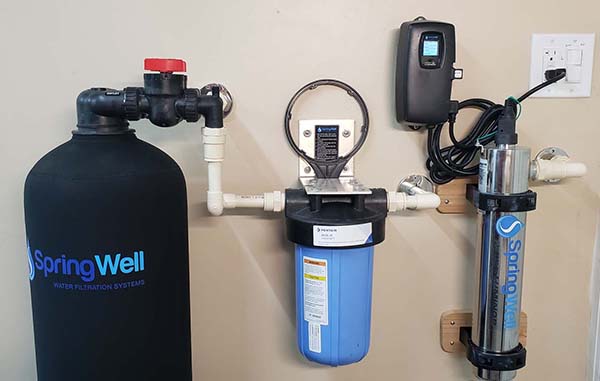
The lab reports cover water chemistry. Four years of ownership added the details that matter once the system is in your basement:
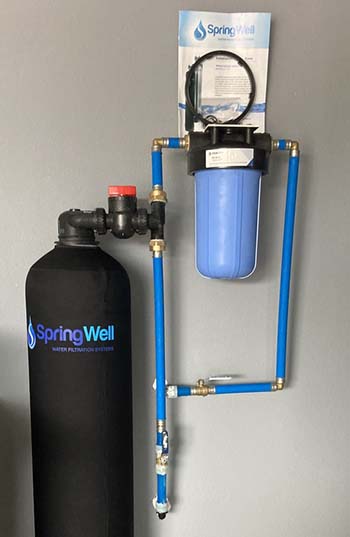
- Pressure and flow held: 68 PSI at install, 65 PSI at year three; about 5.4 GPM at the utility sink with the washer running. No bottleneck.
- The proof we didn’t expect: We flush our Rinnai tankless heater twice a year. Before the CF1, the inlet screen always carried sediment fines. Since installing it, the screen comes out clean.
- The one mistake: On our second filter change, we skipped the gasket-sealer step and had to shut the system down and restart. The bypass valve kept it manageable, but it’s worth knowing before you’re in the basement at 9 p.m. chasing a drip.
What it costs to own: About $1,144 up front plus roughly $40 per year for sediment filters, before installation.
Bottom line: Choose the CF1 if you’re on treated city water and want lab-verified THM reduction, better whole-house taste and odor, and a system that doesn’t need frequent cartridge changes.
Read our full review: SpringWell Whole House Filter Review
#2. Kind E-1000 – Best Compact Cartridge System for City Water
- Filtration 45% 4/5
- Flow/Pressure 20% 5/5
Full scoring basis
- Filtration (45%): Score: 4/5 - Dual-cartridge carbon system; NSF/ANSI 42 components
- Flow/Pressure (20%): Score: 5/5 - Rated 15 GPM; field check measured 4.8 GPM at one outlet (5-gal timed fill, single fixture)
- Install/Maint (10%): Score: 4/5 - DIY-friendly cartridge swaps; washable prefilter helps stretch replacement cycles
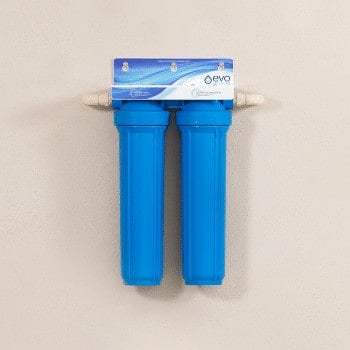
- Build (10%): Score: 4/5 - Compact 29 x 15.5 in. twin-canister design with sturdy hardware
- Taste (5%): 4.5/5 | Cost (5%): 3.5/5 | Certs (5%): 4/5
- Overall: 4.3/5 — weighted average of the factors above
The Kind E-1000 ranks #2 because it’s the strongest cartridge system in this lineup, not because it is the cheapest. In my own Tap Score testing it cut total THMs from 31.83 ppb to non-detect, dropped turbidity by 88%, and pulled copper down 90%, all from a compact twin-canister that mounts on a wall where a tank will not fit. The tradeoff is maintenance: you replace the carbon cartridge on a schedule instead of leaving a media tank alone for years.
Best fit: Treated city water where you want real carbon filtration in a compact footprint. Chlorine, chloramine, sediment, and THMs are the main targets, and the 15 GPM rating covers most normal household demand.
What it does not do: The E-1000 is carbon and sediment only, so it filters taste, odor, and chlorine, not dissolved minerals. TDS stays where your city’s water sets it; for purified water at the kitchen tap, add an under-sink RO.
Before you buy: This is a cartridge system, so budget for swapping the carbon cartridge on a schedule, roughly $150 to $200 a year. The pleated sediment prefilter is washable, which stretches that out, but it is still more hands-on than a media tank.
✓ We tested this one ourselves — independent Tap Score panel on the filtered output against our city-water baseline.
What our lab test found: Kind rates the E-1000 for chlorine, chloramine, VOCs, and sediment. My panel backs the disinfection-byproduct and sediment side directly: THMs to non-detect, turbidity down 88%, copper down 90%. Barium and TDS ticked up slightly, but that tracks the source water, not the filter, and both stayed well under EPA limits.
🔬 Tap Score Lab Results
| Parameter | Before | After | Change |
|---|---|---|---|
| Total THMsiEPA MCL: 80 ppb | 31.83 ppb | ND Removed | −100% |
| Chloroform (THM) | 21.57 ppb | ND Removed | −100% |
| Bromodichloromethane | 7.93 ppb | ND Removed | −100% |
| Dibromochloromethane | 2.33 ppb | ND Removed | −100% |
| TurbidityiEPA SMCL: 1 NTU | 0.8 NTU | 0.1 NTU Reduced | −88% |
| Iron | 10 ppb | ND Removed | −100% |
| CopperiEPA action level: 1300 ppb | 20 ppb | 2 ppb Reduced | −90% |
| BariumiEPA MCL: 2000 ppb | 10 ppb | 15 ppb | +5 ppb |
| Total Dissolved Solids (TDS)iMineral content; not a performance target for carbon filters | 187 ppm | 275 ppm | Source variation* |
Samples analyzed by Tap Score (ETR Labs & Microbac). Overall Tap Score improved 77/99 → 83/99 after filtration with the Kind E-1000.
Context & Methods
“ND” = Not Detected above the lab reporting limit. THMs compared to EPA MCL (80 ppb). Turbidity compared to EPA SMCL (1 NTU).
*Method: Single before/after panel, comparing the Kind’s filtered output against our 2022 city-water baseline. This is a point-in-time test, not the multi-year run we did on the CF1. Barium and TDS reflect source-water variation, not filter performance.
*Note: Kind’s pleated sediment filter is washable and can be reused several times before replacement, which may extend life in heavy-sediment areas. Performance above reflects standard use conditions.
Baseline (Advanced City Test):
View baseline report (PDF)
Post-test (after filtration with Kind E-1000):
View post-install report (PDF)
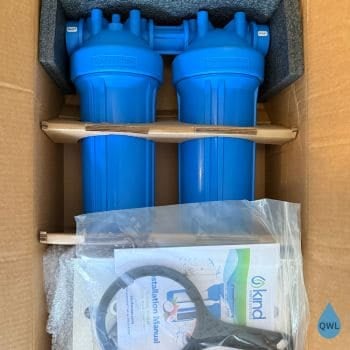
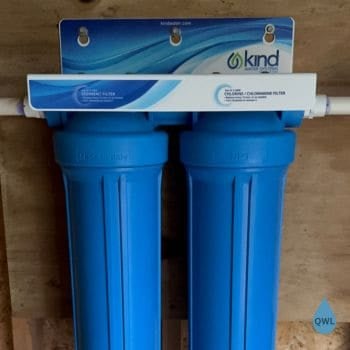
🧾 How the Kind E-1000 Scored
It ranks ahead of the iSpring WGB32B on design and credibility: a cleaner two-stage layout, a washable sediment prefilter, and stronger warranty coverage. That makes it the cartridge system I’d reach for first on city water.
It sits behind the SpringWell CF1 for one reason, and it is not filtration. The cartridge has to be replaced on a schedule, so it is more hands-on over time than a set-and-forget media tank. What you get back is a smaller footprint, a lower upfront price, and no tall-tank clearance problem.
Bottom line: Choose the E-1000 if you want compact, lab-verified cartridge filtration for city water and don’t mind swapping cartridges on a schedule. Step up to the CF1 if you’d rather set a tank and forget it.
Read our full review: Kind E-1000 Whole House Water Filter Review
#3. Aquasana EQ-1000 – Best for City Water Plus Salt-Free Scale Control
- Filtration 45% 4.5/5
- Flow/Pressure 20% 4/5
Full scoring basis
- Filtration (45%): Score: 4.5/5 - NSF/ANSI 42 tested for chlorine; tank certified NSF/ANSI 61
- Flow/Pressure (20%): Score: 4/5 - Rated 12 GPM; steady for most homes
- Install/Maint (10%): Score: 4/5 - Multi-stage setup; pre/post filters every 3–6 months
- Build (10%): Score: 4.5/5 - Large tank; proven 1,000,000-gallon capacity
- Taste (5%): 4/5 | Cost (5%): 4/5 | Certs (5%): 4.5/5
- Overall: 4.3/5 — weighted average of the factors above
The Aquasana EQ-1000 ranks #3 because it bundles two jobs into one tank: whole-house chlorine filtration and salt-free scale conditioning. You can pair scale control with any system on this list, but Aquasana builds it in, which is the draw if you’d rather not run a second unit.
We haven’t run our own lab panel on this one, so it ranks on certifications and design rather than our own test data. It’s the pick when scale is part of the problem, not just taste and odor.
Best fit: Treated city water where you want chlorine reduction plus help with hard-water scale, without a salt-based softener. The TAC media conditions scale with no salt, brine, or electricity.
What it does not do: The TAC conditioner reduces scale buildup, but it does not soften water or lower hardness on a test the way an ion-exchange softener would, and scale control is hard to verify in any given home. It is not an RO system either, so it will not address TDS or give you purified drinking water at the tap.
Before you buy: Settle the install plan before you order. Aquasana’s materials list a 10-year warranty, but full coverage is contingent on installation by a licensed plumber, and no bypass is included by default, so plan the plumbing ahead. The standard 20-inch pre-filter is listed for replacement every 2 months (a 6-month low-maintenance option exists), so sediment-heavy water makes upkeep more hands-on than the tank life suggests.
Use code AQQWL50 if it applies at checkout.
ⓘ Based on certifications and manufacturer data — we have not independently lab-tested this unit.
What the certification covers: Aquasana is NSF/ANSI 42 tested for chlorine reduction, and the tank is NSF/ANSI 61 certified for material safety. That is component- and material-level assurance rather than a full-system contaminant panel. Treat the performance figures as manufacturer and certification data, not our own results.
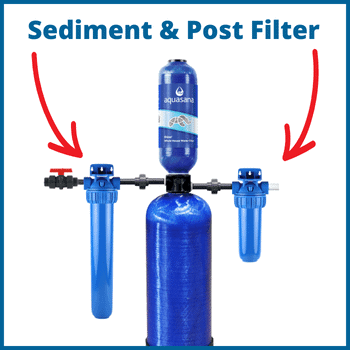
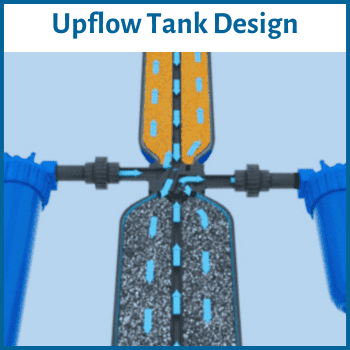
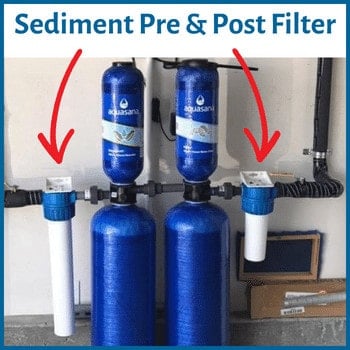
🧾 How the Aquasana EQ-1000 Scored
It sits at #3 on ownership, not filtration. For chlorine and general city-water treatment it is competitive with anything here. The catch is the pre-filter schedule: swaps every 2 to 3 months depending on sediment, which is more hands-on than the set-and-forget media tank in the CF1, exactly the buyer who picks a tank to avoid frequent changes.
The reason to choose it anyway is the TAC scale conditioner. It is the only system in this lineup that bundles chlorine filtration with salt-free scale control. The honest caveat is that scale prevention is harder to verify than contaminant reduction, so it either noticeably helps in your home or it does not.
Bottom line: Choose the EQ-1000 if you want whole-home chlorine reduction with salt-free scale control in one system and don’t mind regular pre-filter swaps. If scale isn’t your issue, the CF1 or Kind is simpler to own.
Read our full review: Aquasana EQ-1000 Review
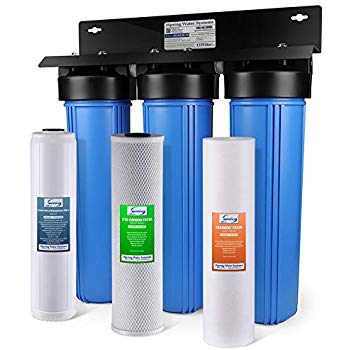
#4. iSpring WGB32B – Best Budget City-Water Cartridge System
- Filtration 45% 4.5/5
- Flow/Pressure 20% 4.5/5
Full scoring basis
- Filtration (45%): Score: 4.5/5 — Our lab test measured lead at 8.57 ppb untreated and below the 0.4 ppb reporting limit after filtration; copper and zinc were also not detected
- Flow/Pressure (20%): Score: 4.5/5 — Rated at 15 GPM for medium–large households
- Install/Maint (10%): Score: 4/5 — DIY-friendly three-stage design with replaceable cartridges rated for up to ~100,000 gallons
- Build (10%): Score: 4/5 — Heavy-duty housings with simple cartridge access and straightforward replacement
- Taste (5%): 4/5 | Cost (5%): 5/5 | Certs (5%): 4/5
- Overall: 4.4/5 — weighted average of the factors above
The iSpring WGB32B ranks #4 because the entry price is hard to argue with. At about $420 it’s less than half the CF1 and well under the Kind. More importantly, our 2026 lab test gave us a lot more confidence in the filtration. Untreated lead measured 8.57 ppb and was not detected after the iSpring above the lab’s 0.4 ppb reporting limit. Copper and zinc were also non-detect after filtration.
Best fit: Budget-focused city-water homes that want whole-house filtration without a $1,000+ upfront cost. The 15 GPM rating keeps up with medium to large households, it’s genuinely DIY-friendly, and our lab results were much stronger than we expected at this price.
What it does not do: It uses NSF/ANSI compliant filter components rather than carrying full-system certification. It’s also not a softener or RO system, so it doesn’t meaningfully reduce hardness, TDS, or dissolved salts.
Before you buy: The warranty is still the catch, just 1 year compared with the lifetime or 10-year coverage on the systems ranked above it. The three cartridges also require more regular attention, so the low purchase price comes with higher ongoing maintenance.
✓ We tested this one ourselves — independent Tap Score lab testing compared with our untreated city-water baseline.
🔬 Tap Score Lab Results – 2026 Untreated Baseline vs. iSpring WGB32B
| Parameter | Untreated | After iSpring | Result |
|---|---|---|---|
| Lead iPost-filter laboratory reporting limit: 0.4 ppb | 8.57 ppb | ND Not detected | >95% lower |
| Copper iPost-filter laboratory reporting limit: 1.02 ppb | 55.8 ppb | ND Not detected | >98% lower |
| Zinc iPost-filter laboratory reporting limit: 5.1 ppb | 26.2 ppb | ND Not detected | >80% lower |
| Total THMs | ND | ND | No measurable challenge |
| Total Dissolved Solids (TDS) iThis type of whole-house filter isn’t designed to reduce dissolved minerals or TDS | 284 ppm | 295 ppm | Essentially unchanged |
| Hardness | 47.1 ppm | 45.3 ppm | Essentially unchanged |
| Sodium | 74.6 ppm | 74.4 ppm | Essentially unchanged |
| Chloride | 103 ppm | 97.8 ppm | Similar |
Context & Methods
- ND means the analyte wasn’t detected above the laboratory reporting limit.
- For non-detect results, the percentage shown is the minimum observed reduction calculated using the laboratory reporting limit.
- The untreated and filtered samples were collected from the same source point. The samples were collected several weeks apart, so normal changes in municipal water chemistry are possible.
- August 19, 2026 – untreated baseline: We collected untreated municipal water before testing the iSpring WGB32B.
- September 8, 2026 – iSpring sample: We collected water after it passed through the iSpring WGB32B three-stage whole-house filter.
- Microbac Laboratories analyzed both samples through Tap Score using the Advanced City Water Test.
- Lead: The untreated sample measured 8.57 ppb. After the iSpring, lead was not detected above the 0.4 ppb reporting limit, representing a minimum observed reduction greater than 95%.
- Copper: Copper measured 55.8 ppb untreated and was not detected after filtration above the 1.02 ppb reporting limit.
- Zinc: Zinc measured 26.2 ppb untreated and was not detected after filtration above the 5.1 ppb reporting limit.
- Expected non-targets: TDS, hardness, sodium and chloride remained broadly similar. The WGB32B is not designed to soften water or remove dissolved salts.
- THMs: Total THMs were non-detect in both samples, so this test could not measure THM reduction.
What the certification covers: iSpring’s sediment and carbon cartridges use NSF/ANSI compliant components, but the WGB32B does not carry full-system certification. We now have independent lab data of our own, including lead dropping from 8.57 ppb untreated to below the lab’s 0.4 ppb reporting limit after filtration.
User Note: My brother ran a WGB32B for a stretch. His read was that the water tasted noticeably better, but the cartridges loaded up faster than he wanted and the swaps got old. That tracks with the maintenance tradeoff of a three-cartridge system and is one reason iSpring still ranks below the tank systems here.
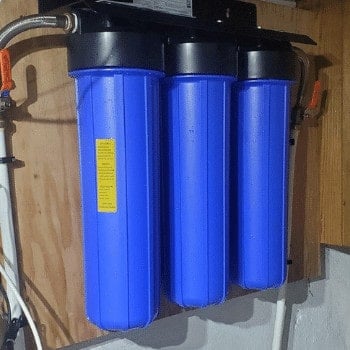
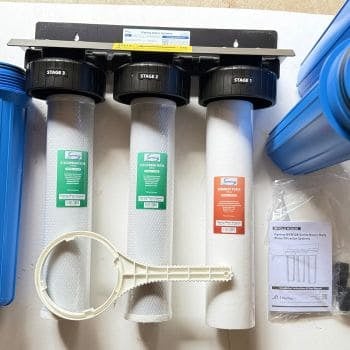
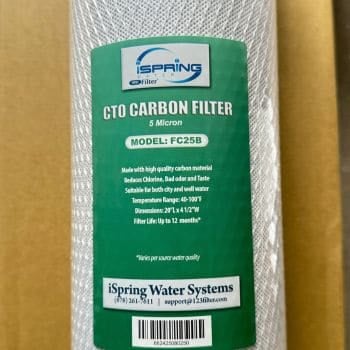
🧾 How the iSpring WGB32B Scored
The real comparison is the Kind E-1000, since both are cartridge systems. Kind is still the stronger long-term pick: a cleaner two-stage design, washable sediment prefilter, better warranty coverage, and less cartridge-management friction. iSpring wins decisively on upfront price, and our new lab results make the filtration side of the comparison much more competitive.
The 1-year warranty is the biggest reason it does not rank higher; everything above it carries lifetime or 10-year coverage. The three-cartridge setup also means more maintenance over time, even though the initial price is much lower.
Bottom line: Choose the WGB32B if you want a low-cost, DIY-friendly whole-house filter and don’t mind more frequent cartridge maintenance. In our 2026 lab test, lead, copper, and zinc were all below their respective reporting limits after filtration.
Read our full review: iSpring 3-Stage Review
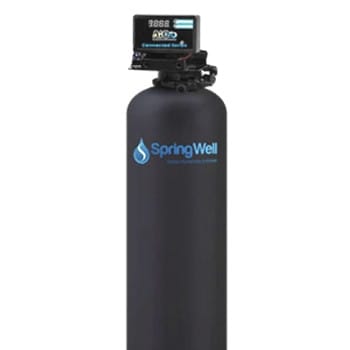
#5. SpringWell WS – Best for Well Water with Iron, Manganese, or Sulfur
- Well-Water Fit 50% 5/5
- Flow/Pressure 20% 5/5
Full scoring basis
- Well-Water Fit (50%): Score: 5/5 — Strong fit for common residential iron, manganese, and sulfur odor issues
- Flow/Pressure (20%): Score: 5/5 — Rated 12–20 GPM for multi-bathroom well-water homes
- Install/Maint (15%): Score: 4.5/5 — Needs drain and power access, but automatic backwash keeps upkeep simple
- Build (10%): Score: 5/5 — Durable tank and control valve with long media life
- Cost (3%) — Score: 5/5
- Certs (2%) — Score: 3.5/5
- Overall: 4.9/5 — weighted average of the factors above
The SpringWell WS ranks #5 because it is the system to reach for when your problem is well water, not city water. It is a chemical-free air-injection oxidizer built for iron, manganese, and sulfur odor, the contaminants a carbon system like the CF1 cannot touch. We have not lab-tested the WS ourselves, so it ranks on its design and field track record.
Best fit: Private wells with iron, manganese, or sulfur “rotten egg” odor. In the field it handles roughly up to 7 ppm iron, 1 ppm manganese, and 8 ppm sulfur, with automatic backwash keeping upkeep low.
What it does not do: This is the opposite of the city-water systems above it. It is not built for municipal chlorine, chloramine, or THM reduction, so if you are on treated city water, the CF1 is the right tool. Very high iron, above roughly 8 to 10 ppm, calls for testing first and likely a stronger oxidizer.
Before you buy: The WS needs a drain and a power connection for its backwash cycle, so the install spot matters more than with a passive tank. And on problem wells, test your iron and sulfur levels first; the right system depends on the numbers.
ⓘ Based on air-injection design and field feedback — we have not independently lab-tested the WS.
What we’re going on: We have not run a Tap Score panel on the WS specifically. We have lab-tested SpringWell’s carbon system, the CF1, where THMs dropped to non-detect over three years, which speaks to the brand’s media quality but not to the WS’s iron and sulfur performance directly. The WS ranks here on its air-injection design and consistent field feedback for typical residential iron and sulfur loads.
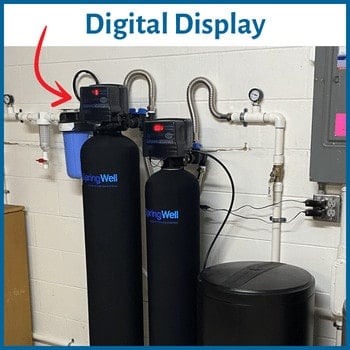
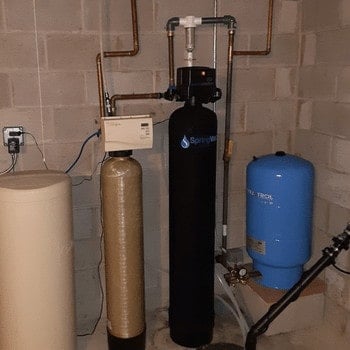
🧾 How the SpringWell WS Scored
Lined up against the SoftPro Iron Master, the tradeoff is clear. The WS is easier to live with day to day, with automatic backwash and a Bluetooth valve for monitoring. The Iron Master is the stronger choice if your water runs to extreme iron above 8 to 10 ppm. For the typical residential range, the WS is the more set-and-forget option.
Upkeep is close to nothing once it is running: a little backwash water and an occasional app check. That is a real contrast with cartridge systems that can run $200 to $400 a year in replacements.
Bottom line: Choose the WS if you’re on well water fighting iron, sulfur odor, or staining and want a low-maintenance, chemical-free fix in the normal residential range.
Read our full review: SpringWell WS1 Review
#6. SoftPro Chlorine & Fluoride Filter – Best for Whole-House Fluoride Reduction
- Filtration 45% 4.5/5
- Flow/Pressure 20% 4/5
Full scoring basis
- Filtration (45%): Score: 4.5/5 — Catalytic carbon + bone char media targets fluoride, chlorine, and chloramine reduction
- Flow/Pressure (20%): Score: 4/5 — Rated 10–14 GPM; best suited for small to mid-size households
- Install/Maint (10%): Score: 5/5 — Non-electric, straightforward setup with minimal upkeep
- Build (10%): Score: 4.5/5 — Solid upflow tank design; operates passively without power
- Taste (5%) — Score: 4.5/5
- Cost (5%) — Score: 5/5
- Certs (5%) — Score: 4/5
- Overall: 4.5/5 — weighted average of the factors above
The SoftPro Chlorine + Fluoride Filter ranks #6 because it fills a gap none of the others do: whole-house fluoride reduction. Its catalytic carbon and bone char target fluoride along with chlorine and chloramine at the point of entry, which is rare outside of reverse osmosis. We have not lab-verified its fluoride performance, so it ranks on a real niche rather than our own data.
Best fit: City-water homes where fluoride is the specific concern and you want it addressed throughout the house rather than only at the kitchen tap. It also handles chlorine and chloramine, and runs passively with no power or backwash.
What it does not do: It carries NSF 61 material certification but no fluoride-specific reduction certification, so the fluoride claim rests on the bone char media rather than independent verification. For fluoride at a single tap, an under-sink RO system is the more proven and cheaper route.
Before you buy: Bone char’s real-world fluoride reduction depends on your water chemistry, contact time, and media age, so it is worth testing your fluoride level before and after. Flow also tops out lower than the biggest city-water tanks, at 10 to 14 GPM, so it suits small to mid-size homes.
ⓘ Based on certifications and research — the fluoride reduction is not independently lab-verified by us.
The honest limitation: The CF1 has two Tap Score panels confirming THM reduction. SoftPro’s fluoride performance rests on media claims, not independent lab verification. Bone char does reduce fluoride, but the real-world rate varies with your water chemistry and media age. The tank materials are NSF 61 certified; the fluoride reduction itself is not third-party certified.
🧾 How the SoftPro Chlorine & Fluoride Filter Scored
For buyers where fluoride is not the main concern, the CF1 or Kind is the stronger recommendation, with real lab data behind them. SoftPro earns its spot for one reason: if you specifically want whole-house fluoride coverage without running RO at every tap, it is one of the few point-of-entry systems built for it, and upkeep is low at $20 to $40 a year.
Bottom line: Choose the SoftPro Chlorine + Fluoride filter if whole-home fluoride reduction is your specific goal. If it isn’t, a lab-tested carbon system like the CF1 or an under-sink RO is the more proven buy.
🧭 Why Some Popular Systems Didn’t Make Our 2026 List
Before our 2025 refresh, this guide covered 11 systems. We cut it to 6 — not to be minimal, but to remove duplication and focus on systems with the clearest long-term value story.
Two names people still ask about:
- 3M Aqua-Pure AP904 – legitimate high-flow cartridge system, but at ~$300–$350 per cartridge versus Kind’s ~$150–$200 annually, the 3-year cost gap is too wide for the same lane.
- Express Water 3-Stage – functional, but too close to iSpring on structure and more expensive to run in dirtier water.
Two others worth mentioning: Pentair PC600 was previously featured – solid NSF/ANSI 42 and 61 certified tank, but its 5-year media cost and replacement pricing put it behind the CF1 on ownership math. Culligan and Kinetico exist for buyers who want a professionally installed system with a service contract – but they require a dealer quote, not a direct purchase.
Bottom line: every cut was a cost or overlap decision, not a quality call.
🛒 Buyer’s Guide
Buying a whole house water filter doesn’t have to be overwhelming or overpriced. The key is matching the right system to your water quality, plumbing setup, and long-term goals – not just grabbing what’s popular.
🧠 Before You Buy
🚰 Municipal Water vs. Well Water
Whether you’re on city water or a private well, no two homes face the same threats. The right system depends on what’s actually in your water, not what’s popular.
City Water Concerns
Even though city water is treated, it can still carry unwanted additives and byproducts:
- Common additives: Fluoride, chlorine, chloramine
- Byproducts & chemicals: Bromate, haloacetic acids, herbicides, pesticides, PFOS/PFOA, VOCs
- Physical impurities: Sediment, trace pharmaceuticals
- Potential intruders: Lead from aging plumbing
Well Water Concerns
Well water follows a different treatment path. Iron, sulfur, manganese, sediment, hardness, and bacteria often need dedicated treatment stages rather than a standard city-water carbon filter.
See our recommendations 👉 Well water filtration system reviews
🔬 Why a Water Test Is Non-Negotiable
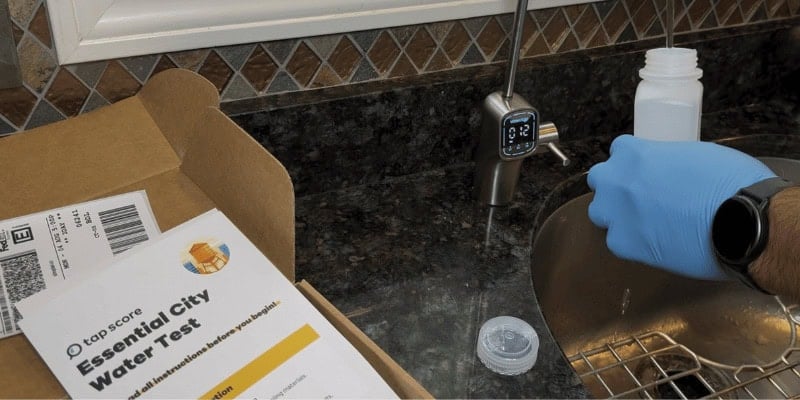
Before spending thousands, get your water tested. You don’t need to guess – or rely on marketing claims.
- City water? Request a report from your utility, then validate it with an at-home test kit.
- Well water? Test at least once per year – more often if you live near farms, industry, or septic systems.
| 💧 What Testing Can Reveal | 🔧 Why It Matters |
|---|---|
| – Iron, manganese, hydrogen sulfide – Hardness, low pH, sediment – Chlorine, chloramine, lead – Bacteria, VOCs, PFAS |
– Prevents system mismatch – Helps you choose the right media – Flags urgent health risks – Saves you from installing the wrong setup |
Even a $30 DIY kit can catch obvious problems, but a certified lab test gives you a much clearer read on what’s actually in your water.
If you’re checking a city water report before buying a filter, I’d look at three things first: whether the utility uses chlorine or chloramine, whether disinfection byproducts like THMs or HAA5 show up, and whether there’s any mention of lead, copper, or older plumbing concerns. That usually tells you pretty quickly whether a standard carbon system is enough, whether catalytic carbon makes more sense, or whether you should also be thinking about a separate drinking-water filter at the sink.
The first time I tested my own tap water, I expected to see a little chlorine and move on. Instead it came back over 3 ppm. My skin had always felt dry, and that result made the connection a lot harder to ignore. That was the point where I stopped guessing and installed a carbon filter.
👉 See our top recommended water test kits.
🧭 Best Setup by Water Problem
Once you know what’s in your water, the next step is matching the problem to the right treatment type. This is where a lot of buyers go wrong – they shop by brand name or stage count instead of choosing the system that actually fits the issue.
| If your main issue is… | Usually the best fit is… | Why |
|---|---|---|
| Chlorine or chloramine | Catalytic carbon whole house filter | Best for improving shower water, odor, taste, and whole-home chemical exposure. |
| Hard water or scale | Salt-based softener or salt-free conditioner | Whole house filters do not truly soften water or remove hardness minerals. |
| Fluoride, PFAS, or nitrates | Under-sink reverse osmosis, sometimes paired with whole-house filtration | RO is usually the stronger tool when your main goal is cleaner drinking water at the tap. |
| Iron, sulfur smell, or manganese | Dedicated well water treatment system | These problems usually need oxidation or specialty media, not a basic city-water carbon filter. |
| Sand, silt, or visible sediment | Sediment pre-filter or spin-down filter | Protects the main system and helps prevent pressure loss from premature clogging. |
| Bacteria, viruses, or cyst concerns | UV purifier after the main treatment stages | Carbon and sediment filters do not disinfect water on their own. |
💡 Quick takeaway: If you’re trying to solve more than one problem, like hard water and chlorine or iron and sulfur, the right answer is often a combination setup, not a single all-in-one filter. And if your city uses chloramine instead of free chlorine, that detail matters more than most buyers realize. In that case, catalytic carbon is usually the better fit for long-term whole-house treatment.
🆚 Whole-House Filter Types: Tank vs. Cartridge
Before comparing brands, understand the format. Tank systems use a large granular activated carbon (GAC) or catalytic carbon media bed that water flows through continuously. Cartridge systems work differently — and the right choice depends on your water demand, budget, and how much upkeep you want.
| Feature | Tank-Based Systems | Cartridge Systems |
|---|---|---|
| 🚿 Flow Rate | High — great for larger homes | Moderate — can restrict pressure with multiple taps |
| 🔄 Filter Changes | Every 6–10 years | Every 6–12 months |
| 📦 Media Capacity | Up to 1 million gallons | Up to 100,000 gallons |
| 🧰 Maintenance | Virtually none | Frequent — especially multi-stage units |
| 🏠 Footprint | Larger — requires floor space | Compact — wall-mounted options available |
| 💲 Upfront Cost | Higher | Lower |
💡 Pro tip: Cartridge systems work well for small households or part-time residences. For families with higher water demand, a tank-based unit typically pays for itself in convenience and long-term value.
⚖️ Whole House Filter vs. Reverse Osmosis – Where Each Fits
🏠 Whole House Filtration
Best for treating all the water entering your home:
- Coverage: Treats every tap – showers, sinks, appliances – from a single entry-point system.
- Taste & odor control: Removes chlorine, sediment, and VOCs without affecting pressure.
- Filtration process: Typically uses sediment + carbon + KDF media for efficient all-purpose treatment.
🚰 Reverse Osmosis
Ideal for drinking water and ultra-purification needs:
- Precision: Filters down to 0.0001 microns – great for lead, fluoride, arsenic, PFAS, and more.
- Limitations: Slower flow, limited daily output, and usually only treats a single faucet.
- Use case: Works best as a final stage under-sink system in homes with specific contamination concerns.
💡 Value tip: For most households, a whole house system is the smarter first move when chlorine, chloramine, odor, and disinfection byproducts are the main concern. Add an RO filter at the kitchen tap later if fluoride, PFAS, nitrates, arsenic, or dissolved solids are the bigger issue. See our top RO systems →
If you are still deciding between whole-house, under-sink RO, countertop RO, pitcher, faucet, shower, or gravity filters, see how we compare water filters we tested.
🚫 What a Whole House Filter Won’t Fix on Its Own
Whole house filters are great for chlorine, chloramine, sediment, odors, and protecting plumbing throughout the home. But they are not a cure-all, and expecting one system to solve every water problem is one of the most common buying mistakes we see.
- Hard water: A whole house filter won’t truly soften water or remove calcium and magnesium. For that, you need a dedicated softener or scale conditioner.
- High-priority drinking water contaminants: For fluoride, PFAS, nitrates, arsenic, and other dissolved contaminants, under-sink reverse osmosis is usually the more reliable solution at the tap.
- Bacteria and viruses: Carbon and sediment filters do not disinfect water. If biological contamination is a concern, you’ll need UV or another disinfection step.
- Every possible well water problem: Iron, sulfur, manganese, hardness, and bacteria often require different treatment stages working together.
🧠 Reality check: The best whole house setup often handles the water you bathe in, cook with, and run through your plumbing – while a separate softener or under-sink RO handles the problems a whole-house filter isn’t built to solve.
📋 What to Look For

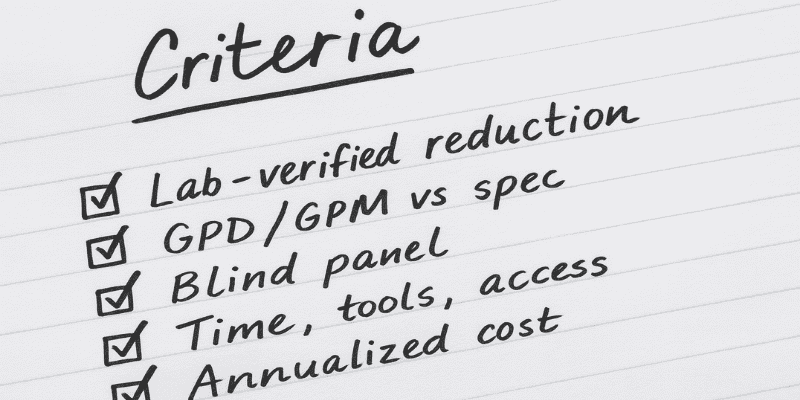
Choosing a system isn’t just about price or popularity — it’s about what actually fits your water, plumbing, and usage. Before you buy, focus on four things that actually matter: contaminant removal backed by independent lab data, flow rate high enough to handle your household’s peak demand, certification depth that matches your specific water risks, and total cost of ownership — not just the sticker price.
Installation complexity and warranty terms matter too, but they’re easier to research after you’ve narrowed the field.
On certifications: NSF listings are useful but they’re not the whole story. Some of the best-performing systems in our testing carry component-level certifications only — not whole-system stamps. The SpringWell CF1 is a good example. What matters more is whether the manufacturer publishes real lab data you can verify independently. A Tap Score report tells you more than an NSF badge.
On flow rate: Most households need 6–7 GPM to cover basic overlapping use — a shower and a faucet running at the same time. If you regularly run multiple showers, a dishwasher, and a washing machine simultaneously, aim for 10 GPM or higher. Undersizing here is a mistake you feel every morning.
On long-term cost: The upfront price is rarely the real cost. A $500 cartridge system that needs $200 in filter replacements every year costs more over five years than a $900 tank system with $40/yr upkeep. Run the numbers before you decide.
💡 Do you need a sediment prefilter? Not always. Many city-water homes can run a whole-house carbon system without a separate sediment stage, but homes with visible grit, rust, or older plumbing often benefit from one. A sediment prefilter can help protect the main system, reduce premature clogging, and preserve flow over time.
👉 Read our guide on what NSF certification actually means.
🔧 Before You Install

✅ Pre-Installation Checklist
Before you pick up the phone to call a plumber, make sure your space and setup are ready. This checklist helps avoid surprises and extra charges on install day:
- Main water shut-off location: Know where it is and confirm it works.
- Adequate space: Ensure at least 2–3 feet of side clearance for tanks or cartridges. Some tank systems may also need about 5 feet of vertical clearance.
- Pipe size compatibility: Most systems work with 1” pipe. Adapters may be needed for ¾”.
- Nearby power source: Required for systems with UV, electronic valves, or booster pumps. Not needed for SpringWell CF1, Kind E-1000, or SoftPro.
- Drain access: Required for salt-based softeners. Not required for carbon tank or cartridge systems.
- Mounting surface: Wall-mounted filters need a stable backing, not drywall alone.
💬 “I didn’t realize I’d need a few extra brass fittings to connect to my 1″ copper line. It only added ~$40, but it’s worth factoring in upfront.”
⚠️ Expert insight: Some installers charge extra if unexpected work is required, like soldering copper pipes, adding bypass valves, or rerouting around tight spaces. The other thing that catches people off guard is clearance. Tank systems need more room than many buyers expect, and cartridge setups still need enough space for filter changes. Having photos and measurements ready before you get quotes can prevent a lot of install-day surprises.
🧰 DIY vs. Professional Installation
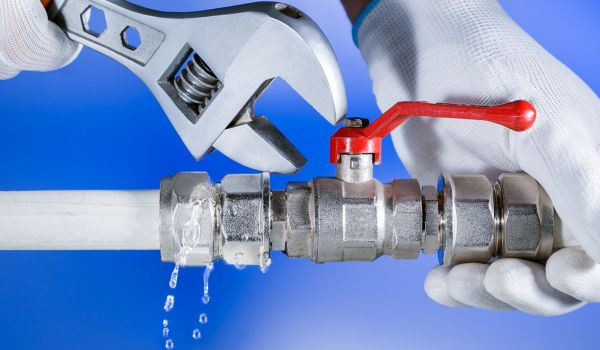
Some systems like the Kind E-1000 and iSpring WGB32B are more DIY-friendly for homeowners with basic plumbing skills. Tank systems like the SpringWell CF1 and Aquasana EQ-1000 are better handled by a licensed plumber due to size, bypass valve setup, and pressure considerations.
| System Type | Labor | Average Installation Cost |
|---|---|---|
| Whole House Filtration System | 4 to 8 hours | $500 to $1,200+ |
| Well Filtration System | 4 to 8 hours | $500 to $1,200+ |
| Reverse Osmosis System | 4 to 8 hours | $500 to $1,200+ |
| UV Disinfection System | 4 hours or less | $350 to $600 |
For more detail: How much do whole house water filter systems cost?
🔁 After You Install

⏳ Filter Lifespan & Replacement Costs
Filters have a finite lifespan and must be replaced on time to maintain water quality and system performance.
| Brand | Media Change / Replacement | Estimated Cost |
|---|---|---|
| SpringWell CF1 | 10 years or 1,000,000 gallons | $335 |
| Aquasana EQ-1000 | 10 years or 1,000,000 gallons (pre-filter: every 2–3 months) | $849 |
| Kind E-1000 | 12 months (cartridges) | $298 |
| iSpring WGB32B | 6–12 months (cartridges) | $149.99 |
| SpringWell WS | 8–10 years or about 1,000,000 gallons | ~$200 |
| SoftPro Chlorine+ & Fluoride | 1,000,000 gallons | $465 |
💡 Expert insight: Don’t just look at the upfront price — consider how often you’ll need to replace the media. A cheaper system with short filter cycles can cost more in the long run than a high-capacity tank with minimal upkeep.
💵 Annual Filter Cost by System
| Brand | Filter | Annual Cost |
|---|---|---|
| SpringWell CF1 | 5 micron sediment | ~$40 |
| Kind E-1000 | Carbon block cartridges | ~$180 |
| Aquasana EQ-1000 | Pre + post filters | ~$120 |
| iSpring WGB32B | 3-stage cartridges | ~$75 |
| SpringWell WS | Sediment pre-filter + backwashing media tank | ~$40 |
| SoftPro Chlorine+ & Fluoride | 5 micron sediment | ~$40 |
🔄 Learn more about filter cartridge types and sizes
🔧 Maintenance Tips for Optimal Performance
Tank-based units are generally low-maintenance. Cartridge systems require more frequent check-ins. Use this checklist to keep your system running smoothly:
- Filter replacement: Replace based on water quality and manufacturer schedule — don’t skip swaps.
- Housing cleanliness: Rinse the housing unit when changing filters to prevent buildup.
- System inspection: Regularly check for tight fittings and signs of corrosion or wear.
- Pressure checks: Annually verify incoming pressure is between 40–60 psi.
- Sediment flushing: Flush out sediment every 6 months using a drain valve or hose bib.
- Leak surveillance: Monitor system joints and valves — even small drips deserve immediate attention.
- Water quality monitoring: Test your water yearly to ensure the filter is working as expected.
💬 “I noticed water pressure started to dip around the 6-month mark. Swapping the sediment filter fixed it instantly — now I just mark it on my calendar.”
📐 Reference & Sizing Guide
Use this section to size your system correctly before you buy.
📊 Capacity & Flow Rate by System
- Capacity — how much water a system can treat before filters need replacing. Larger capacity means fewer changes and less long-term upkeep.
- Flow rate (GPM) — how quickly water moves through the system. Too low and you’ll feel pressure drops when multiple taps run at once.
🧠 Pro tip: A flow rate of 6–7 GPM works for most households. For larger homes or higher demand, aim for 10 GPM or higher.
| Brand | Capacity | Flow Rate |
|---|---|---|
| SpringWell CF1 | 1,000,000 gallons | Up to 20 GPM |
| Aquasana EQ-1000 | 1,000,000 gallons | 12 GPM |
| Kind E-1000 | ~80,000 gallons | 15 GPM |
| iSpring WGB32B | ~100,000 gallons | Up to 15 GPM |
| SpringWell WS | 1,000,000 gallons | 12–20 GPM |
| SoftPro Chlorine+ & Fluoride | 1,000,000 gallons | 8–14 GPM |
💧 Typical Flow Rates by Fixture
| Fixture & Appliance | Flow Rate (GPM) |
|---|---|
| Dishwasher | 1–3 GPM |
| Washing Machine | 3–5 GPM |
| Shower | 2–5 GPM |
| Toilet | 2–3 GPM |
| Faucet | 2–4 GPM |
⚠️ Keep in mind: Filters with broader contaminant removal tend to have lower flow rates. The Aquasana EQ-1000 prioritizes chemical reduction but tops out at 12 GPM, while the Kind E-1000 flows up to 15 GPM with fewer filtration stages.
🧩 Measure Your Home’s Flow Rate
Before choosing a system, know your effective flow rate. Here’s how:
- Make sure all indoor faucets are turned off.
- Place a 5-gallon bucket under your outdoor spigot.
- Turn on the water and time how long it takes to fill.
- Use the chart below to find your GPM.
💡 If it takes 60 seconds to fill the bucket, your flow rate is roughly 5 GPM.
| Seconds to fill 5 gallons | Flow Rate | Seconds to fill 5 gallons | Flow Rate |
|---|---|---|---|
| 76–100 | 3 GPM | 61–75 | 4 GPM |
| 51–60 | 5 GPM | 43–50 | 6 GPM |
| 38–42 | 7 GPM | 34–37 | 8 GPM |
| 31–33 | 9 GPM | 28–30 | 10 GPM |
| 26–27 | 11 GPM | 24–25 | 12 GPM |
| 22–23 | 13 GPM | 21 | 14 GPM |
| 20 | 15 GPM | 19 | 16 GPM |
| 18 | 17 GPM | 17 | 18 GPM |
| 16 | 19 GPM | 15 | 20 GPM |
I’ve run this test on both systems we reviewed. The Kind E-1000 took 61.95 seconds to fill 5 gallons at a single fixture – right at 5 GPM. The SpringWell CF1 filled a gallon in 11.11 seconds at my utility sink with the washing machine running – about 5.4 GPM under actual household demand. If your bucket fills in 20–30 seconds, you’re probably in the 10+ GPM range and in good shape for most systems. If it’s pushing past 60 seconds, I’d look at pressure or pipe restrictions before buying anything.
🔬 Micron Ratings: Why They Matter
The micron rating tells you the smallest particle a filter can remove. Most whole house filters range between 0.5 to 50 microns:
- ✅ 0.5–10 microns: Better for fine sediment and smaller particles. Microbial reduction depends on the filter design and certification, not just the micron number.
- 🪨 20–50 microns: Good for trapping large particles like sand, silt, and visible rust.
⚠️ Lower micron ratings often reduce flow rate — one reason whole house reverse osmosis systems are rarely used for whole-home treatment.
📋 NSF Certifications: What They Actually Mean

| Certification | What It Covers |
|---|---|
| NSF 42 | Improves taste and odor (chlorine, etc.) |
| NSF 44 | Softens water using ion exchange |
| NSF 53 | Removes contaminants known to affect health |
| NSF 55 | UV light to neutralize bacteria, viruses, and cysts |
| NSF 58 | Covers reverse osmosis systems |
| NSF 401 | Targets emerging compounds like PFOA and pharmaceuticals |
🧠 Certifications add a layer of trust — but don’t rely on them alone. Always look at real-world performance and independent lab testing when available.
🛡️ Warranties & Return Policies
| Brand | Warranty | Money-Back Guarantee |
|---|---|---|
| SpringWell CF1 | Lifetime | 6 months |
| Aquasana EQ-1000 | 10 years (pro install) | 90 days |
| Kind E-1000 | 10 years | 120 days |
| iSpring WGB32B | 1 year | 30 days |
| SpringWell WS | Lifetime | 6 months |
| SoftPro Chlorine+ & Fluoride | Lifetime | 90 days |
💡 Pro tip: “Lifetime warranty” often applies only to the tank or housing — not fittings, valves, or filters. Read closely to confirm what’s covered.
🧂 Softening Capability (Without a Softener)
None of the systems we feature are true water softeners. The Aquasana EQ-1000 includes a TAC scale conditioner that reduces mineral adhesion on pipes and appliances — not the same as a salt-based softener, but helpful if you’re not ready to install a dedicated softening system.
🧠 Contaminant Removal: What Each Media Type Targets
- Carbon — targets chlorine, VOCs, pesticides, and odors through adsorption, binding contaminants to the granular activated carbon (GAC) media surface rather than filtering by particle size alone. Standard activated carbon is the baseline. Most systems use it, but performance varies significantly by media quality and contact time.
- Catalytic carbon – better for chloramine and some PFAS. If your city uses chloramine instead of chlorine as its primary disinfectant, this distinction matters more than most buyers realize. Standard carbon won’t cut it.
- KDF or media blends – help reduce metals like lead or iron. Often paired with carbon in tank systems to handle what carbon alone can’t. The SpringWell CF1 uses a KDF + catalytic carbon blend for this reason.
- UV filters – needed for microbes, bacteria, and cysts. Neither carbon nor catalytic carbon addresses biological threats. If you’re on well water or receive a boil-water advisory, UV is non-negotiable as an add-on.
- Bone char – targets fluoride. Rare at the whole house level — the SoftPro Chlorine+ & Fluoride is one of the only systems in this category using it. If fluoride is your primary concern, your options are bone char at the entry point or RO at the tap.
❓ Common Questions
- How do you size a whole house water filter?
Sizing comes down to flow rate, bathroom count, and how many fixtures run at the same time, not just the size of the house. - How much maintenance does a whole house water filter need?
Less than most people expect for a tank system. Our CF1 sediment prefilter visibly loads up by month 7 to 8 on our municipal supply, you can see it darkening, and a $40 swap brings the pressure feel back. The media tank itself we haven’t touched in three years. Cartridge systems are the opposite, you’re changing filters every 6 to 12 months. - Can I install a whole house water filter myself?
Cartridge systems like the Kind E-1000 are genuinely DIY, two connections and basic tools. Tank systems like the CF1 are more involved, there’s a 48-hour media soak before you connect it, and you want a bypass valve in place. One thing I learned the hard way: finish the sediment housing a quarter turn past hand tight with the gasket sealer, or you’ll be back in the basement chasing a drip. Most people hire a plumber for tank installs, figure $500 to $1,200. - How much does a whole house water filter system cost?
Expect about $420 for a budget cartridge system up to $2,255 for a well water system, with most city water tank systems landing around $1,000 to $1,750. Five year cost matters more than the sticker price. A cartridge system at roughly $200/year in filters can cost more over time than a tank system at $40/year. - Do whole house water filters reduce water pressure?
A correctly sized system shouldn’t cause a noticeable drop. On our SpringWell CF1 we measured 68 PSI at install and 65 PSI after three years of daily use, with no change we could feel in showers or laundry. When pressure does drop, it’s almost always a clogged sediment prefilter or an undersized system, not the filter media itself. - Do whole house water filters reduce hard water?
No, and this is the most common mistake we see. A whole house carbon filter removes chlorine, sediment, and VOCs but does nothing for hardness. We run a separate softener alongside the filter for that reason. If you want scale help in one unit, the Aquasana EQ-1000 has salt free conditioning built in, but that reduces scale buildup, it doesn’t actually soften the water. - What’s the difference between a tank-based filter and a cartridge system?
Tank systems usually last longer and need less upkeep, while cartridge systems cost less upfront but need more frequent filter changes. - How do I choose the right whole house filtration system?
The best system depends on your water source, contaminant profile, flow needs, and how much upkeep you’re willing to take on.