
What Does NSF Certified Mean for Water Filters?

Mike Martin brings hands-on installation experience and helps validate the real-world setup and serviceability of the systems we cover.
✅ Quick answer: NSF certified means a water filter has been independently evaluated against a specific NSF/ANSI standard. It doesn’t mean the filter removes every contaminant. Check the exact model, certifier, and named reduction claim in the official listing.
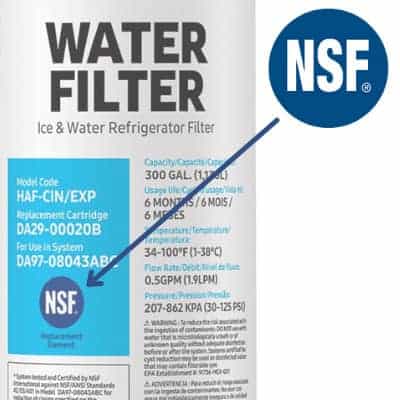
The small print matters more than the logo. A filter may be certified for chlorine taste and odor but not lead, PFAS, VOCs, or microbes. Another filter may meet the same standard for a different set of claims.
✓ QWL evidence check: Certification records, independent lab results, and hands-on use are separate proof layers.
🔎 What does NSF certified mean?
NSF is an independent organization that develops public-health standards and certifies products against them. ANSI, the American National Standards Institute, oversees the process used to develop American national standards.
When a listing says NSF/ANSI 53, for example, 53 is the standard. NSF may be the certifier, but accredited organizations such as WQA and IAPMO can also certify products to NSF/ANSI standards.
That’s why the right question isn’t simply, “Is it NSF certified?” Ask:
- Which exact model was certified?
- Who certified it?
- Which standard does it meet?
- Which contaminant claims appear in the listing?
⚠️ Certified, tested, and compliant aren’t the same
| Wording | What it usually means | What to verify |
|---|---|---|
| Certified to NSF/ANSI | A certification body evaluated the listed product and claims. | Exact model, certifier, standard, and claims. |
| Tested to NSF/ANSI | The company says testing followed part of a standard. This isn’t automatically certification. | Lab report, tested model, conditions, and whether a public certification exists. |
| Uses NSF-compliant materials | A material or component may meet a requirement. | Whether the complete filter has certified performance claims. |
Our rule: If we can’t find the exact model in a certifier’s current database, we don’t treat a logo or vague “tested to” statement as product certification.
📋 Common NSF water-filter standards
Standard numbers aren’t quality rankings. They describe different types of testing, and most require you to check the specific claims attached to the product.
Swipe on mobile to compare the standards.
| Standard | Applies to | Important limit |
|---|---|---|
| NSF/ANSI 42 | Aesthetic effects such as chlorine taste and odor or particulates. | Check the named claims. |
| NSF/ANSI 53 | Health-effect claims such as lead, cysts, or certain VOCs. | It doesn’t prove every 53 claim. |
| NSF/ANSI 58 | Reverse-osmosis systems. | Reduction claims differ by model. |
| NSF/ANSI 44 | Cation-exchange water softeners. | This isn’t a blanket drinking-water filter claim. |
| NSF/ANSI 55 | Ultraviolet microbiological treatment systems. | Class A and Class B serve different purposes. |
| NSF/ANSI 177 | Shower filters. | The standard covers free available chlorine reduction. |
| NSF/ANSI 401 | One or more emerging-compound claims. | Read the exact compound list. |
| NSF/ANSI/CAN 372 | Lead content in plumbing materials and components. | It doesn’t prove lead reduction from water. |
🧪 What certification looks like in real products
We’ve tested filters across pitchers, faucet mounts, shower filters, countertop systems, and reverse osmosis. That work has taught us to keep certification and real-world performance in separate columns.
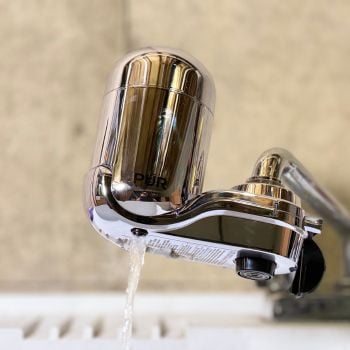
PUR Plus faucet filter: Certification records tell us which claims apply to the model. Our separate Tap Score testing found total THMs and lead below the lab’s reporting limits after filtration. We also measured a real trade-off: flow dropped from 2.29 to 0.57 gallons per minute.
ZeroWater pitcher: The certification scope and performance sheet identify the claims the pitcher is meant to meet. In our separate full-cartridge test, TDS fell from 187 ppm to below the lab’s reporting limit, and sodium, chloride, fluoride, total THMs, and lead were also below their reporting limits after filtration. Those results describe our sample, not every contaminant the pitcher could face.
Weddell Duo shower filter: Its official listing under NSF/ANSI 177 covers free available chlorine reduction. Our separate treated-water panel found THMs below reporting limits. That THM result is useful evidence, but it isn’t what the 177 certification itself promises.
That distinction matters. Certification confirms listed claims under controlled conditions. Independent lab work shows what happened in a specific water sample. Hands-on use reveals flow, cartridge life, leaks, noise, and maintenance.
🔍 How to verify a water filter in five steps
- Copy the exact model number. A product family name isn’t precise enough.
- Find the certifier. Look for NSF, WQA, IAPMO, or another accredited certification mark.
- Search the certifier’s database. Don’t rely only on an Amazon image or brand webpage.
- Read the reduction claims. “NSF/ANSI 53” alone doesn’t tell you whether that model is certified for lead, cysts, VOCs, or another claim.
- Check operating limits. Note the rated capacity, flow rate, replacement cartridge, pressure range, and any required maintenance.
NSF vs. WQA vs. IAPMO
NSF/ANSI identifies the standard, not always the organization that issued the certificate. NSF, the Water Quality Association, and IAPMO maintain product listings and can certify water-treatment products within their accredited scopes.
A valid WQA or IAPMO certification to an NSF/ANSI standard isn’t a lesser version just because the blue NSF mark isn’t on the box. What matters is whether the exact product and claim appear in the certifier’s current public listing.
🚫 What NSF certification doesn’t tell you
- Whether your water contains the contaminant the filter targets
- Whether you’ll like the taste or design
- How annoying cartridge changes will be
- How long the cartridge will last in your water
- Whether the flow rate is practical for your household
- Whether a different treatment method would fit your water better
Certification is a strong starting point, not the entire buying decision. Test your water first when the concern isn’t already known, then match the result to a verified reduction claim.
✅ The QWL bottom line
Don’t shop by the standard number alone. Verify the exact model, certification body, reduction claim, rated capacity, and replacement cartridge in the official listing.
Then look beyond the certificate. Our water-filter testing and buyer guides combine certification checks with lab data and hands-on use, because a filter can have valid claims and still be slow, expensive, or wrong for your water.