

✅ Quick answer: Clearly Filtered is our best water filter pitcher for broad contaminant reduction. Epic Pure is the better value if you want faster filtering, LARQ PureVis adds UV-C reservoir cleaning, Culligan ZeroWater is the pick for near-zero TDS, and Santevia MINA is built for people who prefer remineralized alkaline water.
🔎 Our tested picks
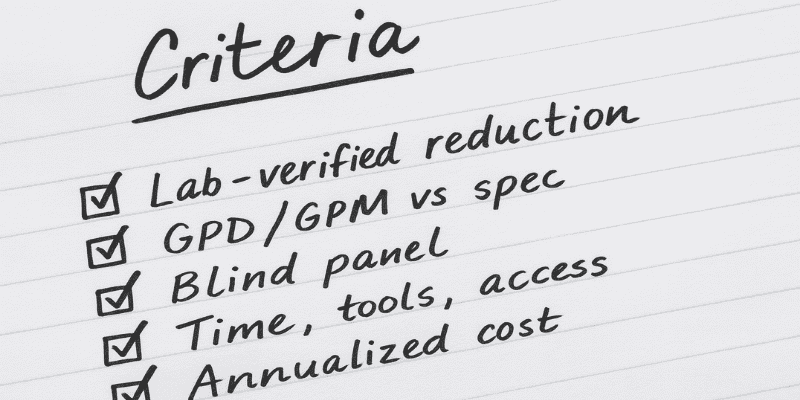
We collected finished-water samples from all five pitchers during the same 2025 testing round, timed their fill rates, and used each one in a real kitchen. We also reviewed certifications, published performance data, filter costs, and our historical city-water baseline.
- Best Overall: Clearly Filtered Water Pitcher
- Runner Up: Epic Pure Water Pitcher
- Most Innovative: LARQ PureVis Pitcher
- Best for Near-Zero TDS: Culligan ZeroWater 10-Cup Pitcher
- Alkaline Boost: Santevia Alkaline Water Pitcher
Our rankings favor verified contaminant reduction first. Taste, filter cost, fill time, build quality, and daily upkeep separate pitchers that perform similarly in the lab.
🔬 How We Test & Choose

Every pitcher went through Tap Score laboratory testing and at least a few weeks of daily use. The five finished-water samples were collected in the same 2025 testing round. Our 2022 city-water report provides historical context, but it isn’t a same-day untreated control.
How we score
We use the same seven scoring categories for every pitcher:
- Filtration performance (40%)
- Certifications and transparency (20%)
- Taste and odor (15%)
- Operating cost (10%)
- Flow rate (5%), maintenance (5%), and build quality (5%)
What earned a spot
For each pitcher we asked:
- Did it actually make the water taste better?
- Was it a pain to fill or keep clean?
- How often are you buying new filters, and what’s the yearly cost?
- Is there real third-party proof (certifications or lab data) to back up the claims?
Brita and PUR didn’t make this testing round. Brita Elite and PUR Plus are legitimate certified budget options, but we haven’t put their current filters through the same QWL laboratory and daily-use process. We won’t rank them beside tested pitchers until we do.
Best water filter pitchers compared
Swipe on mobile to compare all 5 pitchers side by side. The left column stays visible so you don’t lose your place.
| Compare Pitchers |
Best Overall
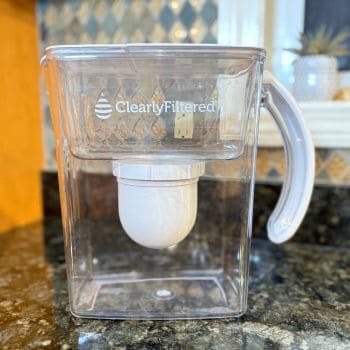 Clearly Filtered
|
Runner Up
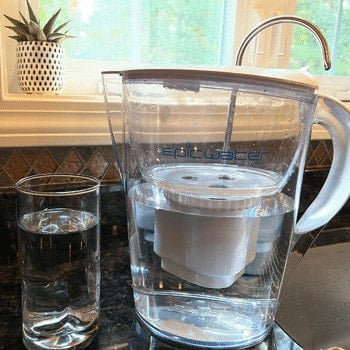 Epic Pure
|
Most Innovative
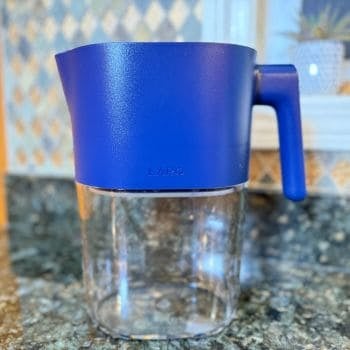 LARQ PureVis
|
Zero TDS
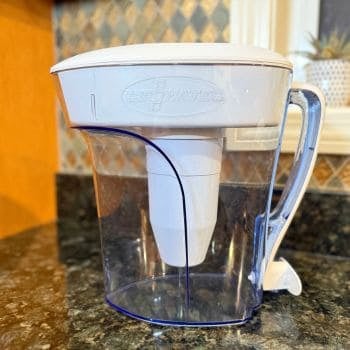 Culligan ZeroWater 10-Cup
|
Alkaline Boost
 Santevia MINA
|
|---|---|---|---|---|---|
| QWL Score | 5/5 | 4.5/5 | 4/5 | 4.2/5 | 4/5 |
| Best For | Broadest contaminant removal | Speed + value | UV hygiene between refills | Near-zero TDS | Alkaline taste + remineralization |
| Type | Granular + compound media | Solid carbon block | Nano Zero + carbon + UV-C | 5-stage ion exchange | Carbon + remineralization |
| Capacity | 10 cups | 10 cups | 8 cups | 10 cups | 9 cups |
| Upfront Price | ~$90 | ~$79 | ~$168 | ~$39 | ~$55 |
| Filter Life | ~100 gal (~4 mo) | ~100 gal | ~120 gal (~3–4 mo) | ~40 gal | ~80 gal (~2–3 mo) |
| Est. Annual Cost | ~$230/yr | ~$150–160/yr | ~$160–180/yr | ~$160–190/yr | ~$110–120/yr |
| Certifications | NSF/ANSI 42 & 372 certified + broader independent lab testing | NSF/ANSI 42 & 372 certified + broader independent lab testing | Independently tested to NSF 42/53/401 (not NSF-listed) | NSF 42 & 53 (lead, chromium) | Independent performance data (no NSF listing) |
| Targets | THMs/DBPs, lead, chromium-6, PFAS, VOCs | THMs/DBPs, lead, PFAS, VOCs, chlorine | THMs/DBPs, lead, PFAS, chlorine + UV on microbes | TDS, lead, chromium-6, chlorine byproducts | Chlorine/taste, some metals & VOCs; remineralizes |
| Proof | Tap Score: THMs ND, lead ND | Tap Score: THMs ND, lead ND | Tap Score: THMs ND in finished water | Tap Score: TDS below reporting limit | Tap Score: pH/alkalinity bump verified |
| Heads Up | Slower pour (~12 min); higher $/gal | Lid can shift if tilted; narrower coverage than CF | Higher upfront; battery needs monthly charge | Short ~40-gal life; taste can feel flat | Narrower scope; lighter build; more swaps |
| Skip If | You want the fastest pour or lowest running cost | You need the broadest contaminant coverage | You want lowest cost or nothing to charge | You want long filter life or dislike flat taste | You need broad, NSF-certified contaminant removal |
| Read More | Jump to review | Jump to review | Jump to review | Jump to review | Jump to review |
#1. Clearly Filtered – Best Overall
- Filtration Performance 40% 5/5
- Certifications & Transparency 20% 5/5
Full scoring basis
- Filtration Performance (40%): Score: 5/5 — Proprietary carbon + specialty media cuts chlorine, fluoride, lead, PFAS, and more.
- Certifications & Transparency (20%): Score: 5/5 — NSF/ANSI 42 & 372 certification plus published independent data covering 386+ contaminants.
- Taste & Odor (15%): Score: 4.5/5 — Clear, crisp taste with chemical notes removed.
- Operating Cost (10%): Score: 4/5 — ~$0.50/gal; filters ~$50 each, ~100 gal life (~4 months).
- Flow/Pressure (5%) — Score: 4/5
- Install/Maint (5%) — Score: 4.5/5
- Build (5%) — Score: 5/5
- Overall: 4.8/5 — weighted average of the factors above
Clearly Filtered is our best overall pick because it combines the broadest published contaminant testing in this group with a 100-gallon filter and straightforward daily use.
Our 2025 finished-water sample reported chloroform and the other measured THMs below the laboratory reporting limits. The test supports the clean result we measured, although the older city-water baseline wasn’t a same-day control.
Why We Like It
- Chloroform was not detected in the finished-water sample
- Also reduced other disinfection byproducts (THMs)
- Noticeably cleaner taste with less chlorine bite
- Large 10-cup design still fits in fridge doors
- Covered by a lifetime warranty (rare for pitchers)
What Could Be Better
- Filters are pricey (~$0.50 per gallon)
- Slower flow compared to Brita
QWL Readers Get 10% Off – Auto-Applied
Best for households that want broad contaminant coverage and stronger testing documentation, even if that means accepting a slower fill and higher filter cost.
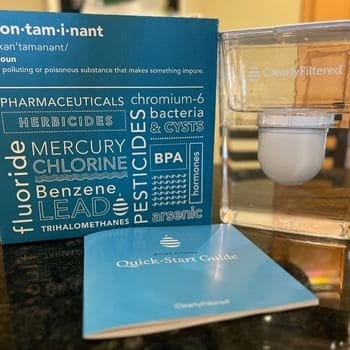
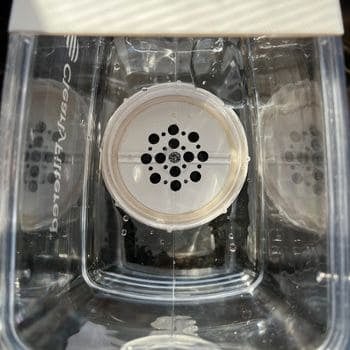
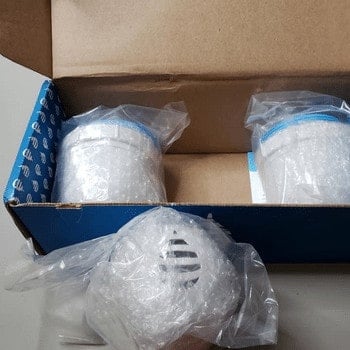
⏱️ Timelapse demo — actual fill time: 11 minutes 52 seconds.
🔬 Tap Score Lab Results — Clearly Filtered Pitcher
| Parameter | 2022 baseline | 2025 filtered | Difference |
|---|---|---|---|
| Chlorine iTaste & odor; EPA MCL = 4 ppm | 1.6 ppm | NDRemoved | −100% |
| Total THMs iDisinfection byproducts; EPA MCL = 80 ppb | 31.83 ppb | NDRemoved | −100% |
| Chloroform (THM) | 21.57 ppb | NDRemoved | −100% |
| Bromodichloromethane | 7.93 ppb | NDRemoved | −100% |
| Dibromochloromethane | 2.33 ppb | NDRemoved | −100% |
| Sodium | 46.3 ppm | 91.8 ppm | +98% |
| Chloride | 67.3 ppm | 101 ppm | +50% |
| Total Dissolved Solids (TDS) | 187 ppm | 303 ppm | +62% |
| Barium iEPA MCL = 2 ppm | 0.01 ppm | NDRemoved | −100% |
Context & Methods
“ND” means not detected above the laboratory reporting limit. The 2022 untreated result is historical context, not a same-day control, so the table compares two snapshots rather than a controlled removal rate. Chlorine came from our separate at-home test strip; it wasn’t included in the 2022 laboratory panel.
Historical baseline (Advanced City Test, Jul 2022):
View baseline report (PDF)
Post-test (Clearly Filtered Pitcher, Sep 2025):
View post-test report (PDF)
🧾 How Clearly Filtered Scored
Clearly Filtered topped our ranking because its 2025 finished-water report showed the measured THMs below reporting limits and the company publishes unusually broad independent contaminant data. That combination is more useful than a TDS reading alone.
On the user side, the water tasted noticeably cleaner — crisp and free of chlorine bite — though the pour speed is slower than Epic’s pitcher. Filters last about 100 gallons (~4 months), which works out to ~$0.50 per gallon. It’s pricier to maintain than the other pitchers on our list, but you’re paying for a dense filter media that actually delivers on performance. Build quality feels solid and fridge-friendly, with a simple design that holds up to daily use.
Bottom line: If you want verified contaminant removal and don’t mind slower pours or higher cost, this is it.
Read our full review: Clearly Filtered Water Pitcher Review
#2. Epic Pure – Runner up
- Filtration 40% 4.5/5
- Taste & Odor 20% 4.5/5
Full scoring basis
- Filtration (40%): Score: 4.5/5 — Solid carbon block targets fluoride, chlorine, lead, PFAS, and more — broad coverage for a pitcher.
- Taste & Odor (20%): Score: 4.5/5 — Produces clean, neutral-tasting water with strong chlorine reduction.
- Value (15%): Score: 4/5 — 150-gallon lifespan means only ~3 swaps per year; averages ~$0.35/gal.
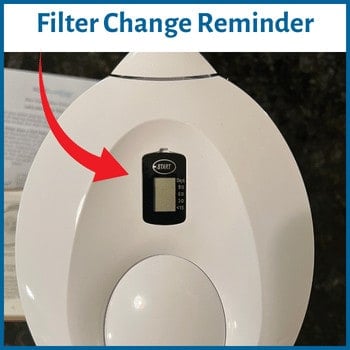
- Build Quality (15%): Score: 4.5/5 — BPA-free Tritan feels sturdy; LED timer adds convenience.
- Ease of Use (10%): Score: 4.5/5 — Standard 10-cup size fits most fridges; refill and pour are straightforward.
- Transparency (5%) — Score: 4/5
- Warranty (5%) — Score: 4/5
- Overall Value (5%) — Score: 4.5/5
- Overall: 4.4/5 — weighted average of the factors above
In our 2025 test, the Epic Pure finished-water sample reported the measured THMs below laboratory reporting limits. Lead was not detected in either the historical baseline or the finished-water sample.
It’s not as exhaustive as Clearly Filtered, but with faster flow and longer filter life, it’s the more practical choice for everyday use.
What We Like
- Faster pour speed than Clearly Filtered, so less waiting around
- Current replacement filter is rated for 100 gallons
- Noticeable chlorine taste and odor reduction in everyday use
- Sturdy build backed by a lifetime warranty
What Could Be Better
- Lid can shift or pop off if you tilt hard to get the last bit of water
- Not dishwasher safe — requires hand-washing
- Clean taste, but lacks the extra “crispness” of the top performer
Best for: Households that want a longer-lasting pitcher filter with solid everyday performance at a lower ongoing cost.
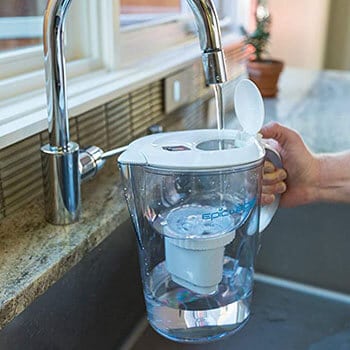
🔬 Tap Score Lab Results — Epic Pure Pitcher
| Parameter | 2022 baseline | 2025 filtered | Difference |
|---|---|---|---|
| Total THMs iEPA MCL: 80 ppb | 31.83 ppb | NDRemoved | −100% |
| Chloroform (THM) | 21.57 ppb | NDRemoved | −100% |
| Bromodichloromethane | 7.93 ppb | NDRemoved | −100% |
| Dibromochloromethane | 2.33 ppb | NDRemoved | −100% |
| Lead iEPA Action Level: 15 ppb | ND | ND | ND in both |
| Fluoride | ND | ND | ND in both |
| Barium iEPA MCL: 2 ppm | 0.010 ppm | 0.033 ppm | +230% |
| Total Dissolved Solids (TDS) | 187 ppm | 289 ppm | +55% |
Context & Methods
“ND” means not detected above the laboratory reporting limit. The 2022 report is historical context rather than a same-day untreated control. Lead and fluoride were not detected in that baseline, so this comparison can’t establish removal percentages for either one.
Historical baseline (Advanced City Test, 2022):
View baseline report (PDF)
Post-test (after filtration with Epic Pure Pitcher):
View post-test report (PDF)
⏱️ Timelapse demo — actual fill time: 10 minutes 48 seconds.
🧾 How Epic Scored
Epic held its own in the testing round, with the measured THMs reported below laboratory reporting limits and a faster fill than Clearly Filtered. Its published contaminant data isn’t as extensive as Clearly Filtered’s, but it remains the stronger value choice.
One correction matters here: the 0.5 ppb figure in our historical report was the laboratory detection limit, not a measured lead result. Lead was reported as not detected before and after filtration, so this test can’t be used to calculate Epic’s lead-removal percentage.
Our sample also showed a rise in TDS and barium, a result of mineral exchange inside the filter. Both remained well within safe limits, and the water still tasted cleaner in day-to-day use.
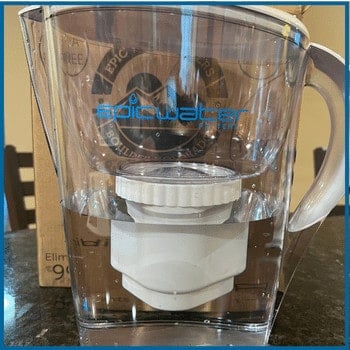
Epic filled faster than Clearly Filtered in our timed test. The current Pure XP replacement filter is rated for 100 gallons, so actual annual cost depends heavily on household use and local water quality. Build quality is solid, although the lid can feel loose when the pitcher is tilted.
👉 Epic Pure is the better fit when you want balanced contaminant coverage, faster filtering, and a lower purchase price than Clearly Filtered.
Read our Full Review: Epic Filter Pitcher Review
#3. LARQ PureVis
- Filtration 35% 4/5
- Taste & Odor 20% 4/5
Full scoring basis
- Filtration (35%): Score: 4/5 — Carbon + NanoZero filter reduces chlorine byproducts, heavy metals, PFAS, and more; UV-C adds microbial protection.
- Taste & Odor (20%): Score: 4/5 — Noticeably cleaner taste, though minerals remain for a more natural profile compared to ZeroWater.
- Tech & Features (15%): Score: 4.5/5 — UV wand keeps the reservoir clean; app + LED timer track filter life — rare extras for a pitcher.
- Value (15%): Score: 3.5/5 — Shorter filter life (~60 gallons standard, 120 with Long-Last) raises cost to ~$0.50+/gal.
- Build Quality (15%): Score: 4.5/5 — Apple-like packaging, sleek design, and durable construction stand out, though price is steep.
- Transparency (5%) — Score: 3.5/5
- Warranty (5%) — Score: 4/5
- Overall Value (5%) — Score: 4/5
- Overall: 4/5 — weighted average of the factors above
The LARQ PureVis isn’t just another pitcher — it filters and uses UV light to keep the reservoir clean, a feature none of the others on our list offer.
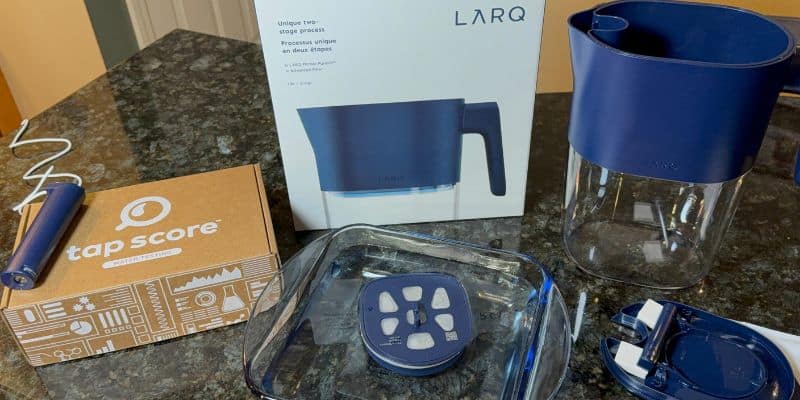
In our test, water tasted fresh and crisp, and setup took just five minutes after charging the UV wand. The app is straightforward and tracks filter life automatically.
Even the unboxing felt premium — triple-layer wrapping and a build quality that rivals Apple gear.
What We Like
- UV-C wand keeps the pitcher chamber clean by preventing bacteria growth
- Sleek, premium design — feels more like a tech product than a kitchen gadget
- App setup is intuitive and adds helpful filter-life tracking
- Faster flow rate than Clearly Filtered or Epic (~3m45s full fill in our test)
- Build feels sturdy and durable, with thoughtful packaging and design touches
What Could Be Better
- Higher upfront price ($168) compared to most pitchers
- Shorter filter lifespan (~60 gallons standard, ~120 with Long-Last) drives up cost/gal
- Doesn’t reduce sodium and chloride as effectively as competitors like Clearly Filtered
- Needs battery charging for UV wand (about once a month)
Best for: Tech-forward users concerned about bacteria buildup, with UV purification for peace of mind.
🔬 Tap Score Lab Results — LARQ Pitcher
| Parameter | 2022 baseline | 2025 filtered | Difference |
|---|---|---|---|
| Total THMs iEPA MCL: 80 ppb | 31.83 ppb | NDRemoved | −100% |
| Chloroform (THM) | 21.57 ppb | NDRemoved | −100% |
| Bromodichloromethane | 7.93 ppb | NDRemoved | −100% |
| Dibromochloromethane | 2.33 ppb | NDRemoved | −100% |
| Lead iEPA Action Level: 15 ppb | ND | ND | ND in both |
| Fluoride | ND | ND | ND in both |
| Sodium | 46.3 ppm | 25.1 ppm | −46% |
| Chloride | 67.3 ppm | 98.6 ppm | +46% |
| Total Dissolved Solids (TDS) | 187 ppm | 320 ppm | +71% |
Context & Methods
“ND” means not detected above the laboratory reporting limit. The 2022 report is historical context rather than a same-day untreated control. Lead and fluoride were not detected in that baseline, so this comparison can’t establish removal percentages for either one.
Historical baseline (Advanced City Test, 2022):
View baseline report (PDF)
Post-test (after filtration with LARQ Pitcher):
View post-test report (PDF)
⏱️ Timelapse demo — actual fill time: 3 minutes 45 seconds
🧾 How LARQ Scored
LARQ PureVis stood out as the only pitcher in this group combining a replaceable filter with UV-C treatment inside the reservoir. The 2025 finished-water report showed the measured THMs below reporting limits, while the UV system addresses microbial growth inside the pitcher rather than contaminants entering from the tap.
On the usability side, setup took a bit longer than others since you need to charge the UV battery and activate the filter before use, but once running the app makes tracking filter life and PureVis cycles straightforward. In our trial, it filled in ~3 minutes 45 seconds, faster than Clearly Filtered, and the water tasted neutral with no trace of chlorine bite.
Filters last about 60 gallons (~2 months) with the Standard cartridge or up to 120 gallons (~4 months) with the Long-Last, putting cost at ~$0.50–$0.55 per gallon — similar to Clearly Filtered, but more than Epic. Build quality is solid, with Apple-like packaging and a reservoir that feels premium and durable.
Bottom line: If you want a pitcher that not only filters but also keeps your water chamber clean between refills, LARQ is the one to beat. It’s not the cheapest, but it offers a level of tech and reassurance others don’t.
#4. ZeroWater
- Filtration 35% 4.5/5
- Taste & Odor 20% 3.5/5
Full scoring basis
- Filtration (35%): Score: 4.5/5 — Excels at removing dissolved solids, heavy metals like lead, and chlorine byproducts.
- Taste & Odor (20%): Score: 3.5/5 — Produces ultra-clean, almost distilled-like taste — though some find it too flat.
- Value (15%): Score: 3.5/5 — Filters only last ~40 gallons; cost works out closer to ~$0.50–0.70/gal.
- Build Quality (15%): Score: 4/5 — Standard plastic pitcher design; comes with free TDS meter but lid fit is just average.
- Ease of Use (15%): Score: 4.5/5 — Quick setup, spigot and pour spout; built-in meter makes monitoring easy.
- Transparency (5%) — Score: 4/5
- Warranty (5%) — Score: 3.5/5
- Overall Value (5%) — Score: 4/5
- Overall: 4/5 — weighted average of the factors above
In our test, the ZeroWater 10-Cup Pitcher lived up to its name — cutting total dissolved solids from 187 ppm to nearly zero using its 5-stage ion exchange filter.
It doesn’t polish flavor as well as Clearly Filtered, but if your top priority is reducing TDS and heavy metals like lead, ZeroWater stands out as the clear winner.
What We Like
- Drops TDS readings close to 0 ppm (we saw 0–11 ppm in testing with the included meter)
- Strong reduction of heavy metals including lead and chromium-6
- Affordable upfront cost compared to other pitchers
- Built-in spigot + pour spout add convenience
What Could Be Better
- Short filter life (~40 gallons), meaning more frequent replacements ($0.50–$0.70 per gallon)
- Water can taste “too flat” since minerals are stripped out completely
- Slower pour rate compared to Brita or Epic
- Lid fit can be finicky if pouring at an angle
Best for: Budget buyers who want “distilled-like” water with TDS readings at or near zero.
🔬 Tap Score Lab Results — ZeroWater 10-Cup Pitcher
| Parameter | 2022 baseline | 2025 filtered | Difference |
|---|---|---|---|
| Total THMs iEPA MCL: 80 ppb | 31.83 ppb | NDRemoved | −100% |
| Chloroform (THM) | 21.57 ppb | NDRemoved | −100% |
| Bromodichloromethane | 7.93 ppb | NDRemoved | −100% |
| Dibromochloromethane | 2.33 ppb | NDRemoved | −100% |
| Lead iEPA Action Level: 15 ppb | ND | ND | ND in both |
| Fluoride | ND | ND | ND in both |
| Sodium | 46.3 ppm | NDRemoved | −100% |
| Chloride | 67.3 ppm | NDRemoved | −100% |
| Total Dissolved Solids (TDS) | 187 ppm | NDRemoved | −100% |
Context & Methods
“ND” means not detected above the laboratory reporting limit. The 2022 report is historical context rather than a same-day untreated control. Lead and fluoride were not detected in that baseline, so this comparison can’t establish removal percentages for either one.
Historical baseline (Advanced City Test, 2022):
View baseline report (PDF)
Post-test (after filtration with ZeroWater 10-Cup Pitcher):
View post-test report (PDF)
⏱️ Timelapse demo — actual fill time: 7 minutes 07 seconds
🧾 How ZeroWater Scored
ZeroWater is the only pitcher we tested that actually took TDS all the way down to zero — at least on some runs. Using the included meter, we saw readings bounce between 0, 3, and 11 ppm, which is still a dramatic drop from our 187 ppm baseline. That makes it the go-to option if your main concern is stripping everything out of your water.
The tradeoff is taste. With all the minerals gone, the water comes across cleaner but a bit flat compared to Clearly Filtered or Epic. Filters also burn out quicker — usually around 40 gallons — so you’ll be swapping them more often at a cost of about $0.50–$0.70 per gallon. On the plus side, the 10-cup design is handy, the spigot makes filling bottles easier, and the build is decent for the price, though the lid sometimes shifts if you pour at an angle.
Bottom line: If you want that “zero TDS” reading and don’t mind flatter water or higher ongoing costs, ZeroWater does exactly what it claims.
#5. Santevia Alkaline Water Pitcher
- Filtration 35% 3.5/5
- Taste & Odor 20% 4.5/5
Full scoring basis
- Filtration (35%): Score: 3.5/5 — Reduces chlorine and some metals while boosting alkalinity with added minerals.
- Taste & Odor (20%): Score: 4.5/5 — Water tastes smoother and less acidic thanks to pH raise and mineral boost.
- Value (15%): Score: 4/5 — Affordable upfront (~$55) but higher replacement cost than budget filters; ~$0.25/gal.
- Build Quality (15%): Score: 3.5/5 — Simple BPA-free build; lighter than premium models but sturdy enough.
- Ease of Use (15%): Score: 4/5 — Setup is quick; pitcher pours easily but filters need swapping ~every 2–3 months.
- Transparency (5%) — Score: 3.5/5
- Warranty (5%) — Score: 3.5/5
- Overall Value (5%) — Score: 4/5
- Overall: 3.8/5 — weighted average of the factors above
In our testing, the Santevia didn’t just cut down on chlorine taste — it also changed the feel of the water. The pH nudged upward and the flavor took on a smoother, softer edge compared to ZeroWater or Epic.
That’s because Santevia goes beyond basic filtration by adding back minerals like calcium and magnesium.
It’s the only pitcher we tried that both reduces contaminants and boosts alkalinity, making it a good fit if you prefer water that tastes more “rounded” than flat.
What We Like
- Only pitcher in our lineup that adds back minerals (calcium, magnesium, potassium)
- Noticeably smoother, less acidic taste after filtering — good for folks sensitive to water harshness
- Raises pH by up to +2.0 in testing, depending on source water
- Affordable upfront cost (~$55), making it one of the most budget-friendly pitchers
- Simple setup and lightweight build makes it easy for daily use
What Could Be Better
- Doesn’t remove as wide a range of contaminants as premium models like Clearly Filtered
- Filter life (~80 gallons) means more frequent swaps than Epic or LARQ
- No NSF/ANSI certification, so performance data comes only from manufacturer testing
- Build feels lighter and less durable than higher-end pitchers
Best for: Anyone wanting budget-friendly filtration with the added perk of higher pH and mineralized water.
🔬 Tap Score Lab Results — Santevia MINA Pitcher
| Parameter | 2022 baseline | 2025 filtered | Difference |
|---|---|---|---|
| Total THMs iEPA MCL: 80 ppb | 31.83 ppb | NDRemoved | −100% |
| Chloroform (THM) | 21.57 ppb | NDRemoved | −100% |
| Bromodichloromethane | 7.93 ppb | NDRemoved | −100% |
| Dibromochloromethane | 2.33 ppb | NDRemoved | −100% |
| Alkalinity (as CaCO₃) | 40 ppm | 60 ppmIncreased | +50% |
| pH | 7.4 | 7.5 | +0.1 |
| Total Dissolved Solids (TDS) | 187 ppm | 332 ppmIncreased | Historical context |
Context & Methods
“ND” means not detected above the laboratory reporting limit. The 2022 report is historical context rather than a same-day untreated control. The finished-water result showed higher alkalinity, pH, and TDS than the historical sample, which is directionally consistent with Santevia’s remineralization design but isn’t a controlled before-and-after measurement.
Historical baseline (Advanced City Test, 2022):
View baseline report (PDF)
Post-test (after Santevia MINA Pitcher):
View post-test report (PDF)
⏱️ Timelapse demo — actual fill time: 4 minutes 55 seconds
🧾 How Santevia MINA Scored
In our testing, the Santevia MINA reduced chlorine byproducts and heavy metals while leaving behind calcium and magnesium that boosted pH. It didn’t polish water as crisp as Clearly Filtered or ZeroWater, but it stood out as the only pitcher to actively remineralize, raising alkalinity for a smoother taste.
Day-to-day, the water felt softer and less acidic, though not everyone may prefer the subtle mineral notes. Filters last ~80 gallons (about 2–3 months), which keeps the per-gallon cost lower than LARQ or Clearly Filtered. Build quality is solid for the price, and the simple lid + handle design makes it easy to use without much fuss.
Bottom line: If you want a budget-friendly pitcher that both filters and adds back minerals for alkaline water, the MINA is the one to grab.
📘 Buyer’s Guide
Not every water filter pitcher is built the same — and picking the wrong one can mean slow pours, pricey filters, or only getting surface-level protection. Some models excel at broad contaminant removal, others at taste, speed, or convenience. The best choice depends on what matters most in your kitchen.
That’s why we tested and broke down each pitcher on the three factors that actually matter in daily use:
- Filtration performance → what it removes (and what it doesn’t)
- Speed & usability → how long you’ll wait for a full pitcher
- Cost of ownership → filter life, price, and annual replacement costs
The tables below give you a side-by-side look at all five pitchers, followed by deeper insights into speed, value, and taste.
| Pitcher | Capacity | Fill Time | Notes |
|---|---|---|---|
| Clearly Filtered | 10 cups | 11m 52s | Slowest in lineup |
| Epic Pure | 10 cups | 10m 48s | Still slower than average |
| LARQ PureVis | 8 cups | 3m 45s | Fastest in lineup |
| ZeroWater | 10 cups | 7m 07s | Balanced speed & performance |
| Santevia MINA | 9 cups | 4m 55s | Quick, smooth pour |
📌 Take Note: A few minutes might not seem like much, but when you’re refilling every day, the difference between 4 minutes and 12 minutes adds up fast.
💰 Cost of Ownership
Sticker price matters, but what really adds up is the cost of filters. Some pitchers need swaps every couple of months, others stretch closer to half a year. Over time, that gap can mean the difference between spending $100 a year or $300+.
🧮 Helpful to Know: Annual costs vary with household size. Our estimates assume ~2 gallons/day — families may spend 2–3× more.
Here’s how the five stack up:
| Pitcher | Filter Life | Cost per Filter | Swaps/Year | Annual Cost |
|---|---|---|---|---|
| Clearly Filtered | 100 gal | ~$50 | 4–5 | ~$230 |
| Epic Pure | 100 gal | ~$50 | 3 | ~$155 |
| LARQ PureVis (Long-Last) | 120 gal | ~$45 | 3–4 | ~$170 |
| ZeroWater | 40 gal | ~$15 | 11–12 | ~$175 |
| Santevia MINA | 80 gal | ~$20 | 6 | ~$116 |
📌 Take Note: Over three years, filter swaps often cost more than the pitcher itself — especially for high-consumption households.
🧪 Contaminant Reduction
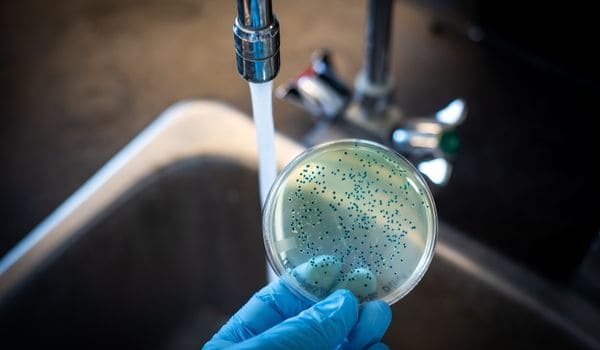
In our testing, the biggest difference between pitchers wasn’t speed — it was what they actually removed. ZeroWater, for example, is laser-focused on TDS, while Clearly Filtered and Epic Pure go after hundreds of contaminants including PFAS, heavy metals, and VOCs.
Large contaminant counts sound impressive, but the useful questions are which claims are formally certified, which come from independent testing, and whether the test applies to the current filter.
Here’s how the five compare:
| Pitcher | Reported Contaminants Removed* | Certifications / Claims |
|---|---|---|
| Clearly Filtered | 386+ tested claims | NSF/ANSI 42 & 372 certified; broader independent lab reports |
| Epic Pure | 200+ | NSF/ANSI 42, 53, 401; third-party lab tested |
| ZeroWater | 23 (per NSF data) | NSF/ANSI 42, 53; strongest on TDS removal |
| LARQ PureVis | ~80–100 | Independent testing; UV adds bacteria control |
| Santevia MINA | ~30+ | Independent testing; focused on chlorine, some metals, VOCs, plus remineralization |
*Manufacturer and independent lab claims; not all are NSF-certified. NSF 42 covers chlorine/taste, while 53, 401, and 473 cover health-related contaminants such as lead, VOCs, and PFAS.
🧠 Good to Know: Pitchers like Clearly Filtered and Epic Pure advertise hundreds of contaminants removed — but only certifications prove it. Always look for NSF/ANSI numbers, not just marketing claims.
💧 Taste & Minerals
Clean water isn’t just about what’s removed — it’s also about how it tastes once it hits the glass. Some pitchers strip everything out, leaving water flat or neutral, while others add back minerals for a smoother, alkaline profile. In our testing, this was one of the biggest “feel” differences between models.
Here’s the quick breakdown:
| Pitcher | Adds Minerals? | Taste Profile | Notes |
|---|---|---|---|
| Clearly Filtered | No | Crisp, clean | Best for cutting chlorine bite |
| Epic Pure | No | Clean, balanced | Similar to CF, slightly slower flow |
| ZeroWater | No | Neutral, flat | All minerals stripped out (0 TDS) |
| LARQ PureVis | No | Fresh, neutral | UV keeps pitcher fresher longer |
| Santevia MINA | Yes (Ca, Mg, K) | Smooth, alkaline | pH boost ~+2.0, softer taste |
💧 Helpful to Know: “Zero” TDS doesn’t always mean better taste — some people prefer the smoother, mineral-rich water from pitchers like Santevia.
⚖️ Should You Care About TDS?

TDS stands for Total Dissolved Solids — minerals, salts, and metals dissolved in water. Some are beneficial (like calcium and magnesium), while others are harmless fillers (like sodium or chloride).
Why TDS can be high:
- Seasonal shifts in water sources (e.g., reservoirs vs. wells).
- Added treatment chemicals (like chlorine, chloramine, or fluoride).
- Natural geology (limestone = higher calcium/magnesium).
- Household plumbing (copper, lead, or iron leaching trace amounts).
👉 Important: A high TDS reading doesn’t automatically mean unsafe water. It just shows there’s more “stuff” in your water — not whether it’s good or bad.
- ZeroWater & RO systems: strip everything, giving a flat, “empty” taste.
- Pitchers like Clearly Filtered, Epic, LARQ: focus on harmful contaminants (lead, THMs, PFAS) while leaving minerals behind. That’s why TDS may stay steady or rise slightly — and that’s not a flaw.
Want the full breakdown? See our guide: How to Reduce TDS in Water.
💧 City Water vs. Well Water
Pitcher filters are designed for treated municipal water, not private wells. City water typically has chlorine and disinfection byproducts (THMs, PFAS, metals) — exactly what pitchers excel at reducing.
Well water, on the other hand, can contain bacteria, iron, manganese, or sulfur — contaminants pitchers aren’t built to handle. If you’re on a private well, you’ll want a dedicated whole house or under-sink system rated for microbial and heavy-metal removal. Pitchers can still polish taste, but they aren’t a primary safety solution.
Pitchers are great for improving drinking water with no install, but they are not built for every job. If you need higher daily capacity, faster flow, RO-level contaminant reduction, faucet-mounted convenience, or whole-home treatment, use our home water filter comparison guide to compare the main filter types side by side.
🔍 Certifications
Big contaminant claims don’t mean much without testing or certifications to back them up. NSF/ANSI standards are the benchmark — but each one covers something different:
- NSF/ANSI 42 → chlorine, taste, and odor
- NSF/ANSI 53 → heavy metals like lead, VOCs, and pesticides
- NSF/ANSI 401 → “emerging contaminants” (pharmaceuticals, BPA, etc.)
- NSF/ANSI 473 → PFAS reduction
Other credible bodies include the WQA product listings and IAPMO certification database.
Some pitchers only meet taste standards, while others go much deeper. Independent lab reports can also add credibility when full NSF certification isn’t published.
Here’s how each pitcher stacks up:
| Pitcher | Certifications / Testing | Transparency |
|---|---|---|
| Clearly Filtered | NSF/ANSI 42 & 372 certified; broader independent contaminant testing | High — publishes reports + certification details |
| Epic Pure | NSF/ANSI 42, 53, 401; independent third-party lab tested | High — makes test data available |
| ZeroWater | NSF/ANSI 42 & 53 (lead, chromium); focus on TDS removal | Moderate — publishes some certs, less broad coverage |
| LARQ PureVis | Independent testing for chlorine, bacteria; UV for microbes | Moderate — transparency improving, but limited NSF certs |
| Santevia MINA | Independent testing for chlorine + metals; no NSF listings | Low — focuses on performance claims without cert detail |
🔍 Good to Know: NSF 42 only guarantees chlorine and taste improvement — for real contaminant protection, look for 53, 401, or independent lab data.
📝 Final Thoughts
Choosing the right water filter pitcher isn’t about chasing the biggest number on the box — it’s about matching the pitcher to your needs.
- If broad contaminant protection is your priority, Clearly Filtered delivers the widest coverage, though at a higher cost and slower flow.
- If you want a solid all-arounder with good speed and balanced cost, Epic Pure is a strong middle ground.
- For those chasing zero TDS and crystal-clear taste in coffee or tea, ZeroWater stands out — just know filters won’t last long in high-TDS areas.
- If you value tech and low-maintenance, LARQ’s UV system keeps things fresher with less fuss.
- And if you prefer a smoother, alkaline taste at the lowest cost of ownership, Santevia MINA is the budget-friendly pick.
At the end of the day, every pitcher here improves your water — it just comes down to whether you care more about speed, cost, taste, or contaminant coverage. Use the tables above as your shortcut, and you’ll land on the one that actually fits your kitchen.