
Water Filter Micron Ratings: Chart and Size Guide

Mike Martin brings hands-on installation experience and helps validate the real-world setup and serviceability of the systems we cover.
✅ Quick answer: A lower micron rating catches smaller particles, but it can also clog faster and restrict flow. For sediment, start coarse and filter finer in stages. For cyst protection, look for an absolute 1-micron rating or a certified cyst-reduction claim, not just a small number on the label.
A micron, written as µm, is one-millionth of a meter. The rating helps describe particle filtration, but it doesn’t tell you whether a filter removes dissolved chemicals, hardness, chlorine, lead, bacteria, or viruses.

📏 Water Filter Micron Rating Chart
Use this chart as a starting point. The right size depends on what is in your water, whether the rating is nominal or absolute, and how much flow the filter needs to support.
| Micron rating | Practical use | Main trade-off |
|---|---|---|
| 100–50 micron | Coarse sand, grit, and larger visible sediment | Good flow, but smaller particles pass through |
| 20 micron | General sediment prefiltration and larger rust particles | More protection than a coarse screen without going very fine |
| 10–5 micron | Finer sediment, silt, and final-stage sediment polishing | Can clog quickly when sediment levels are high |
| 1 micron | Very fine particles; cyst protection only with the right absolute or certified filter | Greater pressure-drop and replacement risk |
| 0.5 micron | Fine point-of-use filtration, often with a carbon block | Needs adequate surface area and timely replacement |
Important: These are practical roles, not universal removal guarantees. A nominal 5-micron cartridge and an absolute 5-micron cartridge don’t perform the same way.
Is a Higher or Lower Micron Rating Better?
Neither is automatically better. A lower number filters smaller particles; a higher number usually preserves flow and holds more coarse debris before clogging.
If well water carries visible sand, forcing all of it through a 1-micron cartridge is a quick way to shorten filter life. A coarse spin-down filter or larger-micron cartridge can take the first hit, followed by a finer stage for the sediment that remains.
At a single drinking-water faucet, a fine filter has far less flow to support. That’s why a 0.5-micron carbon block can make sense under the sink even when the same rating would be too restrictive as the first filter for an entire house.
🔍 Absolute vs. Nominal Micron Ratings
An absolute rating sets a maximum pore size: the filter’s pores are that size or smaller. A nominal rating is an average or manufacturer-defined efficiency, so some larger particles may still pass.
| Rating | What it tells you | Best use |
|---|---|---|
| Absolute | A defined maximum pore size | When consistent particle exclusion matters |
| Nominal | An approximate rating tied to a stated or unstated efficiency | Routine sediment reduction where some variation is acceptable |
Don’t assume “absolute” means a universal 99.9% removal rate. Check the manufacturer’s test method, efficiency at the stated particle size, and third-party certification. The CDC also recommends checking a filter’s pore-size wording and NSF certification when choosing protection against germs.
What Different Micron Sizes Can Catch
Micron ratings are most useful for particles: sand, grit, rust flakes, silt, and some cysts. They become less useful when the contaminant is dissolved in the water.
- 50–100 micron: coarse, visible material that can settle or collect in a screen.
- 20 micron: a common first disposable stage for water carrying larger sediment.
- 5 micron: finer sediment polishing after the heaviest material has been removed.
- 1 micron absolute: may be used for cyst reduction when the product carries the appropriate claim or certification.
- 0.5 micron: often found in point-of-use carbon blocks that combine fine particle filtration with adsorption.
Particle sizes overlap, and real water isn’t a tidy laboratory sample. Clay, corrosion debris, and iron can appear in different forms, so testing the water is more reliable than guessing from color alone.
What a Micron Rating Doesn’t Tell You
A micron number doesn’t prove that a filter reduces chlorine, PFAS, dissolved lead, hardness minerals, nitrates, or other chemicals. Those results depend on the media, contact time, capacity, and validated performance claims.
For example, a carbon block may carry a fine micron rating while also adsorbing chlorine and some organic contaminants. The micron number describes its physical filtration, not the full chemical-removal performance.
Reverse osmosis is also a separate membrane process. Comparing an RO membrane’s separation performance with a standard sediment cartridge by micron number alone can be misleading.
🧪 What We Learned From Real Flow and Clogging
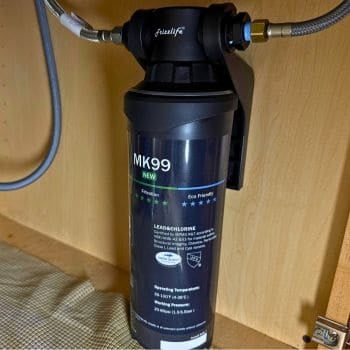
We tested a Frizzlife MK99 with a 0.5-micron carbon block at a kitchen faucet. It filled a one-gallon container in 38 seconds, about 1.65 gallons per minute, while improving the water’s taste. That shows a fine point-of-use filter can still deliver useful flow when the system is sized for one faucet.
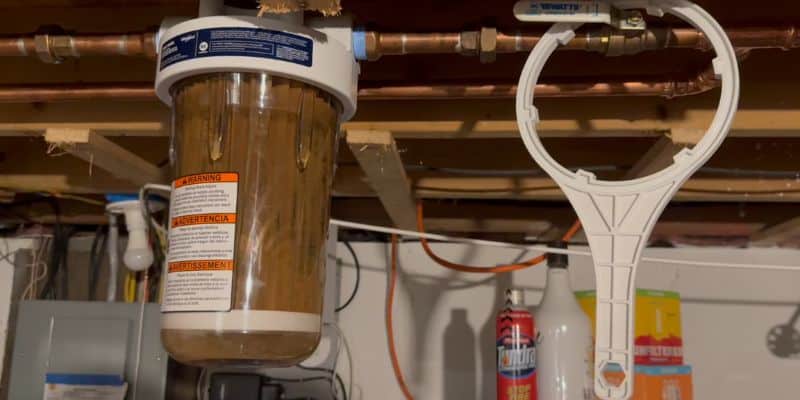
Whole-house demand exposed the opposite problem in another home. A cartridge inside a Whirlpool WHKF-DWHBB housing had been left in service for months beyond its replacement date while treating water with heavy sediment and iron. One faucet seemed normal, but running the shower, washer, and kitchen faucet together caused a sharp drop in flow.
The lesson wasn’t that one micron size is bad. It was that filter area, sediment load, replacement timing, and peak household demand matter just as much as the number printed on the cartridge.
Common Micron Rating Comparisons
1 Micron vs. 5 Micron
A 1-micron filter targets finer particles than a 5-micron filter, but it usually loads sooner. Choose 1 micron when that extra particle control is supported by the product’s efficiency or certification. Choose 5 microns when sediment polishing and longer service life are the priority.
5 Micron vs. 20 Micron
A 20-micron cartridge is better suited to catching larger debris upstream. A 5-micron stage catches finer material downstream. On dirty well water, using both in sequence often makes more sense than asking the 5-micron filter to handle everything.
50 Micron vs. 100 Micron
Both are coarse options. A 100-micron screen favors flow and catches larger grit; 50 microns provides finer screening with somewhat greater restriction. The visible sediment load should decide which one starts the treatment train.
What Micron Filter Is Best for Well Water?
There isn’t one best rating for every well. Match the stages to the water:
- Test first. Identify sediment, iron, manganese, hardness, and any health-related contaminants.
- Remove coarse debris first. Use a spin-down screen or larger-micron stage when sand and grit are present.
- Polish finer sediment next. Step down to 20, 10, or 5 microns only as needed.
- Treat dissolved contaminants separately. Select media or a membrane with verified claims for the actual problem.
- Check flow under peak demand. A setup that works at one faucet may struggle when multiple fixtures run.
Our guide to removing sediment from well water explains how to arrange those stages without making a fine cartridge do all the work.
Can a 1-Micron Filter Remove Bacteria?
Don’t rely on a generic 1-micron label to make water microbiologically safe. Some bacteria are smaller than 1 micron, seals and housings can bypass water, and nominal pores may be larger than the stated rating.
If germs are a concern, test the water and choose a system with the correct third-party claim. Depending on the result, that may include an absolute cyst-rated filter, a validated membrane, ultraviolet disinfection, chlorination, or a combination of barriers.
The Simple Selection Rule
Choose the largest micron size that reliably solves the particle problem, then add finer stages only where they provide a clear benefit. Before buying, confirm whether the rating is nominal or absolute, review the tested removal claims, and make sure the filter can support your required flow.
A smaller number can improve particle capture. It can’t replace correct sizing, water testing, or timely cartridge changes.