

✅ Worth it? The SpringWell CF1 is one of the best whole-house filters we’ve tested for city water. Our 2022–2025 Tap Score comparison found total THMs dropped from 31.83 ppb to non-detect. Pressure moved from 68 to 65 PSI after three years.
Compared with cartridge-heavy systems, it’s a better fit for buyers who want longer media life and less maintenance. Four years after we installed it, that hasn’t changed.
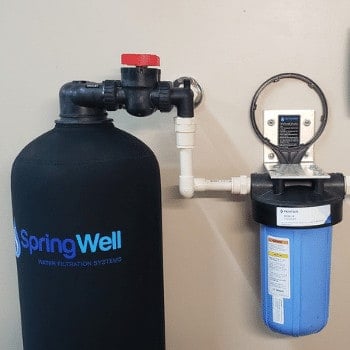
Full scoring basis
- Filtration (45%): carbon + KDF media backed by our 2022–2025 Tap Score comparison
- Flow/Pressure (20%): steady multi-tap performance; holds strong at 9–20 GPM depending on setup
- Install/Maint (10%): clean install; post-filter swaps every 8–9 months on our system
- Build (10%): solid tank and hardware; runs silently once in place
- Taste (5%), Cost (5%), Certs (5%)
We installed this SpringWell whole-house system in August 2022 and have kept it in daily service for four years. This review combines three rounds of Tap Score testing with our water-pressure, maintenance, and ownership notes.
We bought it because the chlorine in our city water smelled strong, and our skin often felt itchy and dry after showering. We wanted to treat the water throughout the house rather than at one faucet.
What we like most:
- The main media tank hasn’t needed service since we put it in
- Household pressure still feels normal at showers and fixtures
- The sediment post-filter is simple to swap and easy to find locally
- The main tank needs no outlet, drain line, or backwash schedule
What we’d improve:
- The opaque post-filter housing gives us no way to check the cartridge at a glance. We’d like a small viewing window or access panel so we could inspect it without opening the housing.
- We’d also like NSF certification for the complete system. Certain components carry NSF/ANSI 42 and 53 certifications, but the entire unit isn’t certified. We understand that certification adds cost, but it would give buyers stronger independent verification.
Use Coupon Code: QWL5 to Save!
SpringWell whole-house water filter lab results after four years
Why this is our main performance test: The 2022 sample was collected before we installed the filter. The 2025 sample came from the kitchen after more than three years of daily use.
This is a real-home comparison, not a controlled lab test. City water changes over time, so we publish the full reports with the result.
Tap Score results – 2022 baseline vs. 2025 post-install
| Parameter | Before | After | Change |
|---|---|---|---|
| Total THMs iEPA MCL: 80 ppb | 31.83 ppb | NDBelow RL | 31.83 ppb → below RL |
| Chloroform (THM) | 21.57 ppb | NDBelow RL | 21.57 ppb → below RL |
| Bromodichloromethane | 7.93 ppb | NDBelow RL | 7.93 ppb → below RL |
| Dibromochloromethane | 2.33 ppb | NDBelow RL | 2.33 ppb → below RL |
| Iron iEPA secondary standard: 300 ppb. Our 10 ppb baseline was already low. | 10 ppb | NDBelow RL | 10 ppb → below RL |
| Total Dissolved Solids (TDS) iMineral content; not a performance target for carbon filters | 187 ppm | 280 ppm | Source variation |
Context & Methods
How to read the table: “ND” means the compound wasn’t detected above the laboratory reporting limit. The 2022 sample was collected before we installed the filter. The 2025 sample came from the kitchen after more than three years of daily use. Tap Score coordinated the testing through ETR Labs and Microbac.
TDS context: A carbon filter doesn’t remove dissolved minerals. We treat the difference between the 2022 and 2025 readings as source-water variation, not filter treatment.
Iron context: The 10 ppb baseline was well below the EPA’s non-enforceable secondary standard of 300 ppb, which addresses taste, staining and other aesthetic effects. Iron wasn’t a problem we needed this system to solve.
Four-year source check: On August 19, 2026, we collected an untreated sample from the basement bypass beside the system. We collected the finished sample from the kitchen tap. The sediment post-filter was close to its scheduled replacement point, and we didn’t service it before testing.
What matched: TDS measured 284 ppm at both points. Hardness was 47.1 ppm untreated and 46.1 ppm at the kitchen. The pH was 7.5 and 7.6. Sodium measured 74.6 and 74.3 ppm, while chloride measured 103 and 104 ppm.
What the same-day pair can’t prove: Total THMs were non-detect at both taps, so this pair can’t show a new reduction percentage. Lead and zinc also differed between the bypass and kitchen samples. Those taps include different sections of home plumbing, so we don’t credit either change to the filter.
Complete laboratory reports:
2022 pre-install baseline (PDF)
2025 post-install kitchen sample (PDF)
2026 untreated bypass sample (PDF)
2026 four-year kitchen sample (PDF)
What four years of use showed us

We returned to the same system in August 2026, exactly four years after we installed it. This time we wanted an end-of-cycle check, so we left the sediment post-filter in place as it neared replacement.
Three takeaways from the retest:
- The 2022–2025 comparison remains our measurable THM result. Both 2026 samples were already non-detect, so the same-day pair couldn’t produce a new reduction rate.
- Hardness and dissolved minerals were effectively unchanged, which is what we expect from carbon filtration.
- Flow softens a little near the end of the post-filter cycle and returns after we change the cartridge.
One practical habit: After a filter change, we briefly open the bypass valve and run city water through the plumbing. The chlorine residual helps flush the lines after we’ve opened the system.
Bottom line: The main tank hasn’t needed service since setup. Our work has been limited to routine post-filter changes.
How we rated this whole-house system
The system earned a 5/5. That rating reflects its filtration results, household water pressure, upkeep, and long-term daily use.
Filtration and contaminant reduction
Performance proof: In our 2022–2025 comparison, total THMs fell from 31.83 ppb to below the laboratory reporting limit. Water pressure moved from 68 to 65 PSI over three years, while normal household flow still felt unchanged.
Flow rate and water pressure
SpringWell rates the CF Series from 9 to 20 GPM depending on system size. In our home, water pressure moved from 68 to 65 PSI over three years, and normal multi-fixture use still feels unchanged.
Purchase price and add-on costs
Cost reality: Current pricing is about $1,144 before promotions. Some homes will still need UV, a softener, or another treatment stage, which raises the total cost.
Who this whole-house filter works best for
The system fits city-water homes concerned about chlorine, disinfection byproducts, VOCs, and other carbon-treatable chemicals.
Best fit for a city-water home
Choose it if you want cleaner water at every tap without frequent cartridge changes. Its tank design keeps routine service simple.
Sizing by bathrooms and household flow
Our CF1 is the 1–3 bathroom model. SpringWell lists the CF4 for 4–6 bathrooms and the CF+ for homes with 7 or more, with service flow ratings of 9, 12 and 20 GPM.
When this system is the wrong fit
The base system isn’t designed to neutralize acidic water or soften hard water. SpringWell sells a separate calcite pH neutralizer for low-pH water. Well water with meaningful iron, manganese, or bacteria also needs targeted treatment.
In those cases, a softener, UV system, or more specialized filter may make more sense.
How the SpringWell CF system works
What’s included
The SpringWell CF pairs an upflow KDF and catalytic-carbon media tank with one replaceable 5-micron sediment post-filter.
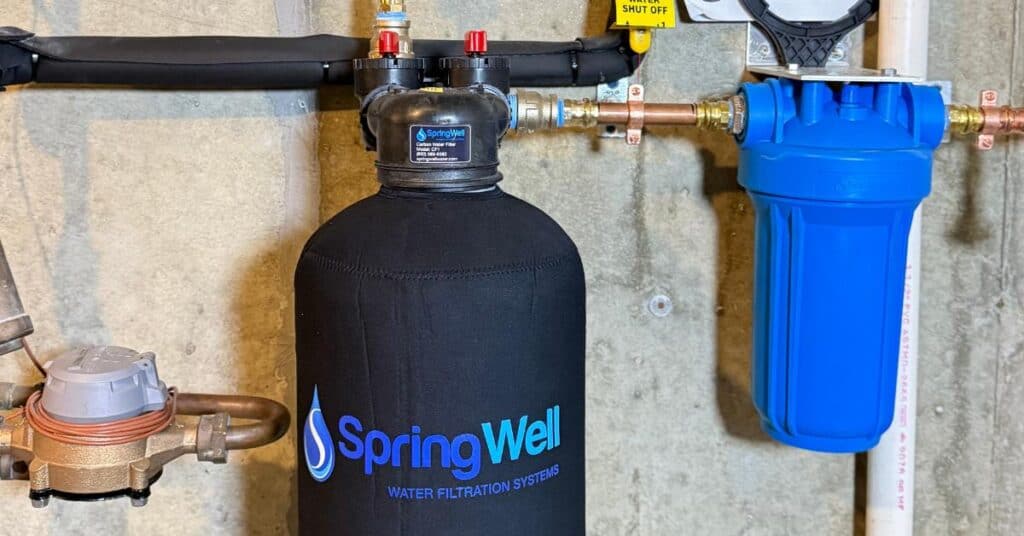
Installed flow path: Water enters the main media tank first, then passes through the blue post-filter housing before returning to the house.
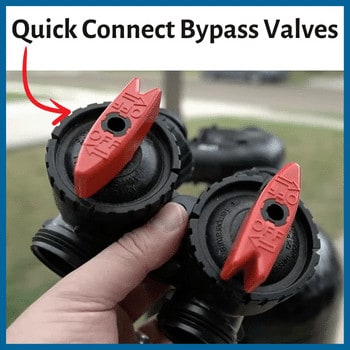
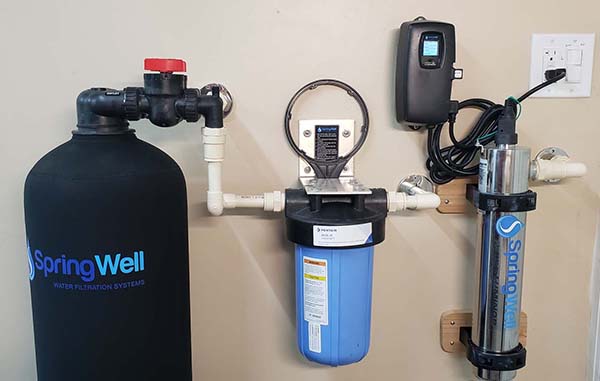
More flexibility: Clack-style connectors make the piping layout easier in tight spaces. Homes that need microbial treatment can add an optional UV system.
Catalytic carbon, KDF and the sediment post-filter
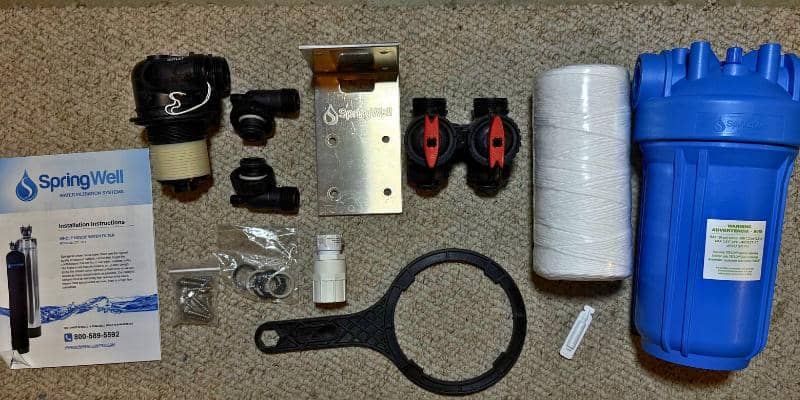
The main tank combines catalytic carbon and KDF media, followed by a replaceable sediment post-filter. That layout hasn’t restricted normal whole-house flow in our home.
Why the design matters: The main tank handles the chemical-treatment work first. The 5-micron post-filter then catches fine particles before the treated water returns to the house. It doesn’t protect the media tank from incoming sediment because it sits downstream.
Long-term fit: SpringWell rates the main media for 1,000,000 gallons. That gives the tank a longer service window than cartridge-based systems.
| Component | Function |
|---|---|
| KDF media | Supports the primary media through a redox process |
| Catalytic carbon | Provides the main chemical-treatment stage |
| 5-micron post-filter | Catches fine particles after the media tank and before water returns to the house |
Common questions about pressure, hard water and power

These are the questions we’d want answered before buying this type of whole-house system.
- Will it hurt pressure? In our house, not in any meaningful way. Our logged readings stayed within 3 PSI across three years, and we didn’t notice a day-to-day loss. Flow softened only near the end of a post-filter cycle.
- Does it soften hard water? No. It doesn’t remove calcium or magnesium, so hard-water homes may still need a separate softener.
- Does the base system need electricity? No. The carbon system runs without power, although the optional UV add-on needs an outlet.
Chlorine, chloramine and other contaminant claims
The table below summarizes SpringWell’s treatment claims. Compare them with the contaminants found in your water test.
| Contaminant | Treatment media |
|---|---|
| Sediment (sand, rust, dirt) | 5-micron sediment post-filter |
| Chlorine and chloramine | Catalytic carbon + KDF |
| VOCs (volatile organic compounds) | Carbon media |
| Industrial chemicals | Carbon/KDF combo |
| PFAS and PFOA | Activated carbon |
| Pesticides and herbicides | Carbon media |
| Lead and other heavy metals | KDF media |
These are SpringWell’s claims for the media. Our independent test supports the THM result shown above, not every claim in this table.
Installation and maintenance after four years
Bypass-valve planning

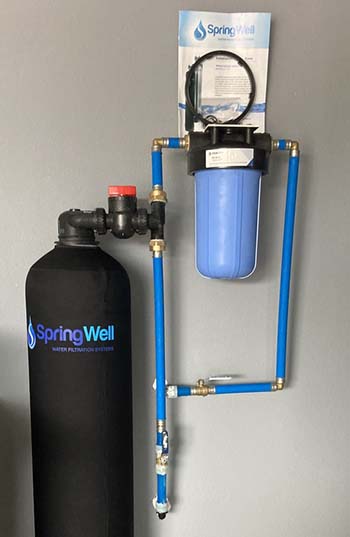
A plumber friend helped us connect the system to our copper plumbing. We completed the 48-hour media soak first, and the physical setup took about three hours.
SpringWell sent the correct fittings for the standard setup. We spent another $80 on fittings and copper pipe for the separate bypass serving our irrigation and wash-sink line.
The bypass valves let us isolate the filtration system for service while the rest of the home still gets water. You’ll also need enough vertical clearance for the tank and room to change the sediment post-filter.
Customer support and lifetime warranty
SpringWell’s customer support was solid in our experience, especially before purchase. Its current lifetime warranty applies to defects in listed components under normal use.
- Included in the warranty: the tank, housing, fittings, bypass, valves, and in/out heads
- Excluded from the warranty: damage caused by improper installation, modification, neglect, fire, or freezing
- Separate return policy: SpringWell also advertises a six-month money-back guarantee
Post-filter maintenance and annual cost
There’s little routine maintenance. We look over the system when we walk past it and replace the 5-micron sediment post-filter every 8–9 months.
Our compatible post-filters cost about $20 each, which works out to roughly $27–$30 per year at our replacement interval. They’re easy to source from Lowe’s and Home Depot. If your city flushes its lines seasonally, keep a spare on hand.
How SpringWell compares with other whole-house systems

- Aquasana Rhino EQ-1000: SpringWell feels steadier on flow and easier to live with long term. Aquasana adds more moving parts with its pre- and post-filters, which means more space and more routine upkeep.
- iSpring WGB32B 3-Stage: The iSpring comes in cheaper upfront, but it leans on cartridge changes. SpringWell trades that for a longer-lasting tank setup with fewer ongoing swaps.
- Pelican PC600: This is the closest match in design and intent. SpringWell offers more sizing options, an available UV add-on, and stronger support.
Bottom line: This isn’t the cheapest system here, but it’s the easiest to live with over time.
Use Coupon Code: QWL5 to save!
Other whole-house filters to consider
Not every home has the same water profile or budget. For the broader shortlist, see our current whole-house filter picks. If SpringWell isn’t quite right, these are the alternatives we’d look at next: