

✅ Quick answer: No. A standard whole-house water filter does not soften hard water.
Sediment, carbon, and KDF filters can reduce particles, chlorine, odors, or other specific substances. They don’t remove the calcium and magnesium that cause hardness.
To make hard water soft, the system needs a true ion-exchange stage. If the product doesn’t contain softening resin, it won’t stop hardness at the source.
👉 One thing people miss: “Whole-house” only tells you where the equipment is installed. It doesn’t tell you what the media inside can remove.
What to check before buying
- Carbon, sediment, or KDF media: filtration, not softening
- Ion-exchange resin with salt regeneration: true hardness removal
- TAC or salt-free conditioning media: scale control without removing hardness
- Filter-softener combination: can do both, but only if it has separate filtration and ion-exchange stages
If the specification sheet never says it reduces hardness in GPG or mg/L, don’t assume it will.
Why hard-water minerals pass through most filters
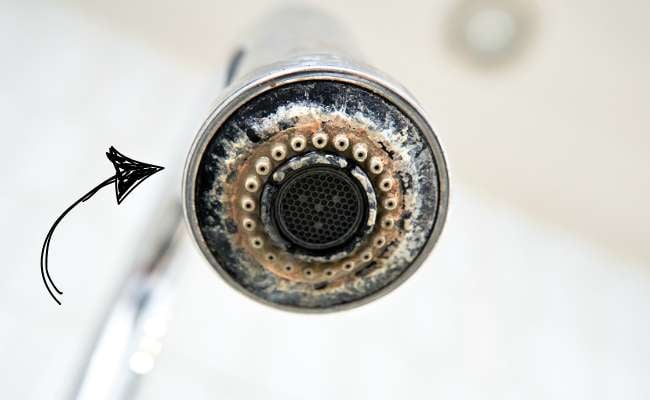
Hard water contains dissolved calcium and magnesium. Those minerals are carried in the water as ions, not floating around as pieces of grit.
- A sediment cartridge can catch sand or rust. It can’t screen dissolved calcium out of the water.
- Activated carbon works differently, but the answer is the same. Carbon is useful for chlorine, taste, odor, and certain organic compounds, not hardness removal.
- KDF and other specialty media also have defined jobs. A long contaminant list doesn’t turn them into water softeners.
Practical takeaway: If scale still forms after installing a whole-house filter, the filter may be working perfectly. It was never designed to remove the minerals behind the scale.
What real hardness removal looks like
We tested untreated well water from a Central Florida home before and after a Whirlpool WHES40E water softener.
Before softening
- Total hardness: 310 ppm, or about 18 GPG
- Calcium: 72 ppm
- Magnesium: 24 ppm
- TDS: 340 ppm
After softening
- Total hardness: 28 ppm, or about 1.6 GPG
- Calcium: 5 ppm
- Magnesium: 2 ppm
- TDS: 350 ppm
Hardness dropped by 91%. Calcium and magnesium both fell by more than 90%.
TDS barely changed, and that’s expected. A softener exchanges hardness ions for sodium or potassium instead of stripping out everything dissolved in the water.
Test note: These results apply to this home’s water and equipment setup. Performance will vary with source water, sizing, settings, and operating conditions.
Three labels that cause confusion

Filter-softener combo
A combination system can filter and soften, but it needs two real treatment stages. Look for contaminant-specific filter media plus ion-exchange resin.
“All-in-one” and “whole-home treatment” are marketing terms. The media list tells you what the equipment actually does.
Salt-free water conditioner
A salt-free conditioner may change how hardness minerals form scale. It doesn’t pull calcium and magnesium out of the water.
Your hardness test will read about the same before and after conditioning. That’s scale control, not softening.
Our guide to template-assisted crystallization explains how that process differs from ion exchange.
Reverse osmosis filter
Reverse osmosis can reduce calcium and magnesium at a drinking-water tap. That doesn’t make a normal under-sink RO system a whole-house softener.
Point-of-use RO treats a small volume for drinking and cooking. It doesn’t protect the water heater, showers, dishwasher, or the rest of the plumbing from scale.
How to tell what your current system is doing

- Check the media. Carbon, KDF, and sediment cartridges don’t remove hardness. Ion-exchange resin does.
- Look for regeneration. A traditional softener has a resin tank, brine tank, control valve, and drain connection.
- Read the performance claim. Look for hardness reduction or softening capacity, not vague promises about scale.
- Test before and after. A hardness kit will tell you whether calcium and magnesium are actually being removed.
Don’t use a TDS meter to judge a softener. Our Florida result moved from 340 to 350 ppm even while hardness dropped from 18 to 1.6 GPG.
Do you need a filter, a softener, or both?
If scale is the only problem, a softener handles the job. A standard whole-house filter adds cost without removing the hardness.
If the water contains sediment, chlorine, iron, sulfur, or another defined concern, filtration may also be needed.
If you have both problems, use both treatment stages. Our filter-versus-softener guide walks through that decision.
Equipment order depends on the water and the media. See whether your filter should go before or after the softener once you know which stages you need.
What to do next
Test the hardness before buying anything. If the result is above roughly 7 GPG and scale is causing trouble, look for a properly sized ion-exchange softener.
Compare our recommended water softeners once you know the hardness level and household water demand.