

✅ Worth it? Yes, if you need a reliable baseline. It’s also useful for checking whether a water filter is doing its job. We’ve used Tap Score for nearly 40 source-water and product tests. Its reports make it easier to turn lab data into a treatment decision. The main drawback is cost, especially when you need a specialty panel.
- Report Clarity 30% 5/5
- Testing Breadth 25% 4.8/5
Full scoring basis
- Report Clarity (30%): Score: 5/5 - Results, reporting limits, benchmarks, test methods, and treatment options are easy to find.
- Testing Breadth (25%): Score: 4.8/5 - Core city and well panels cover common concerns, with separate tests for PFAS, microplastics, and other specialty analytes.
- Sampling and Turnaround (15%): Score: 4.6/5 - Collection steps are clear, sampling materials are supplied, and core kits typically spend 3 to 5 business days in the lab.
- Report Support (10%): Score: 4.8/5 - Interactive reports explain detections and provide access to human support when a result needs more context.
- Value (20%): Score: 4.3/5 - Core kits start at $189, but specialty panels and broader packages get expensive.
🔑 Key findings
- Clear reports: Results, reporting limits, benchmarks, and treatment options are easy to find.
- Useful range: Core city and well kits cover common concerns. Separate panels handle PFAS, microplastics, and other special tests.
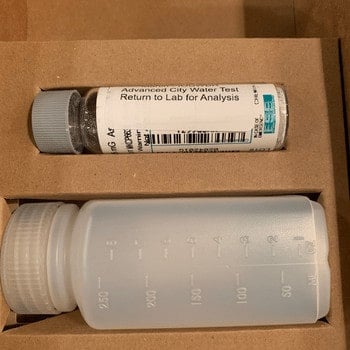
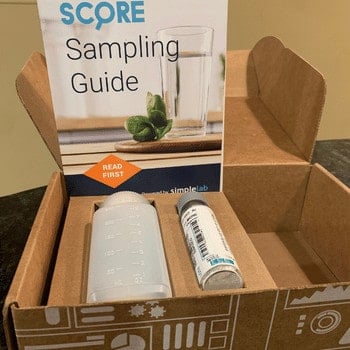
- Simple collection: Bottles, instructions, and return shipping materials arrive together.
- Main trade-off: The wrong panel can leave an important question unanswered, and adding specialty tests gets expensive.
✅ Buy if
- You need a city- or well-water baseline.
- You want before-and-after filter data.
- You want a readable report from a certified laboratory.
❌ Skip if
- You only need a quick chlorine or hardness check.
- Your local health department offers the same panel for less.
- You haven’t decided which contaminants matter yet.
What nearly 40 tests taught us
✓ Repeated QWL use – city water, private wells, pitchers, reverse osmosis systems, softeners, and whole-house filters.
Tap Score lets us compare the water entering a system with what comes out. That’s more useful than relying on taste, a TDS meter, or a brand’s contaminant list.
The reports have helped us answer very different questions. One test covered hard well water in Central Florida. It showed the Whirlpool WHES40E cut hardness from 18 gpg to 1.6 gpg. A separate AquaTru panel found all 14 tested PFAS compounds below the lab’s reporting limits after filtration.
Those examples show why panel selection matters. A standard city-water test can measure metals, minerals, hardness, and common inorganics. It can’t prove PFAS or microplastic reduction unless the ordered panel tested for them.
Our rule is simple: if an analyte wasn’t tested, we don’t call it nondetect. The old version of this review made that mistake with PFAS, and we’ve removed the claim.
What Tap Score does better than a basic test kit
A home strip gives you a fast color match. A lab report gives you a measured result and unit. It also lists the reporting limit, test method, and benchmarks.
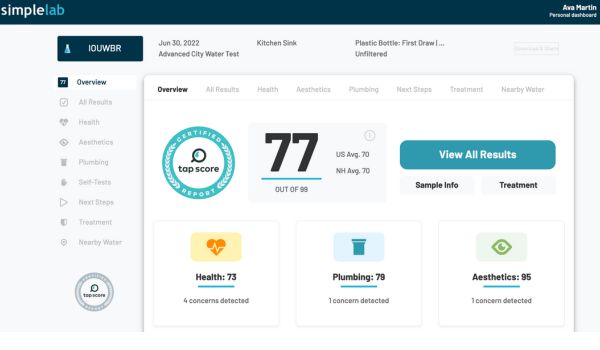
Tap Score organizes that data better than the standard lab reports we’ve received. Open a contaminant to see why it matters. You can then compare benchmarks and review treatment methods that target it.
The downloadable PDF keeps the underlying lab data intact. We use it when publishing results. It shows what was tested and where “not detected” stops.
How we read a Tap Score report
Result: What the laboratory measured in the sample.
RL: The reporting limit. A nondetect means the analyte wasn’t found at or above this level.
Benchmark: The level used for comparison. Regulatory and health-based benchmarks aren’t always the same.
Method: The procedure the laboratory used to analyze the sample.
Don’t judge the report by one score
The Tap Score number is useful for a quick scan. We don’t treat it as the final answer. The score can change when you switch benchmarks, even though the lab result stays the same.
Open every flagged analyte. Check the measured amount, reporting limit, and selected benchmark. Then ask whether the finding explains the problem you’re trying to solve.
This keeps a trace detection from causing an unnecessary whole-house purchase. A high overall score can also hide one result that matters to your home or plumbing.
How to use a Tap Score kit
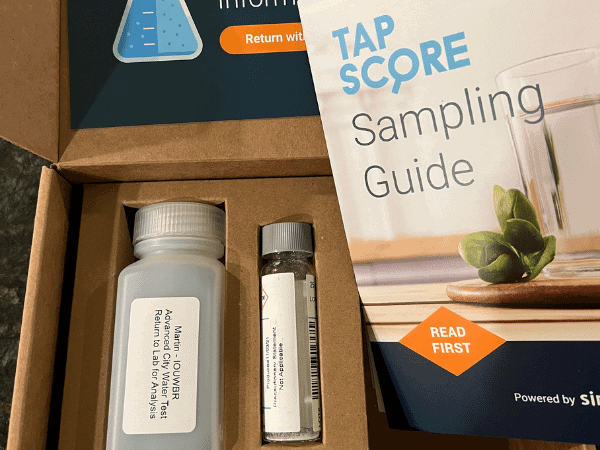
- Activate the kit. Register the test ID before collecting water.
- Read the sampling directions. Some bottles contain preservatives and shouldn’t be rinsed.
- Use the specified tap. Remove faucet attachments only when the directions tell you to.
- Fill each container as directed. Keep the cap and inside of the bottle clean.
- Complete the field tests. The city-water kits we’ve used included Hach strips for free and total chlorine. These are onsite color readings, not laboratory nondetects.
- Pack and return the sample. Follow the timing and temperature instructions included with your panel.
Tap Score says most core results are ready three to five business days after the lab receives the sample. Special panels can take longer. Check the listed turnaround before ordering.
Which Tap Score test should you choose?
| Kit | Best use | Listed analytes | Price* |
|---|---|---|---|
| Essential City | Basic municipal-water baseline, metals, minerals, hardness, nitrate, and fluoride | 49 | $189 |
| Advanced City | Broader city-water check with VOCs and disinfection byproducts | 111 | $299 |
| Essential Well | Routine well baseline with bacteria, metals, hardness, nitrate, and turbidity | 54 | $209 |
| Advanced Well | Wells near agricultural, industrial, mining, or fuel-related activity | 114 | $399 |
*Prices checked August 2026. Tap Score can change its panels, analyte counts, and pricing.
The Essential kits are a sensible starting point for a broad baseline. Pick an Advanced kit when its added VOCs, fuel compounds, pesticides, or disinfection byproducts match a real concern.
PFAS and microplastics need a listed analysis unless an extended package clearly includes them. Don’t assume “advanced” means every possible contaminant.
If you’re unsure, start with our water-testing guide. You can also ask Tap Score which panel includes the exact analytes you need.
Tap Score vs. DIY strips and local laboratories
| Option | Best for | Main limitation |
|---|---|---|
| Tap Score | Mail-in convenience and a homeowner-friendly report | Costs rise with broader and specialty panels |
| DIY strips | Fast checks for chlorine, pH, hardness, or another simple property | Color matching is less precise and covers fewer analytes |
| Local laboratory | State-required testing, real-estate needs, or a custom local panel | Ordering, bottle pickup, shipping, and report clarity vary |
Where Tap Score falls short
- It gets expensive. A core test is reasonable for an occasional baseline. PFAS, microplastics, and other special panels can push the total much higher.
- The kit names can overpromise. Essential, Advanced, and Extended describe package size. They don’t tell you whether your exact contaminant is included.
- The score needs context. A lower score doesn’t automatically mean the water violates a legal limit or needs an expensive system.
- Treatment recommendations are a starting point. They identify useful technologies. They don’t size equipment for flow, hardness load, iron, or household demand.
- Mail-in testing isn’t ideal for every property. Chlorine and similar readings can change during shipping. Field strips are useful alongside the lab sample.
Is Tap Score legit?
Yes. Tap Score supplies the kit, handles shipping, and turns the data into an interactive report. It routes samples to independent certified labs based on the requested analysis.
Certification applies to a lab’s approved methods and analytes, not just a company name. For a sale, permit, legal dispute, or state rule, confirm that the assigned lab and panel qualify before ordering.
Our bottom line
We keep using Tap Score because sample collection is organized. Its reports explain dense lab data in plain language. It’s most useful before buying treatment or when checking a filter with before-and-after samples.
We wouldn’t buy the largest panel by default. Pick the smallest test that covers your water source and concerns. Add special testing only when it answers a separate question.
QWL testing behind this review
This review draws on the same reports we use throughout QWL. These pages show the samples, findings, limits, and treatment decisions behind our Tap Score rating:
- PFAS filter testing: AquaTru and Waterdrop treated-water results compared with our shared city-water baseline
- Microplastics filter testing: AquaTru and Waterdrop laboratory panels by particle-size range
- AquaTru review: PFAS and microplastics results after more than three years of ownership
- Whirlpool WHES40E review: Before-and-after hardness, calcium, magnesium, and iron results
- How QWL tests water filters: Our sampling, scoring, evidence, and reporting standards