

✅ Quick answer: Cleaning a water softener isn’t one universal procedure. Empty and wash the brine tank when it contains dirt or salt mush, use only a manufacturer-approved product on fouled resin, and follow the model manual before opening the injector or sanitizing the system.
Do not pour vinegar, hydrogen peroxide, bleach, or a homemade mixture into the resin tank unless the manufacturer specifically approves the chemical, concentration, and contact time.
Start by identifying what’s dirty. A salt bridge, iron-fouled resin, restricted injector, and sanitation concern require different work.
| What you find | Correct maintenance job | What not to assume |
|---|---|---|
| Salt mush, dirt, or residue in the salt tank | Empty and wash the brine tank. | The resin doesn’t automatically need cleaner. |
| Hard crust suspended over a hollow space | Break the salt bridge without dismantling the valve. | The entire tank doesn’t always need to be emptied. |
| Iron or manganese fouling suspected on resin | Use a compatible resin cleaner according to the manual. | Household vinegar isn’t a substitute for every cleaner. |
| Brine level does not fall during draw | Diagnose and clean the injector or venturi using the model procedure. | Adding more salt won’t restore suction. |
| System requires sanitizing after installation or service | Use the manufacturer’s disinfectant dose and regeneration procedure. | Cleaning and sanitizing aren’t interchangeable. |
| Valve leak, damaged tank, or electrical fault | Arrange repair or replacement. | Cleaner can’t repair a failed component. |
Why water softeners need different types of cleaning

The brine tank holds salt and water. It can collect insoluble salt residue, dirt, sludge, or compacted mush.
The resin tank contains ion-exchange media. It’s normally sealed and cleaned by moving an approved product through the resin during regeneration, not by opening the tank and scrubbing the beads.
The injector or venturi creates the suction used to draw brine. A small restriction there can stop brine movement even when the brine tank is spotless.
Sanitizing is another task. It uses an approved disinfectant procedure to address microbial contamination after installation, service, flooding, extended disuse, or another condition identified by the manufacturer or water professional.
Early signs your water softener needs attention
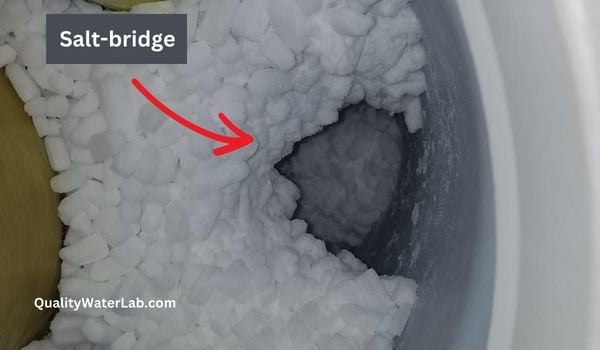
A visible deposit can justify cleaning. A symptom alone doesn’t identify which part is dirty.
| Symptom | Possible explanation | Check before cleaning |
|---|---|---|
| Salt level doesn’t fall | Bridge, mush, failed regeneration, or failed brine draw | Observe whether liquid falls during the brine-draw stage. |
| Hardness returns | Incorrect settings, no brine draw, exhausted capacity, valve leakage, or resin fouling | Test hardness and watch one complete regeneration. |
| Water tastes salty | Incomplete rinse, drain restriction, pressure problem, or valve fault | Compare bypassed and softened cold water. |
| Softener uses excessive salt | Frequent regeneration, high salt dose, leak, or programming issue | Measure cycle frequency and salt used per cycle. |
| Continuous drain flow | Valve stuck in regeneration or unable to return to service | Check the displayed stage and expected cycle time. |
| Orange or brown fouling | Iron, manganese, sediment, or corrosion | Identify the material before choosing a cleaner. |
Use the linked troubleshooting page when the evidence points to a mechanical or programming fault. Cleaning the wrong component wastes time and can introduce chemicals the system didn’t need.
How to clean the brine tank

Clean the brine tank when it contains mush, dirt, mold, or accumulated insoluble residue. EPA WaterSense recommends cleaning it as needed and at least every few years, following the equipment instructions.
- Let the salt level run down so less material must be removed.
- Place the softener in bypass using the manual’s procedure.
- Disconnect power if the instructions require it.
- Remove loose salt into a clean, dry container if it will be reused.
- Remove remaining brine using the disposal method allowed locally and by the manufacturer.
- Remove mush and insoluble residue with a plastic scoop.
- Wash the empty tank with warm water and mild dish soap.
- Rinse until no soap remains.
- Reassemble the brinewell cover, float, tubing, and overflow exactly as documented.
- Add the manual’s required startup water and approved salt.
- Return the valve to service slowly, check for leaks, and complete one approved regeneration.
Bypass doesn’t automatically depressurize the valve or connected tubing. Do not remove pressurized parts merely because household water is routed around the softener.
If the problem is only a suspended salt crust, use the narrower salt bridge procedure instead of emptying the entire tank.
How to clean water softener resin
Resin cleaner is selected by the foulant and the equipment materials. Iron cleaner, general resin cleaner, acid cleaner, and sanitizer aren’t interchangeable products.
Use a cleaner specifically approved for the softener and the condition being treated. Follow its dose, placement, contact time, rinse, and regeneration instructions.
For our Whirlpool WHES40E, the manufacturer recommends its WHE-WSC cleaner every four months and directs the owner to add the bottle through the brinewell before starting regeneration. That schedule and product are model-specific, not a rule for every softener.
Do not open the sealed resin tank to stir or wash the media. Damaged distributors can release resin beads into the plumbing.
Can you clean softener resin with vinegar?
Do not assume vinegar is safe merely because it’s a mild household acid. Resin chemistry, tank materials, seals, metal parts, and the deposits being treated vary.
Vinegar also doesn’t provide a validated sanitizing procedure. Use it only when the manufacturer explicitly permits it and specifies how much to use and how to rinse it out.
Can you put hydrogen peroxide in a water softener?
Do not pour hydrogen peroxide into a softener without an approved procedure for that model. Concentration, exposure time, resin compatibility, seals, and residual chemicals all matter.
Hydrogen peroxide should never be mixed with chlorine bleach, vinegar, or an unknown resin cleaner. If another chemical is already in the system, rinse it according to the product and equipment instructions before doing anything else.
How to clean the injector or venturi
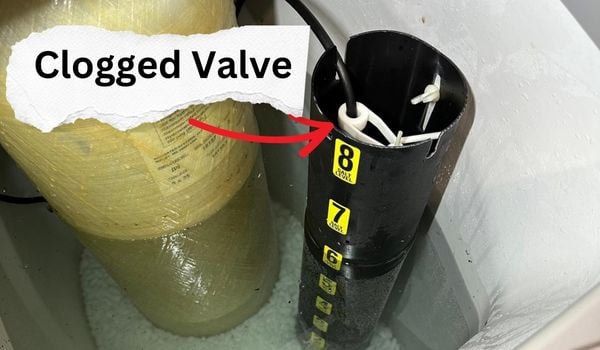
A restricted injector can prevent the softener from drawing brine. The typical clues are a brine level that doesn’t fall, weak drain flow during draw, and hard water after regeneration.
Injector design varies significantly. Some units have a removable nozzle and venturi under a small cap. Others place the components inside a valve assembly that should be serviced by a technician.
- Place the unit in bypass, isolate it, and relieve pressure exactly as the manual directs.
- Photograph the cap, gasket, screen, nozzle, and venturi orientation before removal.
- Clean only with the tools and solution approved for those parts.
- Do not enlarge a nozzle opening with wire, a drill bit, or another hard object.
- Reinstall every seal and component in its documented position.
- Return the softener to service slowly and inspect for leaks.
- Run the diagnostic regeneration and confirm that the brine level falls.
Continue with the not-using-salt diagnostic when cleaning the approved injector components doesn’t restore brine draw.
How to sanitize a water softener
Sanitize after installation or service when the manual requires it, and after a confirmed contamination event under qualified guidance. Use the exact disinfectant, dose, placement, and regeneration sequence specified for the equipment.
For example, the Whirlpool WHES40 manual specifies about 3 ounces of household bleach through its brinewell followed by a recharge. That is an example of a manufacturer-defined procedure, not a universal bleach recipe.
Do not sanitize with vinegar. Do not increase the disinfectant dose because the tank appears dirty. More chemical can damage resin and seals or become harder to rinse from the system.
Never mix bleach with vinegar, ammonia, hydrogen peroxide, or another cleaner. When the system has an unknown chemical history, stop and ask the manufacturer or a qualified water-treatment professional for the correct flushing sequence.
Post-cleaning maintenance
| Task | When to do it |
|---|---|
| Check salt and look for bridging | Approximately every four to six weeks, or as the manual recommends |
| Inspect connections and drain flow | After service and periodically during normal operation |
| Test treated-water hardness | After cleaning, when symptoms return, and periodically thereafter |
| Use resin cleaner | According to the equipment and cleaner instructions |
| Clean the brine tank | When residue, dirt, mush, or mold is present, and at the interval in the manual |
| Sanitize the system | Only when required by the manufacturer or the contamination event |
Cleaning should produce a measurable result. Confirm normal brine draw, complete regeneration, acceptable treated-water hardness, and no leaks.
When to call a professional
- The softener contains an unknown cleaner or chemical mixture.
- The valve, bypass, resin tank, or connected plumbing leaks.
- Resin beads appear in household plumbing.
- The injector remains unable to draw brine after approved cleaning.
- The controller or valve reports a persistent fault.
- Contamination requires a validated sanitizing and sampling plan.
- The work requires opening a pressurized valve or lifting a full tank.
If cleaning reveals a failed control valve, damaged resin tank, or exhausted system that is no longer practical to repair, compare our tested water softener recommendations before replacing it.
The bottom line
Identify the dirty component before choosing the cleaning method. The brine tank can be washed, fouled resin needs a compatible cleaner, and a restricted injector requires model-specific service.
Sanitizing is a separate procedure. Use the manufacturer’s chemistry and dose, never combine cleaners, and verify hardness, brine draw, regeneration, and leaks when the work is complete.