
What is the Ideal Water Hardness Level?

Ava Martin is the founder and chief editor of Quality Water Lab.

Mike Martin brings hands-on installation experience and helps validate the real-world setup and serviceability of the systems we cover.
✅ Quick answer: For most homes, 3.5–7 grains per gallon is a practical water hardness range. The water still contains calcium and magnesium, but scale is usually more manageable than it is above 7 GPG. There’s no single health-based “ideal” number, so the best level depends on scale, cleaning, appliance protection, and how the water feels to you.
Water below 3.5 GPG is classified as soft. Water from 3.5–7 GPG is moderately hard. Once hardness reaches 7 GPG, mineral buildup, spotting, and soap residue tend to become more noticeable.
If your result is above 10.5 GPG, the U.S. Geological Survey classifies it as very hard. At that point, a softener is usually easier to justify because scale forms faster inside water heaters, fixtures, and appliances.
Water hardness scale in GPG, ppm, and mg/L

Hardness measures dissolved calcium and magnesium. Results are commonly reported in grains per gallon, parts per million, or milligrams per liter as calcium carbonate.
For water testing, ppm and mg/L are effectively the same. One GPG equals about 17.1 ppm or mg/L.
| Classification | GPG | ppm or mg/L | What it usually means at home |
|---|---|---|---|
| Soft | 0–3.5 | 0–60 | Little normal hardness scale |
| Moderately hard | 3.5–7 | 61–120 | Some spotting or soap residue |
| Hard | 7–10.5 | 121–180 | More frequent scale and cleaning problems |
| Very hard | More than 10.5 | More than 180 | Faster buildup and a stronger case for treatment |
These classifications describe mineral concentration. They’re not pass-or-fail drinking-water safety limits.
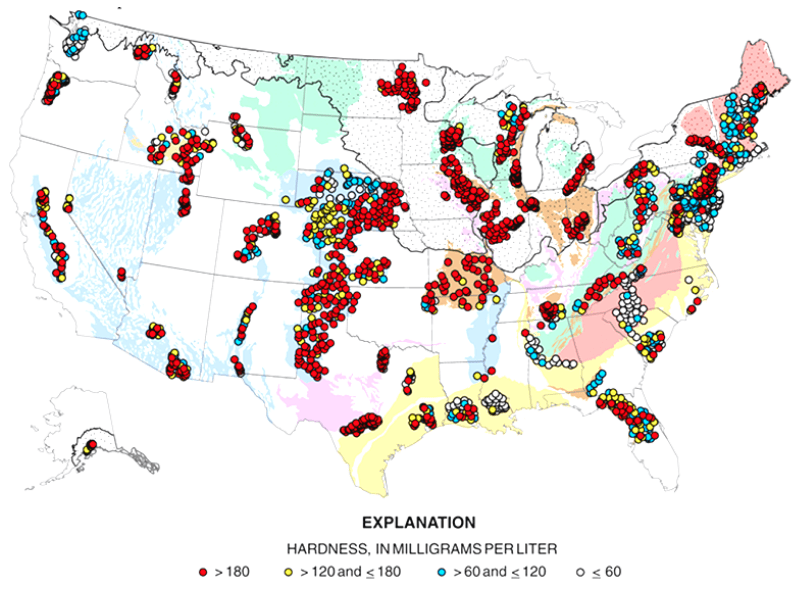
What is a good water hardness level for a home?
A good water hardness level is one that limits scale without creating a water feel or taste you dislike. For many households, that puts the practical target somewhere below 7 GPG.
That’s not a rule requiring everyone with 7.1 GPG water to buy a softener. A family at 5 GPG may want treatment because spotting and soap residue bother them. Another at 8 GPG may decide the maintenance cost isn’t worth it.
The acceptable level depends on what you’re trying to improve:
- For plumbing and appliances: Lower hardness means less scale on heating elements and inside narrow water passages.
- For bathing and cleaning: Soap generally works better as hardness falls, leaving less film on skin, glass, tile, and laundry.
- For drinking: There’s no universal ideal hardness, and hard water isn’t a health risk. Calcium and magnesium affect mineral content and taste, but hardness alone doesn’t determine whether the water is safe.
- For a private well: Hardness must be considered with iron, manganese, pH, sediment, and other test results before choosing equipment.
Think of 7 GPG as a decision point, not a danger line. Above it, the benefits of treatment usually become easier to see and measure.
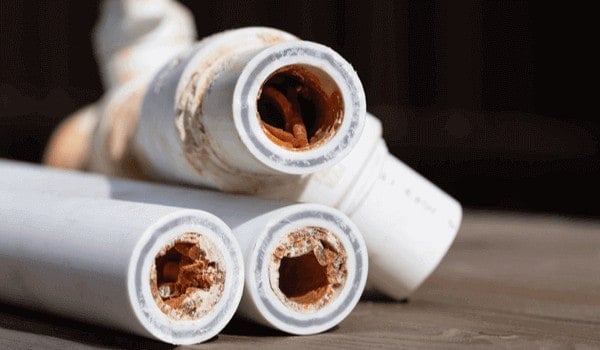
How to interpret common hardness results
- 3 GPG: This is soft water by the USGS scale. A softener is unlikely to provide much scale-control value.
- 5 GPG: This is moderately hard. You may notice light spotting or soap residue, but treatment is mostly a preference.
- 7 GPG: This is the beginning of the hard range. Watch for scale on fixtures, glassware, and heated appliances.
- 10 GPG: This is hard water, equal to about 171 ppm. A softener can make sense when scale and cleaning problems are persistent.
- 15 GPG: This is very hard water, equal to about 257 ppm. Expect mineral buildup to form faster without treatment.
- 250 ppm of hardness: This equals about 14.6 GPG and falls in the very hard range. But 250 ppm TDS doesn’t mean the water has 250 ppm hardness. Those are different measurements.
Our lab results: three real hardness levels

We’ve tested source water with naturally low hardness and very hard well water before and after softening. The numbers show what the scale looks like in actual homes.
New Hampshire municipal water
- Household softener: None
- Hardness: 18.76 ppm
- GPG: About 1.1
- Calcium: 5.39 ppm
- Magnesium: 1.2 ppm
- TDS: 187.2 ppm
Central Florida well water
- Condition: Untreated
- Hardness: 310 ppm
- GPG: About 18
- Calcium: 72 ppm
- Magnesium: 24 ppm
- TDS: 340 ppm
Florida water after softening
- System: Whirlpool WHES40E
- Hardness: 28 ppm
- GPG: About 1.6
- Calcium: 5 ppm
- Magnesium: 2 ppm
- TDS: 350 ppm
The New Hampshire water was naturally soft at about 1.1 GPG. The untreated Florida well water measured about 18 GPG, well into the very hard range.
After the Whirlpool softener, the Florida water measured about 1.6 GPG. Calcium fell from 72 to 5 ppm and magnesium fell from 24 to 2 ppm.
View the New Hampshire baseline report (PDF)
Test note: These samples represent specific homes and dates. Source chemistry and softener performance vary by location, equipment, settings, and operating conditions.
TDS is not a water hardness scale
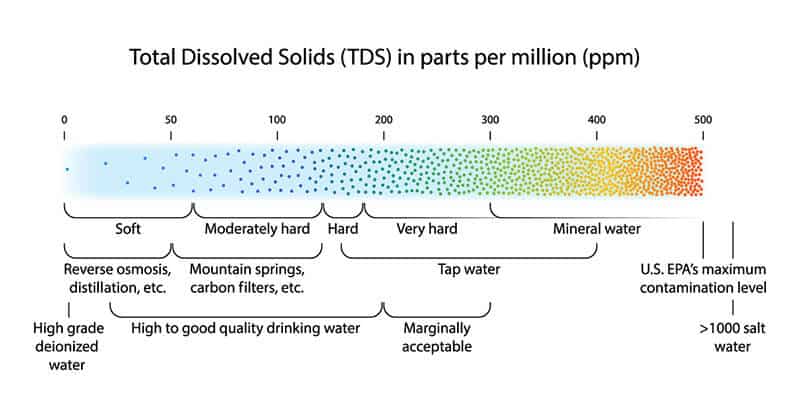
There’s no TDS number that defines hard water. Total dissolved solids includes many dissolved ions, while hardness measures primarily calcium and magnesium.
A TDS reading of 250 ppm could come from soft, moderately hard, or very hard water. You need a hardness-specific result to know which one it is.
Our Florida results make the difference clear. Hardness dropped from 310 to 28 ppm after softening, while TDS changed from 340 to 350 ppm. The softener exchanged ions. It didn’t remove all dissolved material.
That’s why a handheld TDS meter can’t tell you whether a softener is working. Use a hardness strip, a drop-count titration kit, or a laboratory test instead. Our guide to what a TDS meter actually measures explains the limitation in more detail.
How to measure your water hardness
Don’t rely on a national map or visible scale to choose a softener. Hardness can vary between nearby water systems, wells, and seasons.
- City water: Check your utility report or ask the utility for its current hardness range. Test at home when you need a result from your own tap.
- Private well: Include hardness in a broader laboratory analysis, especially when iron, manganese, staining, odor, or low pH may affect treatment.
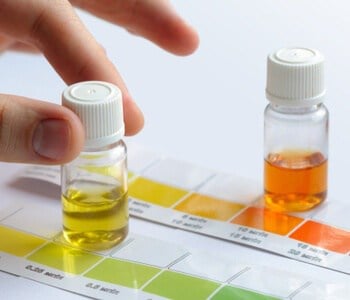
- Quick home check: Use hardness strips or a drop-count titration kit. Confirm the number before sizing expensive equipment.
Record whether the result is reported in GPG, ppm, or mg/L. A softener must be sized and programmed from the actual hardness concentration, not simply the words “hard water.”
Should you soften your water?
- Below 3.5 GPG: A softener is rarely necessary for hardness control.
- From 3.5–7 GPG: Treatment is optional. Let spotting, soap residue, appliance scale, and your own preferences guide the decision.
- From 7–10.5 GPG: You’re in the hard range. A softener becomes easier to justify when scale is already visible.
- Above 10.5 GPG: Very hard water can create faster and more persistent scale. Treatment is usually worth serious consideration.
Hardness alone doesn’t tell you whether you also need filtration. A softener handles calcium and magnesium. Chlorine, lead, PFAS, sediment, bacteria, iron, and other problems require treatment selected for those conditions.
Prefer to skip the salt? A salt-free conditioner won’t remove calcium and magnesium, but it can cut how much scale they leave behind.
If your test confirms that hardness is the problem, compare our recommended water softeners by household size, source water, capacity, and operating needs.
The bottom line
There’s no mandatory ideal hardness level for every home. A practical range is often 3.5–7 GPG, with treatment becoming easier to justify once the result reaches the hard range at 7 GPG.
Measure hardness with the right test, convert the result correctly, and base the decision on the scale and buildup you actually experience.