

Scoring basis
- Filtration (35%): Excels at removing dissolved solids, heavy metals like lead, and chlorine byproducts.
- Taste & Odor (20%): Produces ultra-clean, almost distilled-like taste — though some find it too flat.
- Value (15%): Filters only last ~40 gallons
- cost works out closer to ~$0.50–0.70/gal.
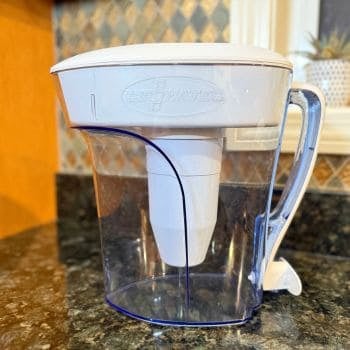
- Build Quality (15%): Standard plastic pitcher design
- comes with free TDS meter but lid fit is just average.
- Ease of Use (15%): Quick setup, spigot and pour spout
- built-in meter makes monitoring easy.
ZeroWater’s 10-Cup Pitcher takes a blunt-force approach to filtration: strip everything out. Our Tap Score test showed total dissolved solids plummet from 187 ppm to essentially zero, along with lead and chromium-6.
The result? A level of purity unmatched by other pitchers, though it comes at the cost of mineral balance and filter longevity.
What We Like
- Took lead and chromium-6 to non-detect in our Tap Score test
- Built-in spigot makes it easy to grab a glass without lifting the whole pitcher
- Consistent zero-TDS readings after 7 cycles with the included meter — you can literally watch it work
- Lower upfront price than Clearly Filtered or Epic Pure
What Could Be Better
- Short filter life (~40 gallons), meaning more frequent replacements ($0.50–$0.70 per gallon)
- Water can taste “too flat” since minerals are stripped out completely
- Slower pour rate compared to Brita or Epic
- Lid fit can be finicky if pouring at an angle
Best for: Households that want the strongest heavy-metal reduction in a budget pitcher, even if it means shorter filter life and flatter-tasting water.
🔬 Lab Results
| Parameter | Before | After | Change |
|---|---|---|---|
| Total THMs iEPA MCL: 80 ppb | 31.83 ppb | NDRemoved | −100% |
| Chloroform (THM) | 21.57 ppb | NDRemoved | −100% |
| Bromodichloromethane | 7.93 ppb | NDRemoved | −100% |
| Dibromochloromethane | 2.33 ppb | NDRemoved | −100% |
| Lead iEPA Action Level: 15 ppb | 0.5 ppb | NDRemoved | −100% |
| Fluoride | 0.7 ppm | NDRemoved | −100% |
| Sodium | 46.3 ppm | NDRemoved | −100% |
| Chloride | 67.3 ppm | NDRemoved | −100% |
| Total Dissolved Solids (TDS) | 187 ppm | NDRemoved | −100% |
Context & Methods
“ND” = Not Detected above the lab reporting limit. THMs compared to EPA MCL (80 ppb). Lead compared to EPA action level (15 ppb). Sampling protocol: ZeroWater 10-Cup pitcher tested with Tap Score Advanced City Water panel.
Baseline (Advanced City Test):
View baseline report (PDF)
Post-test (after filtration with ZeroWater 10-Cup Pitcher):
View post-test report (PDF)
⏱️ Timelapse demo — actual fill time: 7 minutes 07 seconds
🧾 How ZeroWater Scored
ZeroWater lived up to its name in our Tap Score test. Starting from a 187 ppm baseline, the first few runs bounced between 0–11 ppm, but after the seventh cycle the readings locked into a steady 0. It’s the only pitcher we’ve used that can actually strip water this clean, and for folks chasing that “lab-grade zero” number, nothing else compares.
The downside? Taste. With every mineral removed, the water comes across pure but noticeably flat. Compared side by side, Clearly Filtered and Epic keep a more natural balance, while ZeroWater almost tastes distilled. Some households like it; others say it feels “empty.”
Filter life is another weak point. In real-world use, cartridges tapped out around 40 gallons — less than half of Epic or Clearly Filtered. At $15–$18 per replacement, that puts the cost per gallon around $0.50–$0.70, one of the highest among pitchers.
Design-wise, the 10-cup capacity works well for daily use, and the built-in spigot makes bottle-filling easier than pouring. But the lid can slip if you tilt aggressively, and pour speed was mid-pack at ~7 minutes per full pitcher — faster than Clearly Filtered (~12), slower than Brita (~5).
Bottom line: If your top priority is seeing 0 ppm on the TDS meter, ZeroWater is in a class of its own. Just be ready for flatter flavor and a heavier filter replacement schedule.
⚖️ ZeroWater vs. Other Pitchers

ZeroWater carves out a very specific lane in the pitcher market: it’s the only one that reliably drops TDS to zero — something neither Epic, Clearly, LARQ, nor Santevia attempt. That makes it appealing if your main goal is stripping everything out, but it comes with trade-offs: filters burn out faster and the taste isn’t as crisp as mineral-retaining designs.
How it stacks up against our other top picks:
- Epic Pure → Broader contaminant removal (PFAS, lead, THMs) with a balanced taste; ZeroWater undercuts it on TDS but lags on lifespan.
- Clearly Filtered → Best for certifications and depth of coverage across 365+ claims; slower flow than ZeroWater, but longer filter life and less “flat” flavor.
- LARQ PureVis → Focuses on speed + UV disinfection; pours in minutes vs. ZeroWater’s ~10, but doesn’t approach the same level of dissolved solid reduction.
- Santevia MINA → Targets alkaline balance and taste enhancement; opposite philosophy of ZeroWater, which strips minerals instead of boosting them.
💡 Good to Know: If you’re chasing bottled-water style “purity numbers,” ZeroWater wins. If you care more about balanced flavor or less frequent filter swaps, Epic and Clearly are safer bets.
⏱️ What Our Speed Tests Showed
Filtering a full 10-cup carafe takes two complete reservoir cycles on most gravity pitchers. Here’s how long it really took in our timed runs:
| Pitcher | Capacity | Full-Carafe Time | Notes |
|---|---|---|---|
| LARQ PureVis ⚡️ | 8 cups | 7m 30s | Fastest in lineup |
| Santevia MINA 🏃 | 9 cups | 9m 50s | Quick, smooth pour |
| ZeroWater ⏳ | 10 cups | 14m 14s | Mid-pack speed |
| Epic Pure ⚖️ | 10 cups | 21m 36s | Second slowest |
| Clearly Filtered 🐢 | 10 cups | 23m 44s | Slowest; thorough media |
Method: full carafe = two gravity cycles; times reflect the sum of both.
⚖️ Keep in Mind: None of these pitchers are “instant.” But relative to its peers, ZeroWater actually sits on the quicker side — noticeably faster than Epic or Clearly, though not quite as snappy as LARQ.
⚡ Daily Use & Maintenance
ZeroWater’s day-to-day is a little different from mineral-retaining pitchers. Because the filter strips everything out, the taste stays consistent until the cartridge suddenly “bottoms out.” You’ll know it’s time when the included TDS meter jumps from 000 to double-digits overnight — there’s no gradual fade like you get with Epic or Clearly Filtered.
Filter swaps are straightforward (unscrew, screw in), but they happen more often. For a family of three, we saw changes needed every 5–6 weeks, about twice as often as Clearly Filtered. The bulkier resin core also takes longer to prime, and if you skip the soak step you’ll notice slower flow from day one.
One genuine perk: the built-in spigot on the 10-cup dispenser. It makes bottle-filling easier without having to lift a heavy jug, something Brita and Epic don’t offer in most models. Cleaning is simple — the reservoir needs a quick hand wash every couple of weeks, and since there’s no UV or antimicrobial coating, you’ll want to stay on top of it to prevent film buildup.
💡 Good to Know: Don’t wait for taste to change — rely on the meter. ZeroWater filters tend to hold strong right until the end, then spike fast, so the 000 reading is your best maintenance trigger.
👅 Taste & Real-World Differences

ZeroWater is one of the few pitchers where taste feedback splits households. With all minerals stripped out, the water is “pure” in the lab sense but can feel almost too neutral. Compared to Clearly Filtered or Epic, which leave calcium and magnesium in, ZeroWater comes across cleaner but flatter — closer to distilled. Some people love that crisp, blank-slate flavor, others miss the natural mineral balance.
In our blind side-by-sides, guests often described ZeroWater as “empty” compared to the more rounded taste from Epic. Interestingly, it’s the only pitcher that makes coffee and tea taste noticeably different, since the lack of minerals alters extraction. If you’re sensitive to chlorine or chemical notes, ZeroWater nails that — there’s zero trace.
Another thing we noticed: flavor holds steady until the filter is exhausted. Once TDS creeps up, the taste shifts quickly, sometimes developing a bitter note. That sudden drop-off is sharper than what you’d see with Clearly Filtered or Brita, which tend to taper more gradually.
💡 Pro Tip: If you don’t love the flatness, try chilling the water or using it just for cooking, coffee, or tea — places where a clean slate can actually be an advantage.
⏳ Filter Life & Ongoing Costs
ZeroWater filters don’t last long — usually 30–40 gallons before TDS starts climbing. That means heavier users may be swapping monthly, versus Epic or Clearly Filtered which stretch closer to 3 months. At ~$20 per filter, the math works out to about $0.50–$0.70 per gallon — higher than most pitchers.
The upside? You always know when it’s time, thanks to the included TDS meter. Unlike Brita, where you might guess, ZeroWater makes it obvious: once the reading isn’t near zero, it’s time to change.
💡 Good to Know: Buying filters in bulk packs can shave costs down a bit, but this is still one of the pricier pitchers to maintain.
🛡️ Warranty & Support
ZeroWater backs its pitchers with a 90-day warranty and will replace filters that don’t meet performance claims, which is better than most budget brands. Their customer service is responsive, and replacement filters are easy to find in big-box stores and online — a convenience edge over niche brands like Santevia or Clearly Filtered.
The support doesn’t match the lifetime coverage you get from Epic, but for a $30–$40 pitcher, it’s respectable and keeps upkeep simple.
💡 Pro Tip: Register your pitcher on ZeroWater’s site — it makes warranty claims and filter discounts smoother down the line.
🏁 Final Take
ZeroWater isn’t the most polished pitcher on the shelf, but it delivers exactly what it promises: near-zero TDS readings and aggressive heavy metal reduction. That makes it the go-to if your priority is stripping everything out of your tap water, even if it means living with flatter taste and more frequent filter swaps.
Compared to Epic or Clearly Filtered, you trade some contaminant breadth for pure, stripped water. And while the short filter life raises long-term costs, the spigot, widespread availability, and included meter keep it practical for everyday use.
Bottom line: If you want the satisfaction of a “0 ppm” reading every time and don’t mind replacing filters more often, ZeroWater does what no other budget pitcher can.
 94 people found this helpful. Was this guide helpful to you?