LARQ PureVis Water Filter Pitcher: Hands-On + Lab Results

📝 Model: LARQ PureVis Pitcher | Type: Nano Zero + Carbon + UV-C | Capacity: 8 cups | Filter Life: 60–120 gallons | Cost: ~$0.25–$0.50/gal | Warranty: 1 year | Testing: Advanced cartridge · City water (Tap Score PDFs)
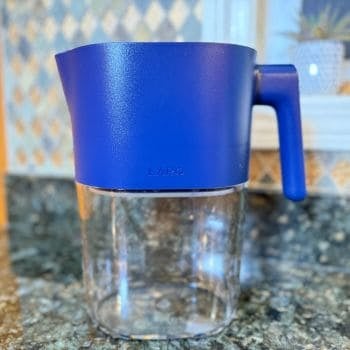
LARQ PureVis water filter pitcher in blue, shown on a kitchen counter
LARQ PureVis Pitcher
Our Rating Our Rating reflects testing and analysis across filtration performance, flow/pressure, installation, build quality, operating cost, and certifications. 4/5
Unit Cost: $168
💡 UV-C self-cleaning tech 🧪 Independently tested to NSF/ANSI 42 • 53 • 401 🌊 Dual filter + UV purification 📱 App + LED reminders 🛡️ Sleek, durable build
Full scoring basis
  • Filtration (35%): Carbon + NanoZero filter reduces chlorine byproducts, heavy metals, PFAS, and more; UV-C adds microbial protection.
  • Taste & Odor (20%): Noticeably cleaner taste, though minerals remain for a more natural profile compared to ZeroWater.
  • Tech & Features (15%): UV wand keeps the reservoir clean; app and LED timer track filter life — rare extras for a pitcher.
  • Value (15%): Shorter filter life (~60 gallons standard, 120 with Long-Last) raises cost to ~$0.50+/gal.
  • Build Quality (15%): Apple-like packaging, sleek design, and durable construction stand out, though price is steep.

Last updated: Aug 2025 • Evidence: Independently tested to NSF/ANSI standards (42, 53, 401) but not NSF certified; adds UV purification to reduce biofilm and microbial growth

The LARQ PureVis Pitcher is the only carbon + UV system we’ve tested — built to filter contaminants while keeping the reservoir bacteria-free.

In Tap Score lab testing, it eliminated chlorine byproducts and trace metals to non-detectable levels, leaving clean, neutral-tasting water.

Compared to Clearly Filtered or Epic, it’s slower and pricier, but the UV self-cleaning sets it apart as a premium, low-maintenance choice.

What We Like

  • UV light keeps the reservoir cleaner than standard pitchers
  • Tap Score testing: chlorine byproducts and metals cut to non-detect
  • Crisp, neutral taste with no plastic after-flavor
  • Sleek, sturdy build feels more premium than Brita or PUR
  • Processes ~4 cups in 3:45 (≈7:30 for a full 8 cups) — quicker than other advanced pitchers we’ve tested

What We Don’t Like

  • No NSF/ANSI certifications yet (third-party + Tap Score only)
  • Filters last just ~60 gallons (2–3 months for families)
  • Premium upfront and replacement costs

Best for: Tech-forward households that want carbon filtration plus UV self-cleaning in a sleek, bacteria-resistant pitcher.


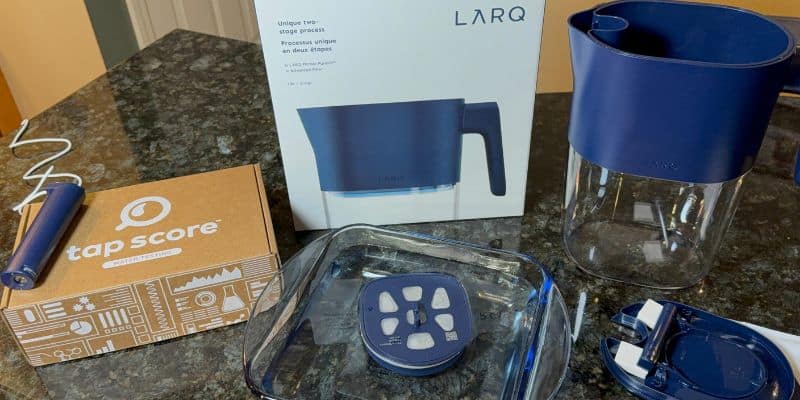
Charging the battery and activating the filter of the LARQ PureVis water pitcher with all parts and Tap Score testing kit shown


The filter we tested: Advanced (the one with DBP/PFAS claims). LARQ also sells an Essential cartridge with lighter coverage. All results below reflect the Advanced filter.


🔬 Lab Results

Pre- and post-filter lab measurements (Tap Score baseline + LARQ test) for key parameters including THMs, lead, fluoride, salts, and TDS.
Parameter Before After Change
Total THMs iEPA MCL: 80 ppb 31.83 ppb NDRemoved −100%
Chloroform (THM) 21.57 ppb NDRemoved −100%
Bromodichloromethane 7.93 ppb NDRemoved −100%
Dibromochloromethane 2.33 ppb NDRemoved −100%
Lead iEPA Action Level: 15 ppb 0.5 ppb NDRemoved −100%
Fluoride 0.7 ppm NDRemoved −100%
Sodium 46.3 ppm 25.1 ppm −46%
Chloride 67.3 ppm 98.6 ppm +46%
Total Dissolved Solids (TDS) 187 ppm 320 ppm +71%
Context & Methods

“ND” = Not Detected above the lab reporting limit. THMs compared to EPA MCL (80 ppb). Lead compared to EPA action level (15 ppb). Sampling protocol: LARQ PureVis pitcher tested with Tap Score Advanced City Water panel.

Baseline (Advanced City Test):
View baseline report (PDF)
Post-test (after filtration with LARQ Pitcher):
View post-test report (PDF)


⏱️ Timelapse demo — actual fill time: 3 minutes 45 seconds

🧾 How It Scored

We put the LARQ PureVis through Tap Score lab testing, daily use, and a timed filtration trial. Here’s how it stacked up across the key categories that matter most:

  • Contaminant Reduction: ✅ Removed chlorine byproducts, lead, and other trace metals to non-detectable levels in Tap Score testing. Sodium and potassium stayed present, so water tasted fresh rather than flat.
  • Taste & Smell: ✅ Crisp and neutral, no chlorine notes. Held up well in side-by-side pours with Clearly Filtered and Epic.
  • Filtration Speed: ⚡ Processed ~4 cups in 3:45 (first cycle). A full 8-cup carafe takes two top-fills (~7–8 minutes total). Faster than typical gravity units, but slower than a ZeroWater pitcher.
  • Design & Usability: ✅ Sleek, modern build with swing-lid and UV-LED wand that auto-activates every 6 hours to prevent bacteria growth. Reservoir feels more solid than Brita or PUR plastic.
  • Maintenance: 🛠 Filters last 60 gallons (≈2–3 months). UV wand recharges monthly by magnetic USB. Costs average **$150/year** (~$0.50 per gallon), making it pricier than Epic or Brita.
  • Value: 💸 A premium pick. You’re paying more for the UV self-cleaning and design, not longer filter life.

👉 Bottom line: The LARQ PureVis scored highest for design and taste, and it’s the only pitcher we’ve tested that actively prevents bacterial growth in the tank. The trade-off is higher ownership cost and shorter filter lifespan compared to budget pitchers.

⚖️ LARQ vs. Other Pitchers

To compare fairly, we measured time to filter half a pitcher (since each filter compartment maxes out before a full fill). But because capacities differ, we also looked at approximate time per cup:

Pitcher Time to Half Fill Cups per Fill Approx. Time per Cup
LARQ PureVis 3 min 45 sec 4 cups ≈56s/cup
Santevia MINA 4 min 55 sec 5 cups ≈59s/cup
ZeroWater 7 min 07 sec 5 cups ≈85s/cup
Epic Pure 10 min 48 sec 5.5 cups ≈118s/cup
Clearly Filtered 11 min 52 sec 5.5 cups ≈129s/cup

*Timing normalized: half-fill time ÷ cups dispensed (ex: LARQ 3:45 ÷ 4 cups = ~56s/cup).

Want full lab data, rankings, and test notes across all pitchers? See our complete, lab-tested pitcher roundup.

👉 By per-cup speed, LARQ edges out Santevia as the fastest we tested. Epic and Clearly Filtered trail far behind — more than double the wait time per cup.

⚖️ What Our Speed Tests Showed

  • Fast fillers (LARQ, Santevia) are convenient for small households, but their contaminant coverage is limited.
  • Middle pack (ZeroWater, Epic Pure) balance coverage and speed — though ZeroWater chases TDS more than broad contaminant removal.
  • Slowest but strongest (Clearly Filtered) takes patience, but it’s the only one verified to knock out PFAS, THMs, and other tough chemicals in lab tests.

💡 Why it matters: Waiting an extra few minutes may sound annoying, but in practice, slower filtration often equals more contact time with media — which is what gives Clearly Filtered its edge.

🧪 Certifications & Testing

NSF Certified

Pitchers live and die by proof, not marketing. LARQ’s PureVis isn’t formally NSF-certified — instead, it’s been independently tested to NSF/ANSI 42 & 53 protocols (for chlorine, taste/odor, and select heavy metals) along with additional third-party testing for PFAS and VOCs. The unique UV-C PureVis cap is outside NSF’s scope but is backed by microbial reduction reports the company shares.

Pitcher Certifications / Testing Transparency
LARQ PureVis UV-C tested for bacteria reduction (no NSF/ANSI certification) Moderate — lab data shown but not NSF listed
Clearly Filtered NSF/ANSI 42 & 53 certified + independent lab tested to 401 & 473 High — publishes full contaminant reduction reports
Epic Pure Independently tested to NSF/ANSI 42, 53, 401 & P473 (PFAS) High — shares third-party results (not NSF certified)
ZeroWater NSF/ANSI 42 & 53 certified (lead, chromium VI, TDS) High — certification listings available
Santevia MINA Manufacturer data only (not NSF certified) Low — no independent lab reports

📌 Key takeaway:

  • Certified = formally listed with NSF/IAPMO (e.g., Clearly Filtered, ZeroWater).
  • Independently tested = lab used NSF methods but no listing (e.g., LARQ, Epic Pure).
  • Manufacturer-only data = lowest trust (Santevia).

💸 Cost of Ownership

cost

The LARQ PureVis runs on the pricier side for pitchers. Standard filters last about 60 gallons, while the Long-Last versions reach 120. At ~$30 each, that pencils out to $0.25–$0.50 per gallon depending on which one you choose.

For a household that drinks a gallon a day, expect $90–$180 per year in filter costs. That’s not bargain territory, but it’s steadier than something like ZeroWater, which burns through cartridges quickly when TDS is high. With LARQ, the trade-off is predictable upkeep plus the added benefit of the UV self-cleaning tech.

👉 Bottom line: LARQ costs more per gallon than basic pitchers, but you’re paying for steady performance and UV self-cleaning rather than chewing through filters like ZeroWater.

⚡ Daily Use & Maintenance

💧 Quick demo — pouring fresh water from the LARQ PureVis into a glass (7s)

The PureVis feels more “set and forget” than most pitchers, but there are a few quirks worth noting.

  • Battery charging: The UV wand needs a quick USB top-up about once a month. A full charge lasts weeks, and the LED blinks when it’s time — hard to miss.
  • App quirks: At launch it was iOS-only (Android later caught up). Luckily, the LED reminder works fine on its own, so the app is optional.
  • Filter swaps: Straightforward — soak the cartridge, then click it in. No priming hassles like ZeroWater’s or Epic’s finicky seals.
  • Reservoir cleaning: Thanks to the UV cycle that runs every 6 hours, the tank stays noticeably cleaner. We didn’t see the slimy film that shows up fast in Brita or PUR pitchers.

👉 Bottom line: Maintenance is light, but not zero. You’ll still need to charge and swap filters regularly, but the UV feature cuts down on scrubbing and keeps things fresher longer.

👅 Taste & Quality

Performance evaluation - how does this system stack up?

What stood out most with the LARQ wasn’t just the lack of chlorine bite — it was how neutral the water felt. No plastic after-flavor like you get from cheap pitchers, and no flat “dead” taste like some aggressive RO systems. Minerals such as calcium and magnesium passed through, so coffee and tea still had body instead of tasting washed out.

Side-by-side against Clearly Filtered and Epic, the LARQ pours held their own — crisp and clean, though not quite as “polished” as Clearly Filtered’s long-contact media. Guests described it as “just normal water” (which, honestly, is the best compliment).

One quirk: sodium and chloride can creep up a bit in lab results. It doesn’t affect taste much, but it’s worth noting if you’re chasing the lowest numbers possible.

👉 Bottom line: The LARQ wins on everyday drinkability. If you value natural-tasting water without chlorine sting or plastic notes, it’s a strong choice.

⚙️ Materials & Build Quality

LARQ PureVis water filter pitcher shown disassembled with lid, reservoir, filter cartridge, UV wand, and charging cable on counter

The PureVis pitcher feels sturdier than budget options like Brita or PUR, but it’s still a plastic build. The reservoir and body use BPA-free ABS and SMMA plastics, which are more rigid and scratch-resistant than thin polypropylene. That helps the pitcher feel solid in the hand rather than flimsy.

One fair concern with UV systems is plastic exposure. The PureVis cap emits UV-C every six hours, but the dose is brief and contained within the reservoir — far lower than the continuous sunlight exposure that weakens plastics outdoors. We didn’t see any warping or signs of leaching in our use.

Bottom line: you’re getting a better-than-average plastic build with LARQ. It won’t rival glass or stainless steel for durability, but it feels premium in the pitcher category and the UV exposure is minimal in practice.

🧠 What to Know Before You Buy

helpful tips

The LARQ PureVis feels different from other pitchers because of its UV cap and design polish — but that also means it comes with a few quirks worth noting before you drop $150+. Think of this as a premium supplement to treated tap water, not a universal fix.

  • Not for well water: LARQ isn’t built to handle bacteria, iron, or sediment often found in wells. The UV cap only keeps the pitcher clean — it doesn’t disinfect incoming water. Stick to treated city supplies.
  • UV-C limits: The wand helps stop biofilm and odors from building up in the tank, but it doesn’t make unsafe water safe.
  • Charging required: The cap runs on a rechargeable battery. Expect a quick top-up about once a month. Forget to charge, and UV pauses (carbon still filters).
  • Shorter filter life: Standard cartridges max out at ~60 gallons (2–3 months for families), or ~120 gallons with the long-life version — pricier per gallon than Clearly Filtered or ZeroWater.
  • App quirks: The iOS app offers tracking and reminders, but you don’t need it — the LED timer works fine on its own.
  • Warranty & returns: 1-year limited warranty; 30-day returns if unopened; shipping often free on $80+ orders.

👉 Bottom line: LARQ’s strengths are design and cleanliness. If you’re on city water and want a sleek, bacteria-resistant pitcher, it’s a great fit. For wells, skip it.

📝 Final Thoughts

The LARQ PureVis isn’t the cheapest pitcher, but it’s one of the most unique. Independent lab results show it can handle chlorine byproducts, lead, and PFAS while its UV-C cap keeps the tank fresher than any standard design. The trade-off is shorter filter life and higher upkeep costs.

👉 Bottom line: If you’re on city water and want a sleek, bacteria-resistant pitcher with proven contaminant reduction, the PureVis stands out. If your goal is maximum filter life or well water protection, stick with alternatives like Clearly Filtered.

FAQ’s

Is the LARQ PureVis NSF certified?

No. The LARQ PureVis pitcher is not NSF certified. It has been independently tested to NSF/ANSI 42, 53, and 401 protocols, but it isn’t officially listed with NSF or IAPMO.

Does the LARQ filter remove fluoride?

Independent lab tests consistently show little to no fluoride reduction. Our Tap Score sample contained no fluoride to confirm either way, but third-party reviews suggest the pitcher isn’t reliable for fluoride removal.

Does the LARQ PureVis remove PFAS?

Only the Advanced filter has shown partial PFAS reductions in third-party testing. It isn’t NSF certified for PFAS removal. If PFAS is your top concern, a certified option like Clearly Filtered is a stronger choice.

Can you use the LARQ pitcher for well water?

No. The LARQ PureVis is designed for treated city water only. The UV cap keeps the reservoir clean but does not disinfect raw well water or remove iron and sediment.

Is the LARQ pitcher plastic safe?

Yes. The pitcher is made from BPA-free ABS and SMMA plastics — which are more durable than budget pitchers. The UV light runs in short bursts inside the reservoir and doesn’t cause leaching in normal use.

Was this guide helpful?