
What Is Ion Exchange in Water Filtration?

Mike Martin brings hands-on installation experience and helps validate the real-world setup and serviceability of the systems we cover.
✅ Quick answer: Ion exchange removes dissolved ions by swapping them for ions held on tiny resin beads. A water softener trades calcium and magnesium for sodium or potassium. Anion resin targets negatively charged contaminants such as nitrate. The resin has to match the ion you want to remove.
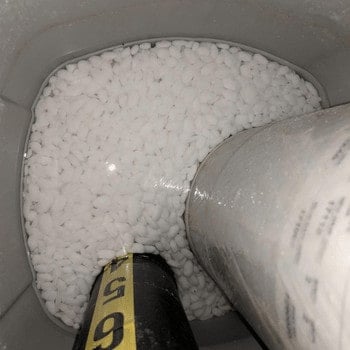
Ion exchange isn’t one universal filter. Conventional softening, nitrate removal, and deionization all use ion exchange, but they use different resins and produce different water.
Our lab testing shows the difference. A Whirlpool softener cut hardness by 91% while total dissolved solids stayed about the same. A five-stage ZeroWater pitcher took TDS from 187 ppm to below the lab’s reporting limit. Both use ion exchange, but they aren’t doing the same job.
How ion exchange works
Minerals and salts break into charged particles called ions when they dissolve in water. Calcium, magnesium, sodium, and many metals carry a positive charge. Nitrate, chloride, sulfate, and several other contaminants carry a negative charge.
Ion-exchange resin is covered with charged sites. As water passes through the resin, it holds selected ions and releases other ions with the same type of charge.
Calcium + magnesium
Holds hardness and releases sodium
A sediment filter catches particles in its pores. Ion exchange works on dissolved material that can pass straight through an ordinary sediment cartridge. That’s why describing it as a simple screen or strainer misses the point.
Cation, anion, and mixed-bed resin
| Resin type | What it exchanges | Common household use |
|---|---|---|
| Cation resin | Positively charged ions | Calcium and magnesium removal in water softeners |
| Anion resin | Negatively charged ions | Targeted treatment for nitrate, sulfate, arsenic, uranium, perchlorate, or certain PFAS |
| Mixed-bed resin | Positive and negative ions | Deionization or aggressive TDS reduction in a cartridge |
Cation exchange is the process used by a traditional salt-based water softener. The resin attracts calcium and magnesium, then releases sodium or potassium into the water.
Anion exchange targets negatively charged ions. Drinking-water systems commonly exchange them for chloride. The correct resin depends on the contaminant, competing ions, pH, and the amount of water passing through it.
Mixed-bed ion exchange combines cation and anion treatment. It can remove far more dissolved material than a conventional softener, but the smaller cartridge may exhaust quickly when the source water has high TDS.
🧪 What our tests showed
✓ We tested both approaches – a whole-house cation softener on well water and a mixed-media pitcher on city water.
A softener removes hardness without lowering TDS
We tested the Whirlpool WHES40E on Central Florida well water from the kitchen tap. Hardness fell from 18 to 1.6 grains per gallon. Calcium dropped from 72 to 5 ppm, magnesium from 24 to 2 ppm, and iron from 1.2 to 0.1 ppm.
TDS moved from 340 to 350 ppm, which is effectively unchanged for this comparison. That isn’t a softener failure. The resin exchanged calcium and magnesium for sodium instead of removing every dissolved ion from the water.
Read the full Whirlpool WHES40E review and lab results.
Mixed-bed treatment can drive TDS toward zero
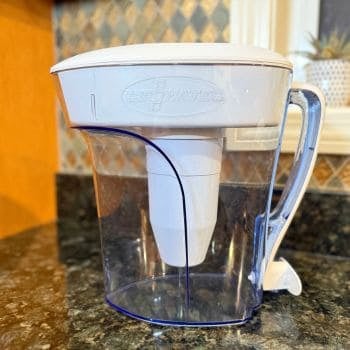
Our ZeroWater pitcher sample started at 187 ppm TDS. After the complete five-stage cartridge, TDS was below the lab’s reporting limit. Sodium, chloride, and fluoride were also non-detect in the treated sample.
ZeroWater uses more than ion-exchange resin, so this wasn’t a resin-only experiment. The complete cartridge still shows how mixed-bed treatment differs from a softener. It targets positive and negative dissolved ions instead of swapping hardness alone.
The trade-off showed up during ownership. The water tasted noticeably flatter, and the cartridge required more frequent replacement than mineral-retaining pitchers. See our ZeroWater pitcher lab test.
What can an ion exchange water filter remove?
The honest answer is: only the ions its resin is designed to target. The words “ion exchange” don’t prove that a product removes lead, nitrate, PFAS, arsenic, or any other named contaminant.
- Standard softener resin: Calcium and magnesium. Some certified systems also have claims for specific dissolved metals.
- Targeted anion resin: Depending on the resin, nitrate, sulfate, perchlorate, arsenic, uranium, chromium-6, or certain PFAS.
- Mixed-bed cartridge: A broad mix of positive and negative ions, often measured as lower TDS.
Ion exchange doesn’t reliably solve sediment, bacteria, viruses, chlorine taste, or VOCs by itself. Those problems call for different treatment stages. Start with a water test, then verify the exact contaminant claim for the system you’re considering.
Ion exchange vs. reverse osmosis
Ion exchange and reverse osmosis both work on dissolved contaminants, but they use different mechanisms.
| Method | Best at | Main limitation |
|---|---|---|
| Ion exchange | Targeting ions that match the resin | Capacity changes with water chemistry and competing ions |
| Reverse osmosis | Broad reduction of many dissolved contaminants | Produces reject water and usually treats one drinking-water tap |
| Activated carbon | Chlorine, taste, odor, and many organic chemicals | Doesn’t soften water or broadly remove dissolved salts |
Many drinking-water systems combine these methods. An RO system may use carbon before the membrane and a small deionization or polishing cartridge afterward. Compare the systems we’ve tested in our reverse osmosis guide.
How resin regeneration works
A conventional softener restores its resin with concentrated brine. Sodium or potassium pushes the collected calcium and magnesium off the beads, and the system sends that mineral-rich brine to the drain.
Not every ion-exchange product regenerates. Small cartridges and some selective anion resins are replaced when exhausted. A salt-free conditioner also doesn’t regenerate ion-exchange resin because it isn’t a softener and doesn’t remove hardness ions.
For the full cycle, see how water-softener regeneration works.
Is ion exchange resin safe for drinking water?
Resin intended and certified for drinking-water use is designed for contact with potable water. The larger concern is using the wrong resin, running it beyond capacity, or ignoring the waste stream created during regeneration.
For a residential cation-exchange softener, check the exact model’s NSF/ANSI 44 listing. That standard covers hardness reduction, material safety, structural integrity, pressure drop, softening capacity, and brine-system accuracy. Certification to the standard doesn’t automatically prove removal of every contaminant.
Does ion exchange make sense for your water?
Use a conventional cation softener when hardness is the problem and you want scale reduction throughout the house.
Use targeted anion exchange only after a lab identifies a matching contaminant and the system is sized for your water chemistry.
Use mixed-bed ion exchange when very low dissolved solids are the goal and you accept shorter cartridge life or more frequent regeneration.
Choose another method when the problem is sediment, microorganisms, chlorine, or organic chemicals. Ion exchange isn’t better than RO or carbon. It’s better only when the resin matches the ion you need to remove.