

✅ Quick answer: Go with pellets if your softener takes either form. They cost a little more but rarely bridge. Crystals are cheaper and work fine, as long as they stay loose in the tank.
Ever stood in the hardware aisle staring at bags of softener salt, wondering which one won’t brick up your tank? The price gap is obvious. What the bag won’t tell you is how that salt behaves once it’s sitting in your brine tank.
🔍 Key takeaways:
- Pellets: the safer choice if your tank has a history of bridging or caking.
- Crystals: usually the budget choice, as long as your manual allows them and they stay loose.
- Purity matters: look for softener salt with less than 1% impurities.
- Switching types: use up or remove the old salt first. Mixing shapes raises the chance of a blockage.
🤔 What’s the difference between pellets and crystals?
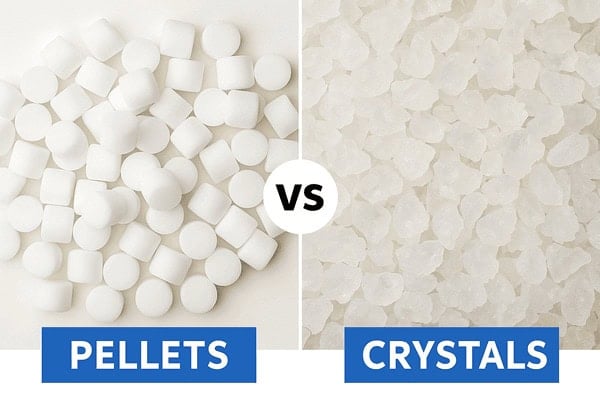
Both make the brine your softener uses to recharge its resin. What actually differs is the shape, the price, the purity, and whether the salt stays loose or packs into a brick inside the tank.
| Type | How it’s made | Main upside | Watch for |
|---|---|---|---|
| 🧊 Crystals | Usually solar salt, made by evaporating brine | Lower price, widely available | Caking or bridging in some tanks |
| 🪨 Pellets | Refined salt compressed into a uniform shape | Less likely to bridge | Higher price, and low-quality pellets can leave residue |
📌 Take note: Shape is only half the decision. Whirlpool wants salt that’s at least 99% pure, whether you go with evaporated pellets or solar crystals. Check your own manual before you buy.
🛠️ When to choose pellets vs. crystals

There’s no universal winner here. Start with the salt types your manual lists, then let price and your tank’s own history settle it.
| Situation | Better starting point | Why |
|---|---|---|
| Your manual specifies one salt type | Use that type | The manufacturer’s instructions come first |
| You’ve dealt with bridging or caking | Pellets | Their uniform shape can reduce bridging |
| Both types are allowed and price matters most | Crystals | Often the cheaper bag |
| You want the cleanest option | Compare the purity label | Impurity level matters more than shape alone |
💡 The simple rule: if both are approved and crystals stay loose in your tank, save the money. If they cake or bridge, pellets are worth the extra.
What happened in our Whirlpool WHES40E
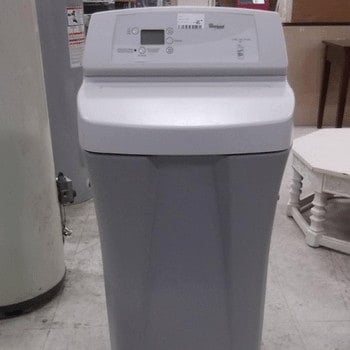
We’ve run a Whirlpool WHES40E on Central Florida well water for about five years, and pellets were our normal salt. One refill we tried crystals to save a few dollars. Bad call.
They caked into a crust and bridged. The tank looked full, but we were getting hard water again, because the salt above the bridge had stopped reaching the water below. We dug it out by hand and went back to pellets.
That doesn’t prove crystals fail in every tank. It just shows the cheaper bag isn’t always the cheaper choice, not if your setup is prone to bridging.
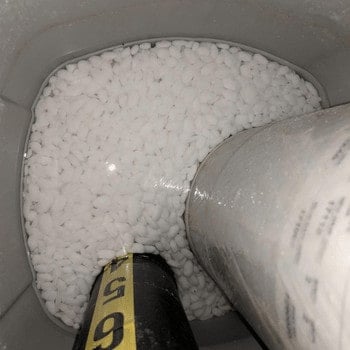
Whirlpool allows evaporated pellets or solar crystals in the WHES40E as long as the salt has less than 1% impurities. We cover the machine itself, including our ownership notes and water results, in our Whirlpool WHES40E review.
💡 Are you looking at a salt bridge or salt mush?

Salt bridge
A salt bridge is a hardened crust with an empty gap underneath it. The tank can look full while the salt above never touches the water, so the softener quietly stops regenerating. Pellets can lower the odds of another bridge, but humidity, overfilling, and long stretches with no salt movement all play a part.
Fix: follow the manufacturer’s instructions for safely breaking and removing the crust. Our salt bridge guide walks through the diagnosis and cleanup.
Salt mush
Salt mush is a wet, packed layer near the bottom of the brine tank. It can choke off brine production even when there’s loose salt sitting above it.
Fix: remove the compacted salt and clean the tank the way the manual says. If the salt level never seems to drop, use our guide to diagnose a water softener that isn’t using salt.
📌 Something to know: Hard water doesn’t automatically mean you picked the wrong salt. A stuck float, a blocked injector, wrong settings, or an overdue regeneration can all cause the same symptoms.
What are solar salt crystals?
Solar salt crystals are made by letting sun and wind evaporate brine. “Solar” is just the production method, not a sign the crystals only work with a certain softener or water source.
They’re a normal salt option when your manual allows them. Read the bag for purity and additives instead of assuming every product labeled “solar salt” is the same.
🔄 Can you mix or substitute pellets and crystals?

You can swap one for the other if your manual approves both. Just don’t pour one shape straight on top of the other. Whirlpool says to stick with one salt shape, because a mixed tank is more likely to bridge or block.
- Check the manual. Confirm the new salt type and any additives are allowed.
- Let the level fall. Use up most of the old salt before adding the new type.
- Remove any problem salt. Clear out existing crust or mush instead of burying it.
- Add the new salt. Keep the tank below the manufacturer’s fill limit.
- Check the tank later. Make sure the salt stays loose and the level drops with use.
There’s no special break-in for the resin just because the salt changed shape. And don’t touch the salt dose or regeneration settings unless the manual or your water test tells you to.
What about water softener salt blocks?
Don’t treat a salt block like an oversized pellet. A block can wedge against the tank wall and keep water from circulating around it. Whirlpool doesn’t recommend block salt for the WHES40E, and plenty of other cabinet softeners have the same restriction.
If your manual specifically calls for blocks, use the size and placement it lists. Otherwise, stick with an approved bagged pellet or crystal.