

✅ Quick answer: Salt-free conditioners can reduce the amount of hard scale that attaches to plumbing and heating surfaces, but they don’t remove calcium or magnesium. Your hardness and TDS readings should remain nearly the same, and the water won’t behave like conventionally softened water.
What matters most
- “Working” means reducing scale attachment, not producing a lower hardness result.
- Mineral spotting, soap behavior, and the familiar hard-water feel may remain.
- Performance depends on the specific technology, water chemistry, flow, temperature, and equipment rating.
- Look for independent scale-reduction testing, such as certification to IAPMO/ANSI Z601, rather than relying on the term “salt-free softener.”
What does “work” mean for a salt-free system?
| Expected result | Salt-free conditioner | Ion-exchange softener |
|---|---|---|
| Lower hardness test | No | Yes |
| Lower calcium and magnesium | No meaningful removal expected | Yes |
| Less hard scale attachment | Possible when properly selected and installed | Yes, because hardness is removed |
| Soft-water soap behavior | No | Yes |
| Salt and regeneration | Usually not required | Required |
| Brine discharge | None from the conditioning process | Produced during regeneration |
The marketing term “salt-free water softener” creates the confusion. These products are more accurately described as scale-control devices or water conditioners.
If your goal is lower hardness, fewer hardness minerals, or traditionally softened water, a salt-free system doesn’t meet that goal. If your goal is reducing scale without salt or wastewater, it may be worth considering.
How template-assisted crystallization works
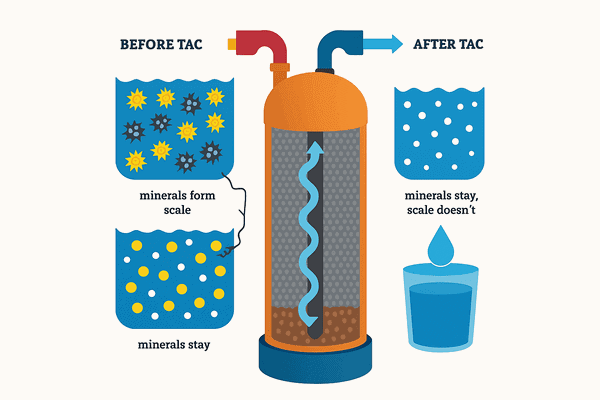
Template-assisted crystallization, usually shortened to TAC, uses specialized media designed to provide nucleation sites for calcium-carbonate crystals. The intended result is that more mineral crystallization occurs in the flowing water and less hard scale forms directly on protected surfaces.
The minerals still travel through the plumbing. TAC doesn’t collect them in a tank or send them to a drain, so a hardness test shouldn’t show the dramatic reduction produced by ion exchange.
Other products sold as salt-free systems may use different methods. Magnetic, electronic, polyphosphate, catalytic, and TAC devices shouldn’t be treated as interchangeable merely because none uses softener salt.
Our detailed TAC technology guide explains the proposed crystallization process and media limitations.
What independent testing tells us
An Arizona State University study (Fox et al., 2011) found that TAC reduced scale formation by roughly 88–97% across its test waters, using a controlled water-heater protocol. That’s evidence the technology can reduce scale formation in a defined setup, not a promise that every residential installation will achieve the same result.
A University of Waterloo study tested TAC with two source waters and found only small changes in calcium and magnesium concentrations. The reductions weren’t large enough to represent practical softening.
Together, these findings describe the intended tradeoff: scale can be reduced without removing much hardness. Performance still needs to be matched to the product’s tested conditions and the home’s water chemistry.
What we can learn from visual testing
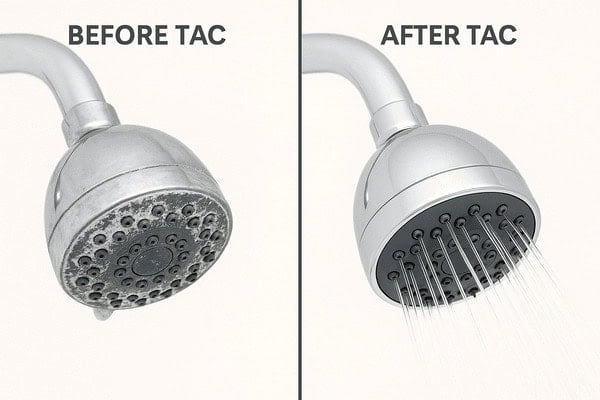
Our practical assessment is more visual than laboratory-based. We look for changes in the amount and texture of new buildup on fixtures, showerheads, glass, and other surfaces after treatment.
That’s useful because scale prevention is the outcome homeowners can actually see. It’s not the same as a controlled scale-reduction test.
| Visual observation | What it may suggest | What it can’t prove |
|---|---|---|
| Less crust on a showerhead | New scale may be attaching less strongly | A specific reduction percentage |
| Deposits wipe away more easily | The character of the buildup may have changed | That calcium or magnesium was removed |
| Water spots remain | Minerals are still present when droplets evaporate | That the system has failed |
| Hardness reading stays similar | The system is conditioning rather than softening | Whether scale protection is effective |
Cleaning method, water use, fixture material, temperature, evaporation, and observation time can all affect a before-and-after photograph. We use visual evidence as a homeowner-level example, not as a replacement for standardized testing.
How to tell whether your salt-free system is working
- Confirm that the system is installed in the correct direction and within its rated flow range.
- Clean one representative fixture or heating surface so you’re observing new deposits rather than old scale.
- Photograph the same area, lighting, and angle at regular intervals.
- Compare how quickly deposits return and how difficult they are to remove.
- Verify that pretreatment, cartridge changes, and media replacement follow the manufacturer’s instructions.
- Don’t use unchanged TDS or hardness as proof of failure — neither is expected to fall substantially.
A controlled home comparison is difficult because water conditions and cleaning habits change. The strongest consumer evidence remains independent certification for scale reduction plus observations that match the product’s intended result.
When salt-free conditioning is a good fit

| Your goal or condition | Salt-free fit | Why |
|---|---|---|
| Reduce new scale without salt | Potentially good | This is the intended use |
| Lower measured hardness | Poor | Hardness minerals remain |
| Improve soap lather and eliminate soap curd | Poor | The water still behaves as hard water |
| Avoid regeneration water and brine | Good | TAC doesn’t regenerate like ion exchange |
| Remove iron, sediment, sulfur, or contaminants | Poor by itself | Separate treatment may be required |
| Protect a water heater from scale | Potentially good | Use a device tested for that application and water chemistry |
There’s no universal hardness cutoff that applies to every salt-free product. Use the manufacturer’s tested range and certification conditions instead of assuming all systems stop working at 15 GPG.
When pretreatment may be necessary
Iron, manganese, sediment, oil, disinfectants, pH, alkalinity, silica, and other water characteristics can affect media or scale behavior. The relevant limits vary by product.
Don’t add a sediment or iron filter automatically. Test the water and compare the results with the conditioner’s published requirements. Well-water installations deserve particular care because a clear-looking sample can still contain dissolved iron, manganese, or other conditions outside the media rating.
If pretreatment is required, install and maintain it according to both manufacturers’ instructions. A generic prefilter can’t correct every unfavorable water condition.
Salt-free conditioner vs. water softener

| Decision factor | Salt-free conditioner | Ion-exchange softener |
|---|---|---|
| Primary purpose | Scale reduction | Hardness removal |
| Hardness after treatment | About the same | Substantially lower when operating correctly |
| Water feel | Still feels like the source water | Characteristic softened-water feel |
| Salt | None for TAC treatment | Required for regeneration |
| Wastewater | No regeneration discharge | Brine and rinse water discharged |
| Maintenance | Prefilters and media as specified | Salt, cleaning, and valve maintenance |
The choice isn’t “natural versus chemical” or “modern versus outdated.” It’s a choice between two different treatment outcomes.
Maintenance is product-specific

Salt-free doesn’t always mean maintenance-free. Some systems use replaceable cartridges, sediment or carbon pretreatment, or media with a stated service life. Others are installed in tanks with different replacement procedures.
Don’t flush a media bed every six months unless the manufacturer instructs you to do so. Unnecessary backwashing or chemical cleaning can damage media that wasn’t designed for it.
Before purchasing, identify the replacement interval, replacement-media cost, maximum flow rate, pressure requirement, warranty conditions, and every pretreatment cartridge.
Are salt-free conditioners more environmentally friendly?
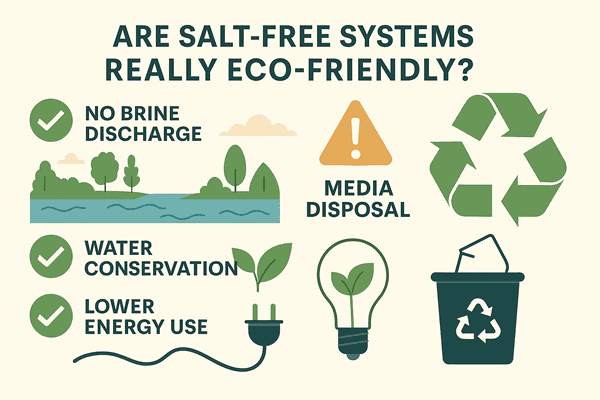
TAC avoids softener salt, regeneration water, and chloride-rich brine discharge. Those are meaningful operational differences, especially where brine discharge is restricted or water conservation is important.
The complete comparison also includes media manufacturing, replacement cartridges, pretreatment, shipping, and disposal. Salt-free operation has clear advantages in water and brine use, but “zero environmental impact” would be an unjustified claim.
What to check before buying
- Is the product a TAC conditioner, chemical scale inhibitor, electronic device, or something else?
- Has that exact model been independently tested for scale reduction?
- Does it meet IAPMO/ANSI Z601 or another relevant published test standard?
- Are your hardness, iron, manganese, pH, temperature, and flow within its stated limits?
- What media and prefilters must be replaced, and what do they cost?
- Does the warranty promise scale reduction, or only freedom from manufacturing defects?
A percentage such as “99% effective” is meaningless without the test method, water conditions, flow, temperature, and exact model attached to it.
The bottom line
Salt-free conditioners can make a visible difference in scale formation, but they don’t soften water in the conventional sense. Hardness minerals, TDS, water spots, and hard-water soap behavior generally remain.
Choose one when scale reduction without salt or regeneration is the actual goal. Choose ion exchange when you need measurable hardness removal and the household effects of truly soft water.
If scale control fits your goal, compare the salt-free conditioners we recommend for different water conditions.