

Waterdrop vs Cloud RO at a glance
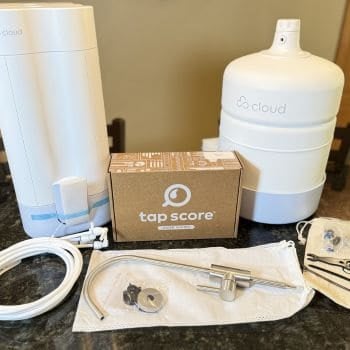
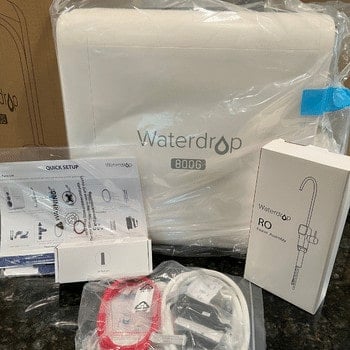
These systems don’t deliver water the same way. Cloud uses a 2.8-gallon pressurized tank and a 50 GPD membrane. Waterdrop uses an 800 GPD tankless design that produces water as you open the faucet.
That difference affects cabinet space, flow, noise, power, and how each system behaves when several containers are filled in a row.
| Feature | Cloud RO | Waterdrop G3P800 |
|---|---|---|
| Current list price | $649 | $999 |
| Design | Tank-based | Tankless |
| Production rating | 50 GPD membrane | 800 GPD |
| Pure-to-drain ratio | 1:1 | 3:1 |
| Remineralization | Included | Optional cartridge |
| Power | Replaceable battery | Electrical outlet |
| Monitoring | Bluetooth app | Smart faucet |
| Published certification | NSF/ANSI 58 | NSF/ANSI 42, 53, 58, and 372 |
| Replacement cost | $200 complete pack | About $160 annually, per Waterdrop |
| Warranty | 5 years | 1 year |
Prices and promotions change. The list prices above create a consistent comparison, but check the current selling price before deciding.
Check the current Cloud RO specifications and Waterdrop G3P800 specifications before ordering.
How we compared them
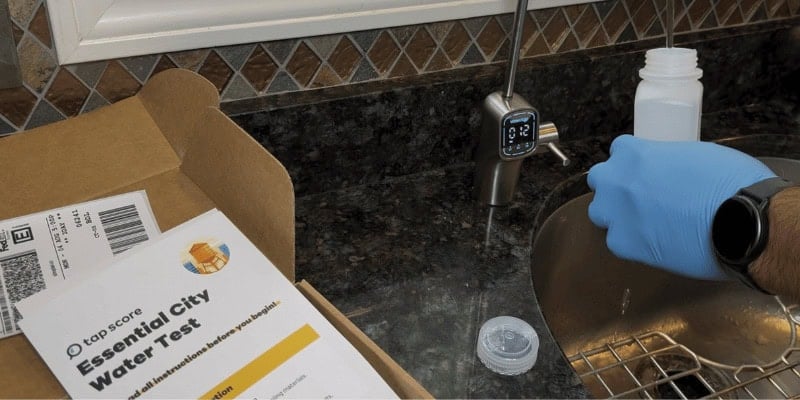
We ran the Waterdrop G3P800 in our New Hampshire home for more than three years. Cloud RO replaced it in August 2025 and has now been used by the same household for 12 months.
Our evidence includes installation, daily use, filter changes, app and faucet monitoring, a timed Cloud flow test, and finished-water laboratory reports for both systems. We also ran separate PFAS and microplastics panels on water treated by the Waterdrop.
✓ QWL comparison context – both systems served the same household, but the samples were collected at different times and aren’t a controlled side-by-side experiment.
Source-water chemistry changed between sampling dates. Our Cloud system also receives water after whole-house carbon filtration. We can compare the finished water we observed, but we won’t present the numbers as simultaneous removal percentages.
Filtration and lab evidence
Both systems produced finished water that scored well in our testing. The more useful distinction is the type and depth of evidence behind each one.
| Observed result | Cloud RO | Waterdrop G3P800 |
|---|---|---|
| Tap Score result | 99/99 after 12 months | 96/99 in our finished-water test |
| TDS in tested sample | 30.8 ppm | 28 ppm |
| Total THMs | Below reporting limit | Not detected |
| Lead | Below reporting limit | Not detected |
| Fluoride | Below reporting limit | Not detected |
| Separate PFAS panel | Not run by QWL | 14 analytes, all not detected |
| Separate microplastics panel | Not run by QWL | Not detected in our sample |
Cloud’s 12-month sample was collected before we replaced its original cartridges. Lead, fluoride, copper, nitrate, and total THMs were below their laboratory reporting limits. The system received the maximum 99/99 Tap Score.
Waterdrop has the deeper contaminant-specific proof in our library. Its separate PFAS and microplastics tests add evidence that we don’t have for Cloud.
Cloud has the better long-term checkpoint. We retested its finished water after a full year on the original filters. Those aren’t conflicting advantages. They answer different questions.
Read the complete Cloud RO ownership and lab review or our Waterdrop G3P800 test results.
Certification: Waterdrop has broader coverage
Cloud RO is listed under NSF/ANSI 58 for TDS reduction. Cloud publishes additional third-party testing, but a tested claim isn’t automatically the same as a certification shown in the public NSF listing.
Waterdrop currently lists the G3P800 under NSF/ANSI 42, 53, 58, and 372. That gives Waterdrop the broader published certification stack.
We removed an older NSF/ANSI 401 reference from this comparison because Waterdrop’s current G3P800 product page no longer includes it in the certification line.
Certification is one reason to choose Waterdrop. It doesn’t erase Cloud’s 12-month laboratory result, five-year warranty, or our ownership experience.
Taste and remineralization
Cloud wins on taste in our home. Its remineralization cartridge comes standard and adds calcium, magnesium, potassium, sodium, and zinc after the membrane.
The Waterdrop’s standard configuration leaves the water more stripped. It was clean, but our family preferred the taste from Cloud. The kids noticed the difference without being prompted.
Waterdrop sells an optional remineralization cartridge, so this isn’t an unsolvable weakness. It does add another component and replacement schedule to a system that costs more at list price.
Don’t use TDS alone to judge safety or contaminant removal. A TDS meter can’t identify lead, PFAS, nitrate, or another individual contaminant. Here, the readings help explain how much dissolved material remained after treatment, not whether either sample was safe.
Flow, tank recovery, and water waste
Cloud filled a one-gallon container in 2 minutes 19 seconds during our timed test. Its pressurized tank supplies water immediately, then the 50 GPD membrane refills the stored volume.
The tank hasn’t run dry during ordinary use by four people. A long run of large containers can still use the stored water faster than the membrane replaces it.
Waterdrop’s 800 GPD tankless design is the stronger choice for repeated filling. We aren’t publishing an estimated Waterdrop gallon time as if we measured it. Its rated production and direct-flow design establish the advantage without inventing a stopwatch result.
Waterdrop also wins on wastewater efficiency. Its 3:1 rating means three gallons of purified water for each gallon sent to the drain. Cloud’s 1:1 rating means one purified gallon per gallon sent to the drain.
Cabinet space and installation
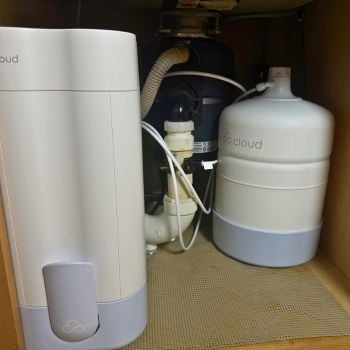
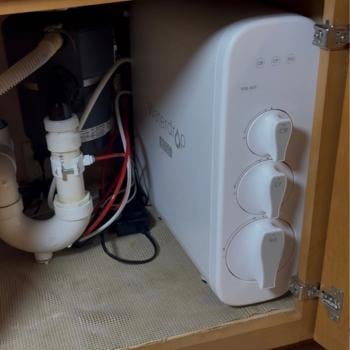
Waterdrop is the easier shape to fit. Its body is about 18.1 inches deep, 5.7 inches wide, and 17.7 inches tall. There is no separate tank.
Cloud’s filter module is smaller, but the separate tank changes the equation. The module is about 11 by 7 by 16 inches, and the tank is roughly 9 by 9 by 15 inches. Measure both pieces and the tubing path.
Cloud avoids one common installation problem: it doesn’t need an outlet. Waterdrop does. We shared the Waterdrop outlet with a garbage disposal, which meant unplugging and reconnecting equipment more often than we liked.
Both systems need a dedicated drinking-water faucet and a drain connection. Cloud’s hardware went in quickly, but its three fill-and-drain flush cycles took several hours. Waterdrop’s startup was faster.
Monitoring and day-to-day ownership
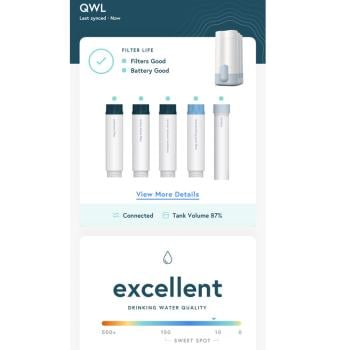
Cloud’s app shows inlet, filtered, and remineralized TDS, plus tank volume, battery status, gallons used, and estimated filter timing. The system uses Bluetooth, so it can’t be checked away from home.
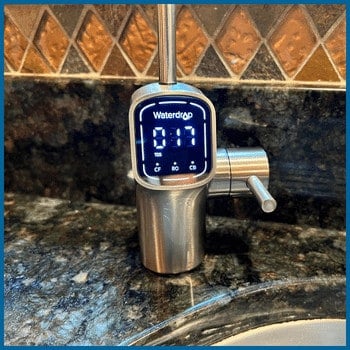
Waterdrop keeps the useful information at the faucet. Its display shows finished-water TDS and filter status without asking you to open an app.
We prefer Cloud’s deeper usage data. Someone who wants fewer connected features may prefer Waterdrop’s simpler display.
Our bigger ownership distinction is less technical. Waterdrop needed more attention around the outlet and late-cycle TDS readings. Cloud has been easier to forget about. Both systems continued producing water, but Cloud created fewer small chores.
Replacement filters and long-term cost
Cloud costs less to buy at current list prices, but its replacement model is less flexible. The $200 pack includes all four cartridges and a replacement battery. Cloud says the typical interval is about one year, while its app adjusts the recommendation from system use.
Our original Cloud filters were still installed when the system earned 99/99 after 12 months. That’s useful evidence for our household, not a guarantee that every home will get the same life.
Waterdrop sells the G3P800 cartridges individually. It currently estimates an average annual replacement cost of about $160.
Waterdrop rates the prefilter for six months, the carbon filter for 12 months, and the membrane for 24 months.
A fixed three-year savings claim would be misleading because sale prices, household use, source water, and replacement timing change.
The reliable conclusion is narrower. Cloud starts with the lower list price. Waterdrop publishes the lower annual cartridge cost and lets you replace cartridges individually.
What about the Waterdrop G3P600 and X12?
The G3P800 isn’t Waterdrop’s only alternative to Cloud. The G3P600 costs less and follows the same basic tankless design with a lower output rating.
If you like the G3P800 but don’t need 800 GPD, the G3P600 is the closer value option.
The X12 moves in the other direction. It adds 1,200 GPD output, alkaline remineralization, and a digital faucet. That makes it closer to Cloud on finished-water taste, but it costs more and still needs an outlet.
We haven’t owned either model, so our verdict on this page remains Cloud RO versus the G3P800.
Which system should you buy?
Choose Cloud RO if:
- You have room for a separate storage tank
- You want remineralization included
- You don’t have a free outlet under the sink
- You want app-based usage and filter tracking
- You value the five-year warranty
See our complete Cloud RO review and 12-month lab results.
Choose the Waterdrop G3P800 if:
- Your cabinet can’t accommodate a tank
- You regularly fill several large containers in a row
- Water-use efficiency is a priority
- You want broader certification coverage
- You prefer individually sold replacement cartridges
Read our long-term Waterdrop G3P800 review.
Our verdict
We’d buy Cloud RO again for our kitchen. The standard remineralization, battery-powered installation, useful app, five-year warranty, and 99/99 result after 12 months make it the better everyday system for us.
Waterdrop still wins two decisions that can override everything else: cabinet space and tankless output. It also wastes less water and carries broader listed certification coverage.
The simplest decision rule is this: buy Cloud when you have room for the tank. Buy Waterdrop when the tank is the problem.
If neither trade-off settles it, compare both with the other systems in our lab-tested reverse osmosis guide.
Frequently asked questions
Cloud RO is better for buyers who want built-in remineralization, app tracking, no electrical outlet, and a five-year warranty. Waterdrop G3P800 is better when cabinet space, tankless delivery, a 3:1 pure-to-drain ratio, or broader certification coverage leads the decision.
Waterdrop G3P800 is the stronger choice for repeated filling because its 800 GPD tankless design produces water on demand. Cloud delivered one gallon in 2 minutes 19 seconds in our test, but its 50 GPD membrane must recover the storage tank after heavy use.
Waterdrop G3P800 has the better published ratio. Its 3:1 pure-to-drain rating means three gallons of filtered water per gallon sent to the drain. Cloud RO is rated at 1:1.
Waterdrop G3P800 requires an electrical outlet. Cloud RO uses a replaceable battery to run its sensors and internal pump, so it doesn’t need a wall outlet.
Our G3P800 remained reliable through more than three years of household use and produced strong finished-water lab results. The brand also publishes model-specific certification and replacement information. We judge the individual model and its evidence rather than relying on the brand name alone.