

✅ Worth it? Yes. This Cloud RO review is based on two Tap Score tests and 12 months of daily use. The original cartridges and battery were still installed when the second sample earned 99/99. We’d buy it again. Our family prefers the water, and the lost cabinet space has been worth it.
Skip it if cabinet space is tight or you want Wi-Fi monitoring away from home. It’s also a poor fit if you prefer inexpensive standard cartridges sold individually.
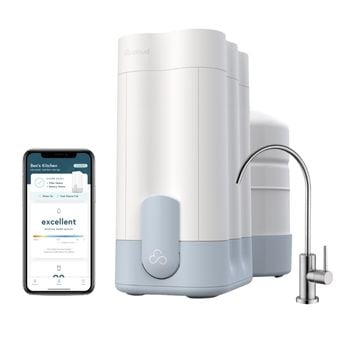
- Filtration (RO) 45% 5/5
- Flow/Pressure 20% 5/5
Full scoring basis
- Filtration (RO) (45%): Score: 5/5 – The September 2025 Cloud-faucet sample earned 97/99. The August 2026 retest earned 99/99 after 12 months on the original filtration cartridges. TDS measured 30.8 ppm in the retest, while lead, fluoride, copper, nitrate, and total THMs were below their laboratory reporting limits.
- Flow/Pressure (20%): Score: 5/5 – In our timed test, the 2.8-gallon pressurized tank and battery-powered system delivered one gallon in 2 minutes 19 seconds, about 0.43 GPM. The tank hasn’t run dry during 12 months of normal use by our family of four.
- Install/Maint (10%): Score: 5/5 – Our hardware installation took under 30 minutes; the three-tank flushing sequence took several hours. The original filtration cartridges and battery were still in service at the 12-month test.
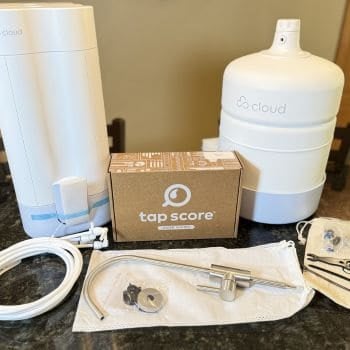
- Build (10%): Score: 5/5 – The compact filter module uses a separate storage tank, an internal permeate pump, twist-lock cartridges, app monitoring, and no wall outlet. The larger total footprint is the main tradeoff against a tankless system.
- Taste (5%) – Score: 5/5
- Cost (5%) – Score: 5/5
- Certs (5%) – Score: 5/5
- Overall: 5/5 — weighted average of the factors above
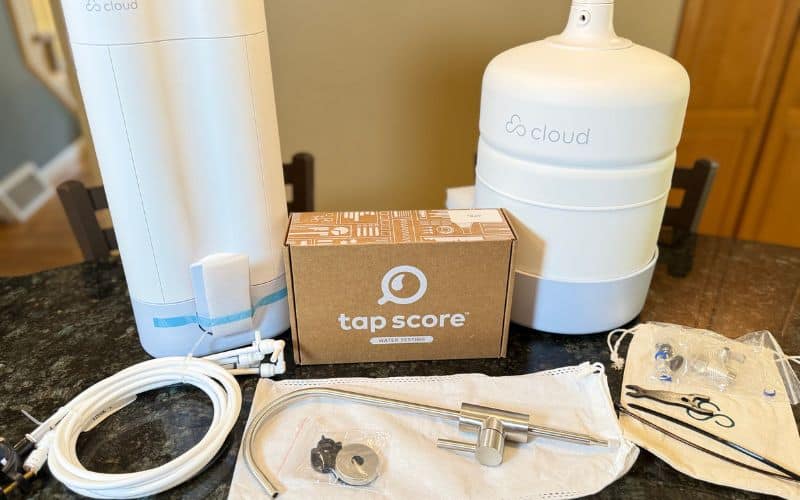
We installed Cloud RO in August 2025 after three years with the Waterdrop G3P800. The hardware went in quickly. The initial fill-and-drain sequence took much longer, so this isn’t a project to start an hour before dinner.
Three weeks after installation, water from the Cloud faucet scored 97/99 through Tap Score. New cartridges should perform at their best, so we wanted to see what a full year of daily use would do. We sampled the same faucet again at 12 months before changing the cartridges or battery. The second sample scored 99/99.
What we like about this RO system
- No cartridge or battery changes during the first 12 months
- Remineralization keeps the finished water from tasting stripped
- The battery-powered system doesn’t need an under-sink outlet
- The app shows filter status, tank volume, TDS, battery, and gallons used
- The storage tank kept up with four people in our household
Main drawbacks
- The app uses Bluetooth, so it can’t be checked away from home
- The filter module and tank take more cabinet space than a tankless RO
- Cloud currently sells the replacement components as a complete $200 kit
- Cloud’s advertised 1:1 purified-to-wastewater ratio is less efficient than Waterdrop’s advertised 3:1 ratio
Best for: Homes with enough cabinet space for the tank but no convenient under-sink outlet.
How the Cloud RO system works
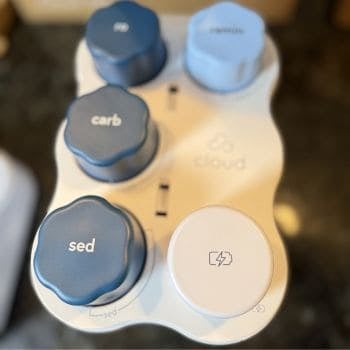
Cloud RO uses a four-stage reverse osmosis system:
- Sediment filter: Catches larger particles before they reach the other filtration stages.
- Carbon filter: Handles compounds that can affect the water’s taste and odor.
- RO membrane: Does most of the dissolved-contaminant reduction.
- Remineralization filter: Adds minerals back before the water reaches the dedicated faucet.
The separate tank is the defining part of the design. Unlike many newer tankless reverse osmosis systems, Cloud stores filtered water under pressure and runs its controls from a replaceable battery. It takes more room under the sink, but water was ready whenever we opened the dedicated faucet.
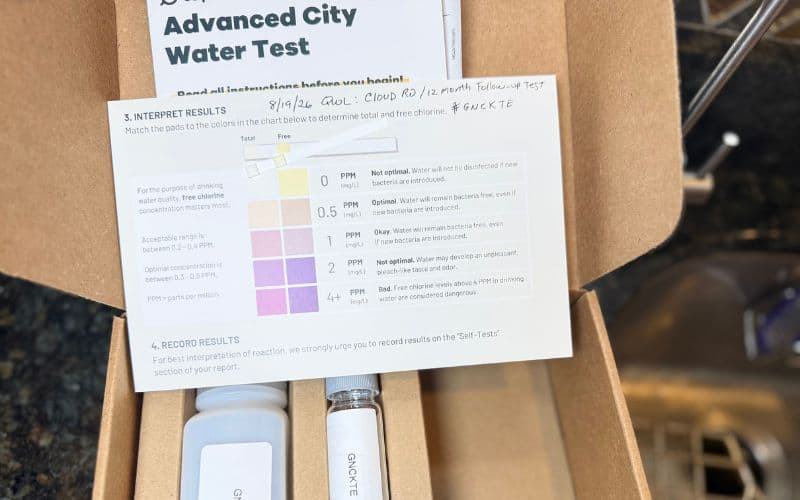
Cloud RO water test and contaminant reduction results after 12 months
At the 12-month check, we hadn’t experienced a leak, an error, a loss of normal faucet output, or an empty tank. The system had worked as it should since day one, and the app hadn’t called for a filter replacement before we collected the anniversary sample.
- September 2025: The Cloud-faucet sample scored 97/99 after about three weeks of use.
- August 2026: The same faucet scored 99/99 after 12 months and 204 gallons on the original cartridges and battery.
- At 12 months: Lead, fluoride, copper, nitrate, and total THMs were below their laboratory reporting limits. TDS measured 30.8 ppm.
We tested the finished water because that is what our family drinks.
✓ QWL long-term lab result – 99/99 Tap Score after 12 months and 204 gallons on the original filtration cartridges.
🔬 Tap Score Lab Results – September 2025 vs. August 2026
| Parameter | September 2025 | August 2026 | Result |
|---|---|---|---|
| Tap Score | 97/99 | 99/99 | Higher score at 12 months |
| Time in service | About 3 weeks | 12 months | Long-term checkpoint |
| Filtration cartridges | Original | Original | No replacement before either test |
| pH | 7.5 | 7.0 | Context only |
| Total dissolved solids (TDS) iTDS doesn’t identify individual contaminants | 66.2 ppm | 30.8 ppm | Varied between samples |
| Hardness | 36 ppm | 12.6 ppm | Context only |
| Calcium | 2.22 ppm | 0.888 ppm | Present after filtration |
| Magnesium | 7.41 ppm | 2.53 ppm | Present after filtration |
| Sodium | 4.32 ppm | 6.81 ppm | Present after filtration |
| Potassium | 2.46 ppm | 0.331 ppm | Present after filtration |
| Total THMs | ND Below RL | ND Below RL | Below reporting limit in both |
| Lead | ND Below RL | ND Below RL | Below reporting limit in both |
| Fluoride | ND Below RL | ND Below RL | Below reporting limit in both |
| Copper | ND Below RL | ND Below RL | Below reporting limit in both |
| Nitrate as N | ND Below RL | ND Below RL | Below reporting limit in both |
Context and methods
- Both columns show finished water collected from the same Cloud faucet. This is a long-term comparison, not an untreated-versus-treated removal test.
- Differences between dates may reflect source-water conditions, sampling, cartridge age, and remineralization. They don’t isolate membrane aging.
- September 2025 – three-week sample: Water collected directly from the dedicated Cloud faucet with the original filtration cartridges and battery installed.
- August 2026 – 12-month sample: Water collected from the same faucet after 204 gallons recorded by the app, before replacing any filtration cartridges or the battery.
- The Advanced City Water Test wasn’t a dedicated PFAS or microplastics panel.
- The mineral results confirm that calcium, magnesium, sodium, and potassium reached the faucet. They don’t separate minerals already in the source water from those added by the remineralization stage.
- July 2022 city-water baseline (PDF) – baseline used with our first Cloud test.
- September 2025 Cloud faucet report (PDF) – collected after about three weeks.
- August 2026 untreated city-water baseline (PDF) – baseline used with our 12-month test.
- August 2026 Cloud faucet report (PDF) – collected after 12 months on the original filters and battery.
TDS fell from 66.2 to 30.8 ppm between samples. We can’t attribute that change to cartridge age alone because the source water and the amount added by the remineralization stage can vary.
Cloud RO under-sink installation and flushing
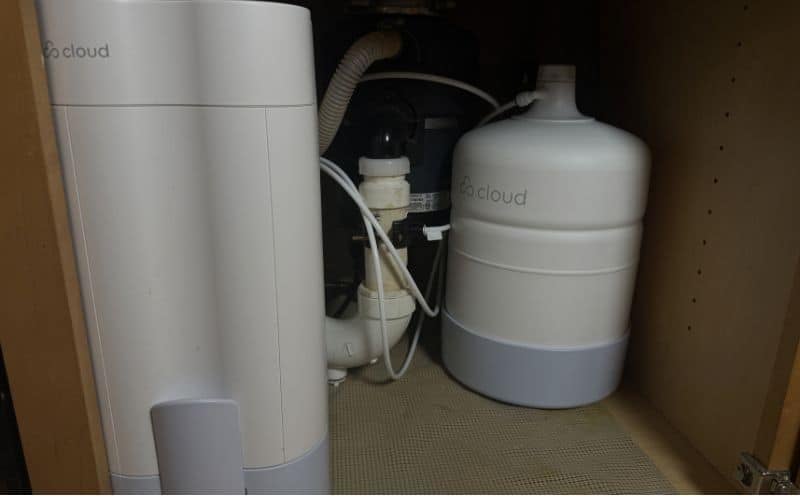
How long the RO system took to install
The hardware took under 30 minutes because we reused the faucet opening we had drilled for Waterdrop. Nothing about the installation was difficult. Commissioning took much longer. We flushed three full tanks, about 7.5 gallons, and each tank had to fill before we could drain it. We processed roughly 17 gallons including wastewater before sampling. After the final cycle, we purged the faucet for 90 seconds.
Cloud was quick to hook up and slow to make ready. Early water looked cloudy from trapped air, then cleared after the system sat and flushed.
Tank size and under-sink cabinet space
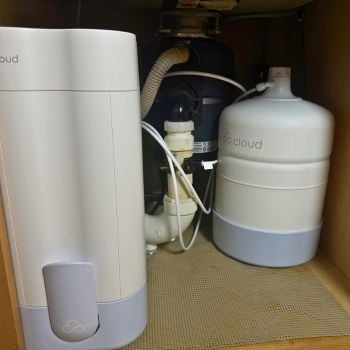
The filter module measures 11 by 7 by 16 inches. The separate tank is roughly 9 by 9 by 15 inches. Measure the full arrangement, not just the filter module, especially if the cabinet also holds a disposal or pull-out bin.
We put the tank on the right side of the cabinet and the filtration unit immediately to its left. We lost storage space, but Cloud doesn’t need the outlet we had shared between the Waterdrop and garbage disposal. No more unplugging one appliance to use the other.
Leave room for tubing and cartridge changes. If you need to drill the sink or countertop, your installation will take longer than ours.
RO flow rate, holding tank, and daily use
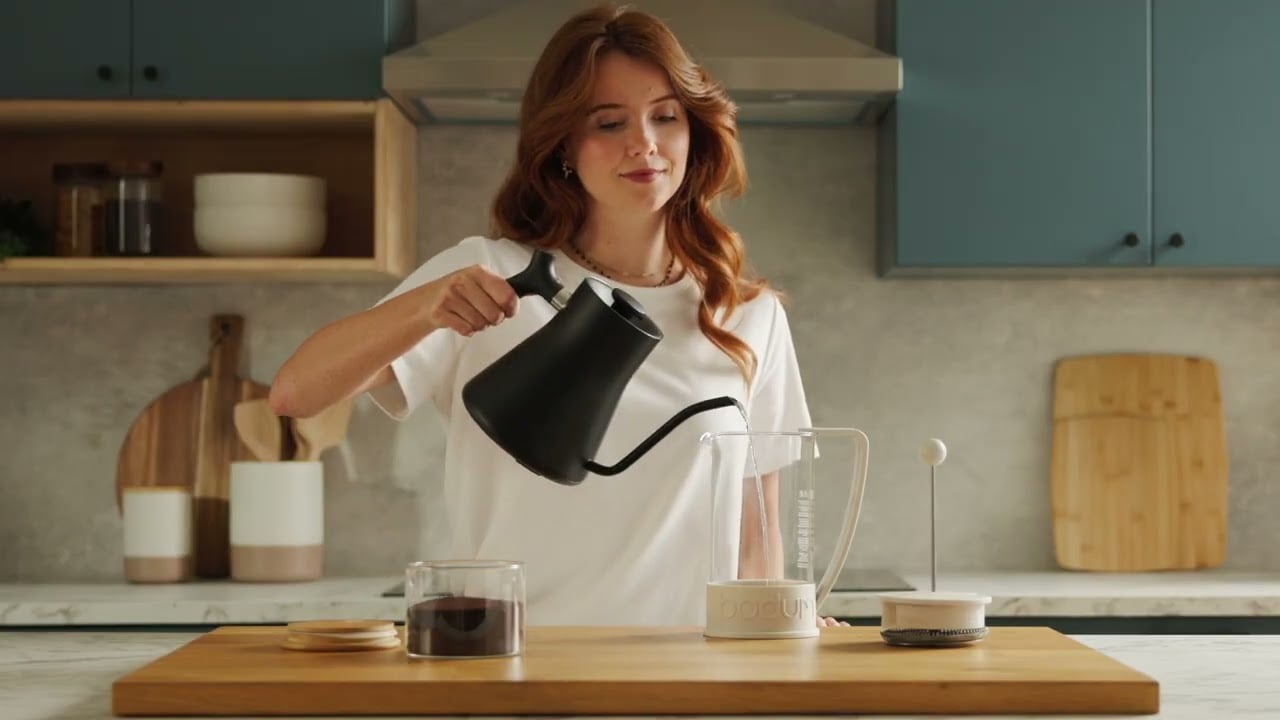
Cloud filled a one-gallon container in 2 minutes 19 seconds during our timed test. The pressurized tank supplies the faucet immediately, while the membrane refills the tank afterward. We occasionally hear a soft click or the pump start, but the house has to be very quiet for us to notice it.
Our family fills 24- to 32-ounce water bottles several times a day, and we fill a 12-cup coffee maker every morning. We haven’t emptied the tank during that routine. Filling several large containers back to back can still outrun any storage-tank RO, so high-volume users should compare tank recovery rather than faucet flow alone.
The pressurized tank and pump fed our normal kitchen demand without running dry. We didn’t connect Cloud to our refrigerator, so we can’t report how it performs in that configuration.
App, battery, and filter replacement
Water quality tracking in the app

The app shows inlet TDS, filtered TDS, remineralized TDS, tank volume, battery status, gallons used, and estimated cartridge dates. We use those readings to watch the system between lab tests. A TDS sensor can’t identify lead, PFAS, nitrate, or another individual substance.
The app uses Bluetooth and only updates when we’re near the system. We can’t check it while traveling.
Tank volume, gallons used, and filter status are the screens we check most often.
On April 3, 2026, the app rated our drinking water quality “excellent” and showed 120 total gallons consumed and 962 water bottles saved. The recorded water use gave us a useful checkpoint between the three-week and 12-month tests.
Filter replacement cost and service life
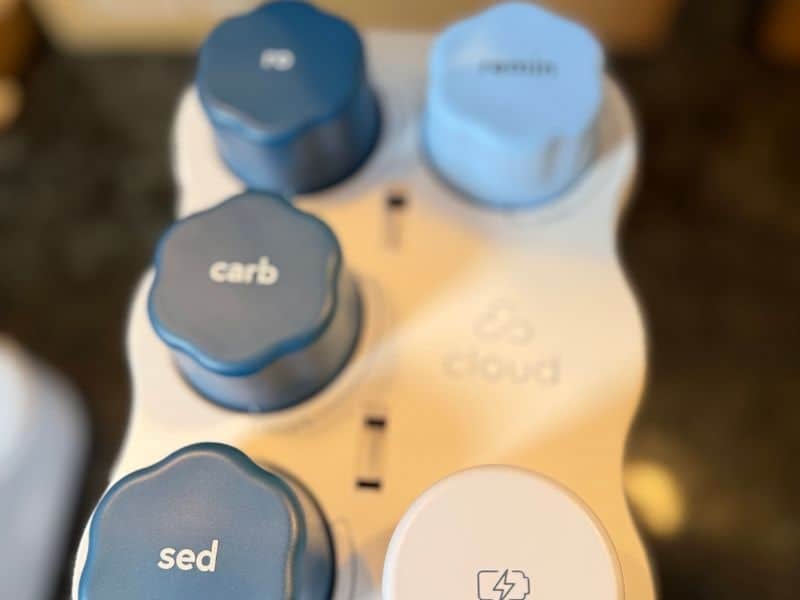
Cloud’s current complete replacement kit costs $200 and includes the sediment filter, carbon block, RO membrane, remineralization cartridge, and battery. That’s the price of the kit, not our observed annual cost.
At the 12-month sample, the original sediment, carbon, RO, and remineralization cartridges were still installed. So was the original battery. The app hadn’t told us to replace anything.
The filters are easy to access by lifting the lid. When replacement time comes, we’ll probably pull the filtration module out of the cabinet rather than work around the plumbing.
Our source water, upstream filtration, and household use all affect that result. Another home could reach the replacement point much sooner or later. When ours finally does, we’ll update this page with the service interval and actual annualized cost.
Water quality, taste, and remineralization
Water from Cloud doesn’t taste like the very low-mineral output we associate with some reverse osmosis systems. The remineralization stage gives the finished water more body, which is one reason we preferred it for drinking, coffee, and cooking. Our children asked what had changed because the water tasted better, even though they didn’t know we had installed a new system.
Both lab samples contained measurable calcium, magnesium, potassium, and sodium after filtration. Those readings don’t prove a fixed remineralization rate, but they fit our experience: the water has tasted consistently good. If your goal is the lowest possible TDS instead, choose a system without remineralization.
Cloud RO vs. Waterdrop: why we switched
We used the Waterdrop G3P800 for more than three years before installing Cloud. It shared the only under-sink outlet, so we kept swapping plugs. Cloud’s battery ended that routine.
Waterdrop remains the better choice when cabinet space and water efficiency lead the decision. Its tankless body is smaller, and Waterdrop advertises a 3:1 purified-water-to-wastewater ratio versus Cloud’s advertised 1:1 ratio. Actual wastewater varies with feed-water pressure, temperature, incoming water quality, tank recovery, and household use.
With the Waterdrop, we watched the active TDS display rise from about 11 ppm with newer cartridges to around 39 ppm on average after they passed the midpoint of their service life. We haven’t seen the same upward trend with Cloud, and its taste has remained consistent in daily use.
We accepted the lost cabinet space because getting that outlet back improved the kitchen every day. Read our full Cloud versus Waterdrop comparison for the remaining differences.
NSF certification and manufacturing
NSF lists Cloud RO under NSF/ANSI 58 for total dissolved-solids reduction. The public listing also indicates lead-free material compliance under the applicable plumbing requirements. That material designation isn’t a performance certification for lead reduction.
The certification and our Tap Score tests answer different questions. NSF/ANSI 58 covers the listed claim under standardized conditions. Our two samples show the water produced at the dedicated Cloud faucet in our home, including the 12-month lead result.
Cloud Water Filter, LLC is a US company based in San Diego. Cloud’s FAQ says it sources components globally and uses a primary manufacturing facility in Suzhou, China. The current NSF listing also identifies the facility in Wujiang, Suzhou, China.
Cloud currently advertises a five-year warranty. Warranty terms, prices, and promotions can change, so verify them before ordering.
Our verdict after 12 months
The anniversary test answered the question that prompted it: the strong three-week result wasn’t a one-off. Cloud scored even better after a year on the same cartridges and battery.
We gave up cabinet space, remote monitoring, and the option to buy one replacement cartridge at a time.
After 12 months, we’d make the same trade. If the tank won’t fit, compare the other models in our guide to the best reverse-osmosis systems we tested.
Cloud RO FAQ
Yes, if you have room for its separate tank. Our Cloud-faucet sample earned 99/99 after 12 months on the original filtration cartridges and battery.
Cloud claims that it removes microplastics, but QWL hasn’t run a microplastics panel on this model. The public NSF listing we reviewed shows a certified TDS-reduction claim, so we don’t present microplastics removal as a QWL-verified result.
Cloud Water Filter, LLC is a US company based in San Diego. Cloud says its primary manufacturing facility is in Suzhou, China, and the NSF product listing identifies the facility in Wujiang, Suzhou, China.
Cloud’s app estimates replacement timing from use and system data. At 12 months and 204 recorded gallons, it hadn’t requested a replacement, and the original filtration cartridges and battery were still in service when our Cloud-faucet sample earned 99/99. Your interval can differ with feed-water quality, upstream treatment, and water use.
No. Cloud uses a replaceable battery and doesn’t require an under-sink outlet. The current complete replacement kit includes a new battery.
Cloud’s internal pump is built to maintain pressure for refrigerator and ice-maker connections, but we didn’t connect ours, so this isn’t a QWL-verified result. If you do, the outcome depends on tubing length, elevation, and your refrigerator’s inlet requirement.