

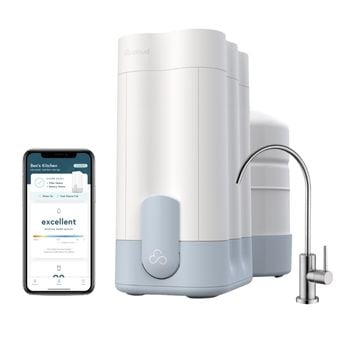
Scoring basis
- Filtration (RO) (45%): 4-stage RO with sediment, carbon block, RO membrane, and built-in remineralization. Tap Score 97/99 — THMs, lead, fluoride, copper all removed to ND. TDS dropped from 187 to 66 ppm, landing in the sweet spot for taste.
- Flow/Pressure (20%): 2.8-gallon pressurized tank with battery-powered pump delivers steady on-demand flow. Timed at 2:19 to fill a gallon in our test — right in line with tankless systems. Tank volume visible in real time via app. In 6+ months of use with a family of four, tank has never run low.
- Install/Maint (10%): DIY-friendly — requires standard faucet hole and drain hookup. Filters bundled in annual kit (~$200). Battery estimated to last ~2 years per app data
- ships with replacement membrane kit.
- Build (10%): Compact under-sink footprint, stainless tank + BPA-free plastics. App tracks filter life, TDS, gallons filtered, and tank volume in real time. No wall outlet required.
- Taste (5%), Cost (5%), App/Data (5%)
I switched to Cloud RO in August 2025 after three years on the Waterdrop G3P800. Installation took under 30 minutes — the initial flush sequence another 2–3 hours, so plan for it.
Three weeks later, Tap Score came back at 97/99. Six months in, here’s what living with it has actually looked like.
What We Like
- Silent — never heard it cycle in six months
- Remineralization built in — 66 ppm, not flat RO water
- No outlet required — battery pump handles it
- App shows filter life, TDS, tank volume, gallons filtered
- Tank never ran low with four people in the house
What Could Be Better
- Filters bundled only — no individual cartridges
- Bluetooth app — no remote monitoring
- 1:1 waste ratio vs Waterdrop’s 3:1
- Larger footprint than tankless units
Best for: Households that want proven RO filtration with built-in remineralization and no outlet required.
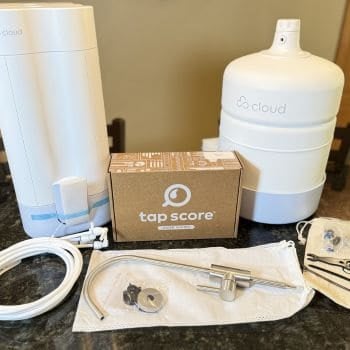
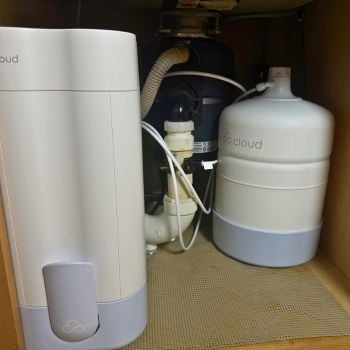
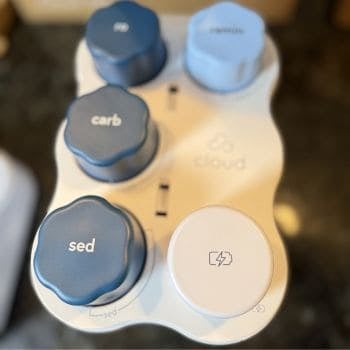

🔬 Lab Results
🔬 Tap Score Lab Results — Cloud RO
| Parameter | Before | After | Change |
|---|---|---|---|
| Total THMs iEPA MCL: 80 ppb | 31.83 ppb | NDRemoved | −100% |
| Chloroform (THM) | 21.57 ppb | NDRemoved | −100% |
| Bromodichloromethane | 7.93 ppb | NDRemoved | −100% |
| Dibromochloromethane | 2.33 ppb | NDRemoved | −100% |
| Lead iEPA Action Level: 15 ppb | 0.5 ppb | NDRemoved | −100% |
| Fluoride | 0.7 ppm | NDRemoved | −100% |
| Copper | 20 ppb | NDRemoved | −100% |
| Sodium | 46.30 ppm | 4.32 ppm | −91% |
| Chloride | 67.26 ppm | 10.70 ppm | −84% |
| Barium iEPA MCL: 2 ppm | 0.010 ppm | 0.0018 ppm | −82% |
| Total Dissolved Solids (TDS) i66 ppm is within the optimal taste range of 50–150 ppm. Cloud’s remineralization stage intentionally preserves minerals rather than stripping to near zero. | 187 ppm | 66.2 ppm | −65% |
Context & Methods
“ND” = Not Detected above the lab reporting limit. THMs compared to EPA MCL (80 ppb). Barium compared to EPA MCL (2 ppm). Lead compared to EPA Action Level (15 ppb). Sampling protocol: 2.5-gallon storage tank was flushed three complete times (~7.5 gallons). To ensure no residuals, we doubled that volume and processed ~17 gallons total (including wastewater) before collection. After the final flush, the faucet line was purged for 90 seconds prior to sampling; analysis performed by Tap Score.
Pre-test baseline:
View baseline report (PDF)
Post-test (Cloud RO):
View post-install report (PDF)
View official Tap Score report
NSF/ANSI 58 covers RO performance and TDS reduction, but the contaminant outcomes shown here come from our post-install Tap Score testing.
🧾 How It Scored
⏱️ Timelapse demo — actual 1-gallon fill time: 2 minutes 19 seconds.
What the lab doesn’t show is what I see in the app every day — tank at 87%, all filters green, drinking water quality rated excellent.
Before Cloud, our tap water was coming in at 31 ppb of total THMs. That dropped to non-detect. Lead, fluoride, and copper were also reduced to non-detect in our post-install sample. TDS lands at 66 ppm after remineralization puts minerals back in, which is exactly where you want it. Municipal TDS shifts with seasons and storms, so having real-time numbers actually matters.
The kids noticed the taste difference before I mentioned anything.
Flow held up too — filled a gallon jug in 2:19 in our timed test, and in six months the tank has never run low with four people in the house.
On cost: filters run ~$200 per year. Cloud tracks replacement dates by actual gallons used, not a calendar. Battery replacement ships with your next filter order — nothing to track separately. At 102 gallons so far, that works out to roughly $0.20 per gallon all-in.
We scored it 5/5 based on filtration performance, flow consistency, build quality, and real-world ownership data. That 97/99 is the highest score we’ve recorded among the under-sink systems we’ve tested with Tap Score.
Nothing has surprised me negatively in six months.
🔄 Why I Switched

Three years on the Waterdrop G3P800, no complaints about filtration. A few things just got old though.
- The outlet shared with my garbage disposal — constant unplugging, constant resets.
- TDS creep toward the end of filter cycles — water tasting slightly off before I’d gotten around to swapping filters.
- Remineralization as an afterthought — a separate add-on I had to track and replace independently.
- A faint hum from the pump — nothing loud, but noticeable at night.
With tankless systems the membrane aging shows up in your TDS readings. Mine would creep into the mid-30s toward the end of a cycle. Flushing cleared it, but I was doing it more than I wanted to.
Cloud addressed all of it. No outlet needed, remineralization is part of the system, and the tank means no creep between changes. Waterdrop is still a solid system — I just found something that fit our kitchen better for $400 less.
⚠️ Before You Install
Every review talks about the 30 minute install. What they skip is the flush.
Fill and drain the storage tank three times before the water’s ready to drink. Each fill on a new membrane takes about an hour — drain takes 5-10 minutes. Three cycles puts you at 3-4 hours total. I started mine on a Saturday morning and it was ready by early afternoon.
First couple cycles the water comes out cloudy — air working its way through the new system. Nothing wrong with it, just keep draining.
The instructions are straightforward. Just give yourself plenty of time by not starting too late in the day.
📱Inside the App

Most RO systems give you one data point at the faucet — a TDS number. Cloud’s app goes further.
The main screen shows three things at a glance: filter status, battery status, and tank volume. Right now filters are good, battery is good, and the tank is sitting at 87%. That’s the daily check — opens in two seconds, tells you everything you need to know.
Tap into the water quality screen and it breaks TDS into three stages. Tap water coming in at 220 ppm. After filtration, 12 ppm. After remineralization, 19 ppm — minerals added back in, sitting in what Cloud calls the sweet spot. That number moves around depending on what the city is pushing through. Having it visible in real time matters more than people expect.
The system status screen shows each filter individually — sediment, carbon block, RO membrane, remineralizing post filter, and battery — all with estimated replacement dates based on your actual usage, not a fixed calendar. Our sediment filter and battery are both showing September 2027. At 102 gallons through the system, that tracks.
One detail worth knowing — a replacement battery ships automatically with your next filter order. Nothing to track separately, nothing to forget.
📅 6 Month Check-In
I pulled up the app the other day just out of habit. 102 gallons filtered, everything green, battery still showing September 2027.
Nothing has gone wrong. No alerts, no sync drops, no weird readings. Filters are tracking right where they should be.
Flow is the same as day one. Kids grab water, fill bottles, no one says anything. With four people in the house that’s all you can really ask for.
The only thing I keep coming back to is the Bluetooth. App only updates when I’m home. I travel for work sometimes. Would be nice to check in remotely. Just not possible with Bluetooth.
Six months in and the system has faded into the background. For a $599 purchase that required a Saturday afternoon to install, that’s exactly what you want.
⚖️ How It Compares

There’s no shortage of under-sink RO systems out there — but not all of them have been tested side by side in the same kitchen. Here’s how Cloud holds up:
- Waterdrop G3P800 — Same lab outcomes, same NSF 58 certification, $400 less. Waterdrop wins on footprint — tankless, smaller cabinet profile, 3:1 waste ratio. Cloud wins on taste (66 ppm vs 28 ppm) and value. If cabinet space is the deciding factor, Waterdrop. If it isn’t, Cloud.
- iSpring RCC7AK — Tank-based RO with a built-in alkaline filter, so minerals are added back in similar to Cloud. Lower upfront cost, standard non-proprietary filters. Trade-off is no app monitoring, no lab data from our testing, and an older canister design that requires a wrench for filter swaps.
- APEC ROES-50 — Lowest upfront cost, standard filters, proven 5-stage design. No app, no remineralization, no independent lab data from our testing. Cloud costs more but delivers significantly more in daily experience.
🛡️ Warranty & Company
Cloud Water Filters is based in San Diego. Founded in 2020, one product, small team. Direct-to-consumer with no retail markup.
- Warranty: 5 years covering mechanical defects, manufacturing issues, and performance flaws. Filters aren’t covered — that’s standard. One thing to know: the warranty requires Cloud’s own replacement filters and accessories. Third-party cartridges void it.
- Returns: 90-day money-back guarantee. You pay return shipping. No restocking fee.
- Shipping: Free to continental US, Alaska, and Hawaii. Ships within 2 business days.
- Other: HSA/FSA eligible. Affirm financing available. Filter replacement runs about $200 per year for a family of four per Cloud’s own estimate — budget accordingly.
Support goes directly to the company at [email protected].
🏆 Who It’s Built For
Cloud RO is built for households that want the highest level of drinking water protection available without hiring a plumber.
If PFAS, microplastics, or disinfection byproducts are on your radar — and they should be — nothing at the point of use comes close to what an RO membrane delivers. City water treatment has improved but it wasn’t designed to handle emerging contaminants. An RO system fills that gap.
I run Cloud RO alongside a SpringWell CF1 whole-house carbon filter. The SpringWell handles chlorine, chloramines, and VOCs at every tap in the house. Cloud handles the final mile — the drinking and cooking water that needs to be as clean as possible. Together they cover everything.
You don’t need a whole-house system to make Cloud worth it. But if you’re serious about what’s in your water, that combination is hard to beat.
❓FAQ
During the initial flush it’s air in the system — normal, clears after a few drain cycles. After break-in, occasional cloudiness is hydrogen bubbles from remineralization. Let the glass sit 10-20 seconds. If it clears from the bottom up, it’s fine.
Not necessarily. Cloud tracks by actual gallons used, not a calendar. A family of four typically lands around 9-12 months — the app tells you when it’s time.
No outlet needed. Runs on a battery pack that ships with the system. Replacement battery comes automatically with your next filter order.
Yes. The internal pump maintains pressure over long lines — something most standard RO systems can’t do reliably.
1:1 ratio — one gallon purified for every one gallon to drain. Traditional RO systems typically waste 3-4 gallons per gallon filtered.
Yes. No subscription, no monthly fee. Connects via Bluetooth and is included with the system.
No. DIY-friendly with everything included. Most installs run 30-60 minutes.
 130 people found this helpful. Was this guide helpful to you?