
♨️ What’s the Difference Between Distilled and Deionized Water?

Ava Martin is the founder and chief editor of Quality Water Lab.

Mike Martin brings hands-on installation experience and helps validate the real-world setup and serviceability of the systems we cover.
You’ve probably seen both labels on bottles — maybe even used them in your CPAP machine, steam iron, or aquarium. They look the same, sound equally scientific, and both seem ultra-clean — but how they’re made (and what they’re good for) is where things split.
If you’re wondering which one is: safer, tastier, or better for your appliances, this guide breaks it all down.
✅ Key Takeaways
- 🧪 Distilled water is created by boiling and condensing steam — it removes everything with a lower boiling point than water.
- ⚡ Deionized water is purified by ion exchange — it removes charged minerals but may leave some organics behind.
- 🧼 Distilled water is considered “pure” and is better for medical uses.
- 🐠 Deionized water is often used in: labs, aquariums, and cleaning applications.
- 💧 Both are drinkable — but neither offers minerals or flavor.
⚡ What Is Deionized Water?
Deionized water (or DI water) has had its mineral ions removed — things like calcium, magnesium, sodium, chloride, and sulfate. These ions are stripped out using a process called ion exchange, which swaps them for hydrogen (H⁺) and hydroxyl (OH⁻) ions to create nearly pure H₂O.
Unlike distillation, deionization doesn’t involve heat or evaporation. It’s fast and efficient — which makes it a go-to method for labs and industrial settings.
🧪 Where you’ll find DI water:
- In laboratories and cleanrooms where mineral-free water is a must
- In cooling systems and electronics factories
- At home in aquariums, steam irons, or hydroponics
- Sometimes used in brewing or beer-making
💡 Good to Know:
Deionization removes minerals, but not bacteria, organics, or chemicals — so it’s not automatically “safe” for drinking unless it’s paired with other purification steps.
More on: Learn more about how demineralization works here.
💨 What Is Distilled Water?
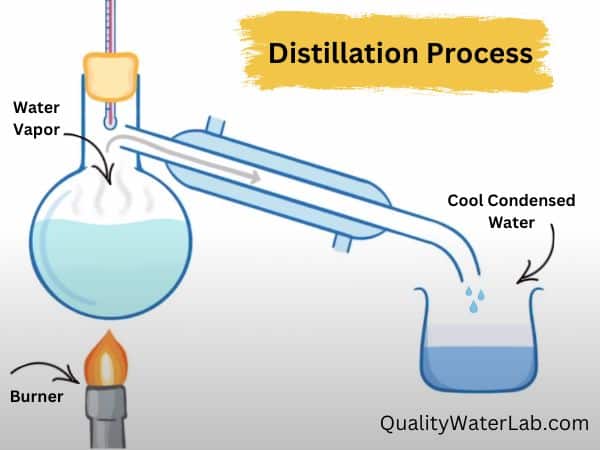
Distilled water is created by boiling water, capturing the steam, and condensing it back into liquid form — a process that leaves behind most contaminants, including minerals, metals, and many bacteria.
Because it removes anything with a higher or lower boiling point than water, distillation is one of the most thorough purification methods around. It’s also one of the oldest.
🧼 Where distilled water is commonly used:
- CPAP machines and other medical devices
- Cleaning lab equipment and glassware
- Car batteries and steam irons
- Cooking, baby formula, or anywhere ultra-clean water is needed
💡 Good to Know:
Distillation removes minerals and many pathogens, making it a top choice when you need water that’s both mineral-free and microbiologically safe.
🥤 Can You Drink Distilled or Deionized Water?

Technically, yes — both are safe to drink. But whether you should drink them regularly depends on what you care about: taste, mineral content, or long-term health habits.
Let’s break it down:
⚠️ Contaminants
- Distilled water removes most minerals and bacteria, making it safer in medical or emergency situations.
- Deionized water removes charged ions but doesn’t eliminate all microbes or organics — so it’s not ideal for drinking unless it’s been filtered or disinfected.
🧪 Want to test for contaminants like lead before choosing? Here’s how to do it.
😬 Taste
- Both types taste “flat” or bland because they lack minerals.
- DI water can vary in flavor depending on the source and leftover organics.
- Distilled water is consistent — just neutral and a little boiled-tasting.
💡 Pro Tip: If you’re using purified water for cooking, distilled is usually preferred — especially for things like coffee or baby formula.
🧠 Nutrition & Health
- Neither option contains electrolytes or minerals like calcium, magnesium, or iron.
- While most people get minerals from food, drinking mineral-free water doesn’t help supplement anything — and it may be less hydrating long-term.
🚨 The World Health Organization notes that drinking large amounts of deionized water may flush electrolytes from your system over time. This mostly applies in emergency settings — not casual use.
🏠 Can You Make Distilled or Deionized Water at Home?

Yes — but the effort, cost, and output are very different depending on the method. Here’s how each one works and what to expect.
| ⚙️ Method | 🔬 How It Works | 🎯 Best For |
|---|---|---|
| 💨 Distillation | Boils water and collects purified steam as it condenses — removes minerals, metals, and microbes. | CPAP machines, humidifiers, cooking, or emergency use. |
| ⚡ Deionization | Uses charged resin to strip mineral ions — does not remove bacteria or organics. | Lab work, aquariums, or equipment that needs low conductivity. |
💡 Good to Know:
- Home distillers are affordable (around $80), but slow — only a few gallons per day.
- Residential deionizers are expensive and not common unless you’re running a small lab or niche application.
- If you want purified water for everyday drinking, a reverse osmosis system is often more practical.
🧩 Distilled vs Deionized Water — Which Should You Use?
Both distilled and deionized water are purified — but they’re built for different jobs.
Here’s how to decide which one fits your needs:
✅ Choose Distilled Water If You…
- Need microbiologically clean water (like for CPAPs or medical devices)
- Want consistency for cooking, coffee, or baby formula
- Are dealing with lead or heavy metal contamination
- Prefer a safer all-purpose option for emergency use
✅ Choose Deionized Water If You…
- Need ultra-low mineral content for labs, aquariums, or electronics
- Don’t need microbial removal (source water is already clean)
- Want low conductivity for cooling or rinsing precision tools
- Are using it short-term for cleaning or spot-free rinsing
💡 Still not sure?
If you just want cleaner drinking water, a reverse osmosis system gives you the best of both: mineral-free water, plus added filtration for bacteria, VOCs, and more. And if you want minerals back in, many RO systems offer a remineralization stage.
✅ Final Thoughts
Distilled and deionized water might sound like scientific twins — but they’re more like cousins with different strengths.
Both remove minerals and deliver ultra-clean water — but only distilled eliminates bacteria and organics, making it a better fit for anything health-related.
The best choice depends on your end goal — whether it’s for drinking, cleaning, or something more specialized.
- 🧪 Distilled water is ideal for health-related uses and purity.
- ⚡ Deionized water is perfect when minerals interfere with sensitive equipment or processes.
- 💧 Reverse osmosis gives you a bit of both — high purity, plus versatility for everyday use.
When in doubt, start with a water test so you know exactly what you’re working with — and what you actually need to filter out.