
Does the SpringWell CF1 Remove Chloramines?

Mike Martin brings hands-on installation experience and helps validate the real-world setup and serviceability of the systems we cover.
Last Updated on October 17, 2026
Answer
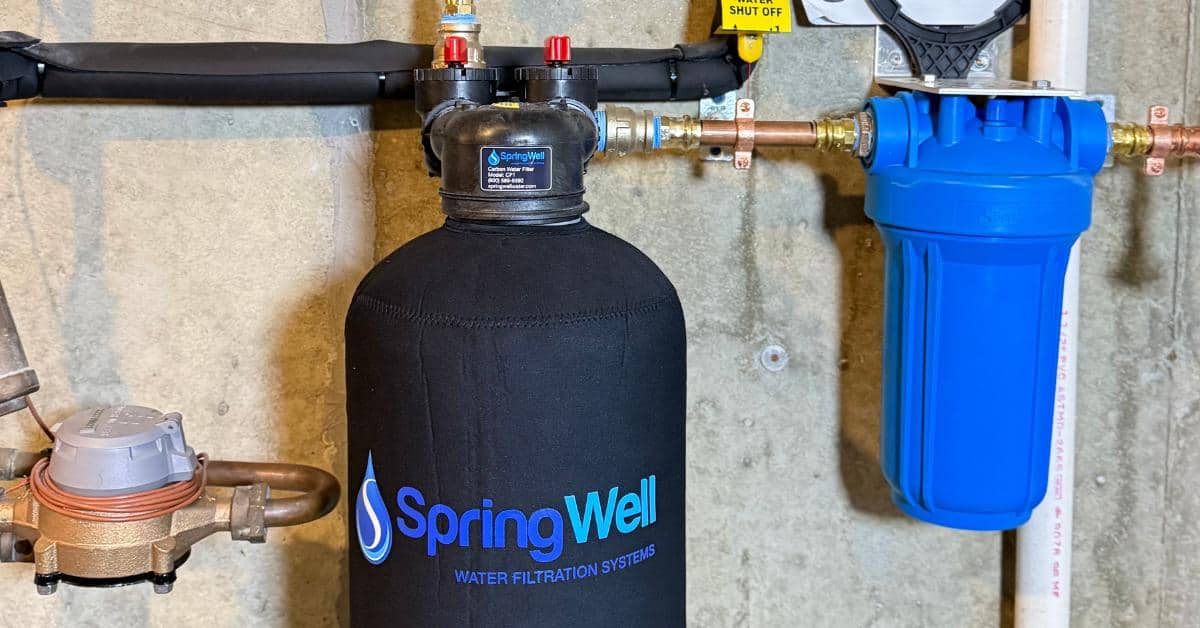
Yes, according to SpringWell’s current specifications. The CF1 uses catalytic coconut-shell carbon, the carbon type normally chosen for chloramine, along with KDF media. The important limit is our proof: QWL has not measured chloramine directly. Our utility uses free chlorine, and our published laboratory reports document THM performance rather than a chloramine residual test.
Before buying: Check your utility’s Consumer Confidence Report or call the utility. If it uses chloramine, confirm the current CF1 chloramine claim and choose a tank sized for your peak household flow. Chloramine needs more contact time than free chlorine, so a high-flow home should not be paired with the smallest tank simply to save money.
What our testing can prove: Our CF1 has treated chlorinated city water since August 2022. In the 2022–2025 comparison, total THMs fell from 31.83 ppb to below the laboratory reporting limit. At the four-year check in August 2026, both the untreated bypass and kitchen samples were already non-detect for THMs, so that same-day pair could not calculate a new removal rate. Neither report measured chloramine directly. Our data supports long-term THM performance on the water we tested, not an independent chloramine-removal claim.