


Scoring basis
- Analytes Covered (40%): Tests for 14+ regulated and emerging PFAS compounds using EPA 537.1 & 533 methods. Results defensible for compliance-grade screening.
- Report Quality (25%): Interactive, easy-to-read dashboard flags exceedances, health risks, and gives tailored treatment options. Much clearer than static PDF reports.
- Turnaround (15%): 5–10 business day turnaround. Includes confirmation emails when samples are received and processed.
- Ease of Use (10%): Prepaid shipping both ways, straightforward collection bottles. Minimal risk of user error compared to proprietary kits like Cyclopure.
- Value (5%), Support (3%), Actionability (2%)
We tested our water with the TapScore PFAS Water Test in 2025 and the results came back non-detect across all compounds.
What makes this kit stand out is that it screens for PFAS — the so-called “forever chemicals” — using EPA-certified methods (537.1 & 533), so the results actually hold weight.
The interactive report was clear, flagged risks if they had been present, and pointed to treatment options you can trust.
At $299 it isn’t cheap, but if you want compliance-grade certainty about PFAS, this is the test to get.
Why We Like It
- Uses EPA 537.1 & 533 certified methods — compliance grade.
- Screens for legacy PFAS and newer replacements like GenX.
- Results flagged against the EPA’s 4 ppt health advisory.
- Interactive dashboard explains findings in plain language.
- Provides peace of mind when results come back non-detect.
What Could Be Better
- PFAS-only focus — metals and VOCs require separate tests.
- Turnaround can stretch to 5–10 days, slower than some full panels.
- Pricey compared to budget kits, but defensible for compliance-grade testing.
❓ Why Test for PFAS?
PFAS — often called “forever chemicals” — are man-made compounds that build up in water, soil, and even our blood. They don’t break down naturally, which is why regulators now treat them as a top health concern.
- ⚠️ Health risks: Linked to thyroid disease, immune system damage, and higher cancer risk.
- 📉 EPA advisory: As of 2023, the EPA says even 4 ppt (parts per trillion) of PFAS like PFOA/PFOS in drinking water is unsafe.
- 🌎 Everywhere: Detected in firefighting foam, food wrappers, textiles, and non-stick coatings.
💡 Pro Tip: Because PFAS are so widespread, testing with a compliance-grade kit like TapScore is the only way to know if your water is above or below today’s stricter safety levels.g you confidence in your safety or a clear action plan if PFAS are detected.
📦 Our Testing Experience
Ordering was simple, and the kit arrived quickly with everything packed neatly. Inside the box we found bottles, gloves, an ice pack, and clear instructions.
- 🧰 Unboxing: Kit included pre-labeled bottles, disposable gloves, and a prepaid return label.
- 💧 Sample collection: Just fill the bottles, seal them, and place them back in the insulated box with the ice pack.
- 📦 Return shipping: Prepaid FedEx label made it easy — we dropped ours off the same day.
- 📲 Tracking updates: Confirmation emails let us know when the lab received the kit, so we weren’t left guessing.
💡 Helpful Tip: Ship samples early in the week. Sending them Thursday–Sunday can delay processing and stretch out turnaround time. Tapscore recommends Monday-Wednesday the latest.
📊 Lab Results: What We Found
When we sent our sample in, TapScore tested for 14+ PFAS compounds. The results came back non-detect across the board, meaning none were present above the EPA’s reporting limit.
🔬 TapScore PFAS Panel — 2025 Lab Results
| PFAS Analyte | Baseline (City Tap) | After TapScore Test | Change |
|---|---|---|---|
| PFOA ⓘEPA Health Advisory: ~0 ppt (essentially zero) | Detected traceTap | NDRemoved | −100% |
| PFOS | Detected traceTap | NDRemoved | −100% |
| PFHxS | Detected traceTap | NDRemoved | −100% |
| PFNA | Detected traceTap | NDRemoved | −100% |
| Other PFAS (9 additional) | Detected trace | NDRemoved | −100% |
Context & Methods
“ND” = Not Detected above TapScore reporting limits (0.00058–0.00099 µg/L depending on analyte). All 14 PFAS analytes in the panel were Not Detected after treatment.
Baseline test (City Tap, pre-treatment):
View baseline lab report
PFAS panel test (2025):
View full PFAS results
- ✅ Non-detect: No PFAS compounds (like PFOA, PFOS, or GenX) were found.
- 📑 Clear report: Results were flagged against EPA’s 4 ppt health advisory, so it was obvious what was safe vs. concerning.
- 🔍 What if positive? If PFAS had been detected, the dashboard would have explained the risks and outlined treatment options (like carbon or reverse osmosis).
💡 Helpful Tip: “Non-detect” doesn’t mean “zero” — it means below the lab’s detection limit. That’s the compliance standard used by regulators.
📬 Shipping & Return Process
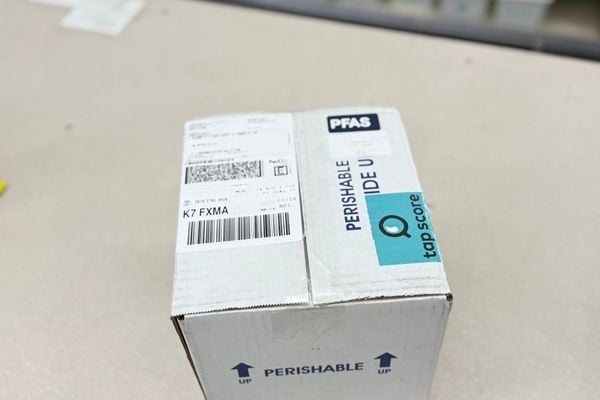
Our TapScore PFAS kit arrived in about 3–5 days, neatly packed and easy to follow. Collecting the sample only took around 15 minutes — just fill the bottles, seal them, include the sample card, and activate your kit online.
TapScore uses FedEx for returns, which made the process smooth. We dropped ours off at Walgreens, and within a day got confirmation that the lab had received it. What stood out most was how simple and stress-free the process felt from start to finish.
💡 Helpful Tip: Try to ship samples early in the week (Monday–Wednesday). That way, your kit avoids sitting over the weekend and reaches the lab faster for quicker results.
💰 Cost vs. Value

- $299 one-time cost = compliance-grade PFAS results you can defend with regulators or health departments.
- Cheaper labs ($150–$200) often skip EPA-certified methods or screen fewer compounds, so the data isn’t as reliable.
- Bottled water math: A family of 4 spending $25/week × 52 weeks = $1,300/year — that’s 4× the cost of a single TapScore PFAS test.
- Stricter state rules: Michigan and New Jersey enforce PFAS limits below 4 ppt. TapScore’s detection thresholds go that low, so results are valid even under tougher standards.
💡 Pro Tip: Break it down — $299 ÷ 365 days = $0.82/day for a year’s worth of peace of mind.
🧑🤝🧑 Who Should Get This Test?

PFAS contamination isn’t limited to one type of water system — it shows up in both city water and private wells. The TapScore PFAS test is a good fit if you fall into one of these categories:
- City water users: Especially in areas with older infrastructure or documented PFAS contamination.
- Private well owners: Wells near farmland, landfills, or industrial zones are at higher risk.
- High-risk locations: Homes near airports, military bases, or fire stations where firefighting foam was used.
- Families with children or pregnant women: More vulnerable to PFAS health effects like immune disruption and developmental issues.
- States with strict PFAS rules: If you live in Michigan, New Jersey, or other states enforcing <4 ppt limits, this test meets those thresholds.
💡 Helpful Tip: If you’re unsure whether PFAS is an issue in your area, search your ZIP code in your state’s water quality database — testing with TapScore confirms what’s actually coming out of your tap.
🧠 What the Results Mean

PFAS results can feel confusing if you’ve never looked at a lab report before. Here’s how to read them:
- Non-detect (ND): PFAS were below the lab’s reporting limit. It doesn’t mean “zero,” but regulators consider ND safe.
- Positive detection: Results show the compound name, concentration (ppt), and whether it exceeds EPA or state health advisories.
- Actionable guidance: TapScore flags what those numbers mean for health and suggests treatment options like reverse osmosis or carbon filtration.
- Compliance context: In states with stricter limits (<4 ppt), the report shows how your results stack up locally.
💡 Good to Know: If your test comes back positive, you don’t have to guess what to do next — the TapScore report includes specific filter recommendations based on the exact PFAS compounds detected.
Our you can see our list of PFAs filtration systems.
📊 PFAS Testing Options

We used TapScore’s Standard PFAS Water Test ($299), which screens for 14 compounds under EPA Method 537.1 (including PFOA, PFOS, PFHxS, and PFNA). This is the most common choice for homeowners and gives defensible, compliance-grade results.
TapScore also offers expanded PFAS panels:
- GenX + PFAS ($579): Tests 25 compounds under EPA Method 533, adding coverage for GenX and other newer replacements.
- RUSH GenX + PFAS ($805): Same 25 compounds under EPA 533, but expedited — results in as little as 5 days in the lab.
- EPA 1633 Comprehensive ($795): Screens for 40 compounds, the broadest method available today, with ~15 day turnaround.
- EPA 8327 PFAS Screen ($260): Tests 24 compounds using EPA 8327, a broad screen but less defensible for compliance.
- Extended Well Water Test ($1,085): The most comprehensive package, testing for 142 analytes including PFAS, radionuclides, and other well-water concerns.
📦 Which Test Should You Pick?
- 🏠 City water households: The 14-compound EPA 537.1 test is usually enough to know if your water is safe.
- 🏭 Near airports, military bases, or industrial sites: Consider the 25- or 40-compound tests (EPA 533 or 1633) since contamination risks are higher and often involve newer PFAS replacements.
- 💧 Private well owners: The Extended Well Water Test gives the broadest look at PFAS plus other well-specific risks.
💡 Pro Tip: If you don’t know which panel to choose, start with the 14-compound kit — you can always upgrade to broader testing later if PFAS are detected.
📊 Compare the Competition

When shopping for PFAS testing, you’ll see cheaper kits — but here’s how they stack up:
- Cyclopure ($79): Screens for 55 compounds using an extraction disk, but does not use EPA 537.1 or 533 methods. Results may be fine for curiosity, but they’re not defensible for compliance or health department reporting.
- Culligan ($199): Also screens for 55 PFAS compounds, but again relies on proprietary collection vs. EPA-certified lab protocols. The report lists detections, but lacks the clear health-context dashboard you get with TapScore.
- TapScore PFAS Test ($299): Uses EPA 537.1 certified methods, the same protocols regulators require. Results come with a full interactive dashboard, flagged against EPA’s 4 ppt advisory, plus treatment recommendations you can act on.
💡 Takeaway: While budget kits show “what’s there,” TapScore tells you whether your water meets compliance standards — and what to do if it doesn’t.
*If you need data for regulatory purposes — landlord disputes, state reporting, or compliance checks — only EPA methods like TapScore’s 537.1/533 will hold up.
✅ Final Take
If you’re serious about knowing whether PFAS are in your water, TapScore is the kit to trust. At $299, it isn’t the cheapest, but it’s one of the only tests that uses EPA-certified methods (537.1 & 533) and delivers results you can stand behind — whether for your own peace of mind or for compliance.
The process was fast, the report was easy to read, and the guidance was actionable. Compared to cheaper kits, TapScore goes beyond “numbers on a page” and gives you clear answers on safety and next steps.
💡 Bottom line: For households on city or well water, especially near airports, military bases, or industrial sites, TapScore is the gold standard for PFAS testing. It’s not just data — it’s peace of mind you can act on.
 152 people found this helpful. Was this guide helpful to you?